
Hastings Local Plan Pre-Submission Version 2023-2041 (Regulation 19) September 2026
4. Strategic Policies Comment
Introduction
4.1One of the principal functions of the Local Plan is to set out the amount of future development being planned for, where it is to be located, and what form it will take. This section presents both the overall development strategy, set out in Policy SP1, which identifies the spatial approach and broad distribution of development across the borough, and complementary 'strategic policies', which set out the overall approach in relation to key themes including the scale of housing and employment growth.
4.2These borough-wide strategic policies form the basis of this Local Plan’s policy framework and are the starting point for the more detailed policies and proposals in subsequent sections. It is these key strategic policies to which neighbourhood plans should generally conform. The strategic policies should be read alongside specific development potential and regeneration area policies, site allocation policies and detailed development management policies, as well as any locally specific policies set out within future neighbourhood plans.
4.3The National Planning Policy Framework advises that plans should ‘[avoid] unnecessary duplication of policies that apply to a particular area (including policies in this Framework, where relevant)’.
4.4The Hastings Local Plan therefore seeks to avoid unnecessary duplication of national policy, and any duplication of national, regional or local policy or guidance within the policies of this plan will only be introduced where it is in the interests of good policy logic or the essential to the delivery of a coherent written statement.
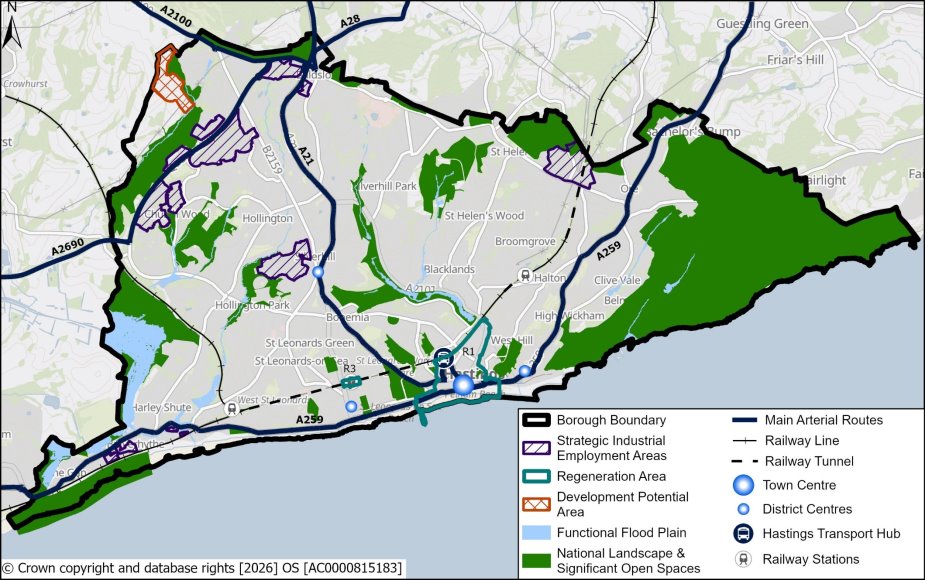
Figure 1: Key Diagram
Strategic Policy 1 (SP1): Directing Growth – a Spatial Strategy Comment
4.5At the heart of our spatial strategy is the need to promote sustainable development as the framework for growth and change in Hastings. The Local Plan provides an ambitious and positive framework for addressing local housing and economic needs and other social and environmental priorities to better enable the council and other stakeholders to invest in housing, jobs, communities and places, making the most of investment opportunities as they arise to effectively address spatial planning challenges over the plan period.
4.6Growth in the first instance is directed to locations which are well supported by existing or planned sustainable transport infrastructure and other services. This approach will help minimise carbon emissions from travel and allow significantly increased development densities in appropriate locations. This in turn can also help to deliver much needed housing, alongside spaces for businesses to grow. This increased demand from new occupants can help bolster local shops and services and may help justify greater investment in infrastructure, such as increased bus services and other sustainable transport initiatives.
4.7The council has set an ambitious target for the town to work towards becoming carbon neutral ahead of the UK target of 2050. This target is consistent with and informs our development strategy for accommodating growth and change. Managing the pattern of development in this way, supports sustainable growth, will lessen encroachment on the natural environment - including protecting soil, water, and vegetation that have an important role in carbon mitigation.
4.8Our growth strategy focuses on prioritising development on Previously Developed Land (Brownfield land) within the urban area, through renewal, regeneration and densification and lastly through suitable greenfield site development in order to maximise the number of new homes which can be delivered.
4.9To maximise housing delivery over the life of the plan, the Hastings Densification and Capacity Study puts forward suggested minimum densities at which new housing development sites should be built, with no identified maximum density. Whilst these minimum densities are a guide, they are put forward with the intention of ensuring that the very best use of land is made in redevelopment. The Study divides the Borough into Density Zones according to their appropriateness for increased density. A map showing these Density Zones within Hastings Borough is shown in Figure 7.
4.10The Density Zones are a starting point based on analysis of suitability only with no account taken of potential individual site sensitivity arising from the natural and built environment. Seven criteria have been combined and analysed to provide an overview of the relative suitability of densification for different parts of the Borough. Conclusions on the potential for increasing densities can be drawn from where and how these criteria overlap, building a case for how some areas are more suitable than others for significant densification.
4.11As well as using the Density Strategy to inform indicative capacity numbers at individual site level, in some circumstances we have relied on other information. This includes, for example, where a site has an existing planning approval, or the capacity has been informed by design work from another study, or the site is located in a highly sensitive location such as the High Weald National Landscape. In addition, across all Density Zones, small sites which might only involve one single building on a plot, might deliver densities well in excess of the Density Zone within which they are located. This is particularly so for small sites in the most sustainable and central locations.
4.12The Spatial Strategy seeks to achieve the right balance between planning positively to meet the town’s development needs for homes, jobs, shops and services whilst continuing to protect and enhance the town’s environment, recreational spaces and heritage assets. The core principles that will help to direct this are set out in strategic Policy SP1.
Strategic Policy 1 (SP1): Directing Growth
The Council will prioritise sites for development which are brownfield and offer regeneration opportunities. The Council will allocate greenfield sites where these are sustainably located and well-related to the existing urban area. The Council will require new residential developments to robustly justify that they have maximised delivery of housing within site constraints. The Council will resist development proposals on protected green, open and recreational spaces and where this conflicts with other development plan policies.
To achieve this:
- The delivery of at least 2,970 net new homes over the plan period will be focused upon a sustainable pattern of distribution across the Borough, with priority given to the regeneration of brownfield sites.
- Residential development proposals should deliver the maximum amount of development possible having regard to the minimum density within the ranges as identified within the Council’s Density Zones, (as shown in Figure 7) whilst ensuring high quality design well-related to the character of the area and surrounding uses, which enhances natural and historic assets, where relevant.
- The Council will resist developments that underutilise land notwithstanding the Density Zones set out in Figure 7.
- The Council will allocate land to provide for additional employment floorspace meet the requirement for 70,400sqm of additional employment floorspace. The supply of industrial floorspace will be increased and delivered through the development of new floorspace on allocated sites and through the effective use of existing employment land and premises in our Strategic and Local Industrial Employment Areas. In these locations intensification and renewal of existing industrial premises will be promoted Borough-wide, the loss of any existing viable industrial floorspace will be resisted.
- The primary location for a range of uses including larger scale office functions, leisure offers, visitor accommodation, cultural and retail development, and appropriate education facilities should be Hastings Town Centre. Whilst smaller scale development, appropriate to its context and the character of area, are directed to District and Local Centres.
- Visitor attractions should primarily be located in the resort area as identified on the Policies Map.
Strategic Policy 2 (SP2): New and Affordable Housing Comment
4.13Local Plans are expected to promote sustainable patterns of development. This includes meeting, as a minimum, the identified level of housing needs for their areas in full. National policy requires us to use a government-set methodology to calculate the housing needed in our area, and to meet or exceed this number. For Hastings, this requirement is currently (August 2026) 686 homes a year. This equates to a requirement for 12,348 net new homes over the lifetime of the Plan.
4.14The Framework provides two exceptions to meeting development needs in full. First, where protecting areas or assets of particular importance provides a strong reason for restricting the scale, type or distribution of housing development within an area. Second, where the adverse impacts of meeting needs in full would significantly and demonstrably outweigh the benefits, when assessed against the policies in the Framework as a whole.
4.15The Strategic Housing and Employment Land Availability Assessment [ii] (SHELAA) is an up-to-date and on-going data source in relation to housing land supply potential. In accordance with sustainable development objectives of the Framework, all suitable, available and deliverable housing sites, as currently identified in the SHELAA, have been allocated in the Plan.
4.16This capacity-led approach is also informed by other studies that have fed into the Plan, which include densification, landscape sensitivity, flood risk assessments together with a Sustainability Appraisal. The scale and distribution of housing growth in the Borough aims to promote a sustainable pattern of housing development. A key aim has been to focus housing development in the most suitable and sustainable and least sensitive areas of the Borough.
4.17The housing target for the Plan period is 2,970 net new homes. Annualised, this equates to 165 net new homes per annum. This is an “at least” target and represents the baseline position in relation to housing delivery. Table 2 shows all sources of housing supply and demonstrates the potential to exceed this target.
Table 2: sources of new homes to 2041
|
Sources of new homes to 2041 |
Net number of units |
|
Units completed during Plan period to date: 2023/24 and 2025/26 |
1,050 |
|
Commitments – sites under construction, or with planning permission including communal living schemes |
431 |
|
Sites allocated for development in the Plan |
1,131 |
|
Small site Windfall allowance 2026/27 – 2040/41 (15 years x 45 dwellings) |
675 |
|
Total |
3,287 |
4.18In addition, the SHELAA also identifies sites that do not yet meet all three tests (suitable, available, achievable) that would allow them to be included within the supply of deliverable sites in the Plan period. In recognition of this the Plan includes a number of locations where more housing could be delivered within the Plan period. We have set out a policy framework to guide future proposals in the event that the deliverability of these sites changes during the Plan period. These are:
- Regeneration Area Opportunity Sites. Areas that include these sites are identified by the prefix R in section 5
- Development Potential Area. This site is identified by the prefix D in section 5
4.19Every effort has been made to make as much use of previously developed land (brownfield land) as possible in an effort to meet housing needs. However, due to issues with viability, deliverability and limited supply, it has also been necessary to identify greenfield sites to help promote housing delivery within the Borough.
4.20Windfall development has made a significant contribution to housing delivery in the past. Evidence shows that small site Windfalls (less than 5 dwellings) will continue to come forward in all years of the Plan up to 2041. An average of 45 Windfall dwellings per year has been assumed between 2023/24 and 2040/41.
4.21The new homes will be delivered primarily through private development, but there will be considerable partnership working with Registered Providers (RPs) in the delivery of affordable housing.
Size type and tenure
4.22In addition to developing a housing target for the Plan, the NPPF states that ‘the size, type and tenure of housing needed for different groups in the community should be assessed and reflected in planning policies.
4.23The council’s Housing and Economic Development Needs Assessment[iii] (HEDNA) Update and addendum is a key evidence source in relation to housing needs over the Plan period. The HEDNA provides in-depth information in respect of overall housing need together with the size, type and tenure of housing required to meet the needs of different groups of current and future residents. Whilst Policy SP2 covers the tenure and size of affordable housing, we do expect all new homes to be well-designed, have reasonable space standards and be adaptable or accessible. Therefore, Policies SC1 and SC2 respectively will also be relevant when considering the provision of affordable homes. This also applies to specialist housing, such as homes targeted at specific age groups which include care or support, covered under Policy H1.
4.24The level of need for Gypsy and Traveller accommodation in the Borough is set out within the latest Gypsy and Traveller Accommodation Assessment (GTAA).[iv]. The council acknowledges that there is insufficient land identified through site allocations to meet this need, and therefore a proactive approach to ensuring sites are able to come forward during the plan period is required.
4.25In order to maximise land supply to meet traveller needs throughout the plan period, the council will require developers to investigate the potential for residential sites of sufficient size to accommodate permanent traveller pitches. Where a proposal is for self-build or custom housebuilding, is within an incompatible flood zone, or involves a change of use of an existing building, this policy requirement will not apply. The strategy for meeting the housing needs of Gypsies and Travellers is based on Windfall delivery. Policy H5 enables the council to determine planning applications for Gypsy and Traveller windfall sites on a site-by-site basis, subject to individual circumstances and need.
Affordable Housing
4.26Affordable housing is a national term defined in the Framework meaning housing available to those who are unable to access accommodation suitable for their families’ needs, at a price that they can reasonably afford on the open market, whether for rent or home ownership. It should be available at a cost low enough to be afforded by eligible households and is determined with regard to local incomes and house prices. In Hastings, affordable housing is essential because:
- Local house prices and rents are much higher than local incomes.
- Many households rely on benefits or low-paid work.
- The private rented sector is large but often expensive and insecure.
- There is strong demand for genuinely affordable homes.
4.27Affordable housing is delivered by the planning system through open market schemes working in tandem with affordable housing providers (registered providers (RPs)). In these circumstances affordable homes are secured either by a planning condition or a planning obligation. However increasingly, specialist affordable housing providers are delivering development sites entirely as affordable homes.
4.28There are a number of different types of affordable housing, including social and affordable rented housing, and affordable home ownership. In Hastings, social and affordable rented homes are typically provided by housing associations. Social Rents are set using a national formula and are typically around 50–60% of local market rents. These are the lowest cost rented homes. Affordable rented homes can be up to 80% of local market rents. However, in Hastings we have worked with key partners to cap rents at the Local Housing Allowance (LHA) rates— the maximum rent level that can be covered by Housing Benefit or Universal Credit. This ensures that people on lower incomes can realistically afford them. Affordable home ownership includes shared ownership, rent-to-buy and discounted market homes for example. These tenure options provide different routes into affordable housing, helping meet a range of needs from those requiring long-term rented homes to households looking to move towards ownership.
4.29The council’s Housing Strategy recognises that affordable rent homes are not always affordable to everyone locally, which is why the council works with providers to cap rents at LHA rates. We will seek to prioritise social rented homes where we can, however if agreeing to affordable rent homes (capped at LHA) results in more affordable homes being developed on a site we will support this.
4.30The HEDNA Assessment follows the approach outlined in the Planning Practice Guidance (PPG) to model net affordable housing needs, based on relative costs and incomes. It takes account of current unmet needs, newly arising needs and the current annual supply of affordable housing. As of August 2026, this translates into a net requirement for 566 affordable homes per annum over the Plan period.
4.31For Hastings, meeting this need in full is not a realistic prospect in view of the constraints and difficulties in meeting housing requirements in general. This is recognised in National Guidance, which does not require planning authorities to meet the full extent of affordable housing need. The circumstances do, however, demonstrate the pressing need to secure as much affordable housing through the planning system as development viability will allow. The policy approach set out here supports and complements the council’s Housing Strategy[v] which also includes council-led projects relating to the acquisition and return of empty homes back into residential use, or the conversion of other premises for residential use. All these initiatives are part of the drive to increase the supply of affordable homes.
4.32The council must have regard to national planning policy which makes clear that the viability considerations of the policy requirement for affordable housing should be considered as a whole, with other policy requirements, such as infrastructure contributions. This is the job of the council’s Whole Plan Viability Assessment[vi] which has informed the percentage requirement for affordable housing contained within our Policy.
4.33Homes England provides funding to help build new affordable homes. Current funding processes mean that it is often more viable for housing associations to deliver developments for 100% affordable housing rather than secure homes on a private development through the use of planning conditions or a planning obligation. Increasingly specialist affordable housing providers are delivering housing schemes which are entirely made up of a mix of affordable tenures. The council’s affordable housing policy supports this potential.
4.34Where applicants seek to reduce affordable housing provision for viability reasons, they will be expected to submit a viability report as a basis for negotiation. The council will require independent verification of viability reports, and the costs associated with this will be recouped from the applicant. Where agreement has been reached during the planning application stage on providing less than the full on-site affordable requirement, any reduced affordable housing contributions will be subject to a review mechanism. Property markets do experience change at both the local and national level. The viability of a scheme may therefore be notably different by the time of implementation due to changes in market conditions; and uncertainties in relation to aspects of a viability assessment at the application stage. In considering viability matters, regard will be had to best practice, particularly as set out in PPG.
4.35To ensure that the maximum reasonable level of affordable housing is provided in line with Policy SP2, and that other plan requirements are met, the council will require a viability review through planning condition/obligations on all residential/mixed use schemes which do not meet the affordable housing requirement and/or policy requirements in full at the time permission is granted. A viability review will determine whether a development is capable of providing additional affordable housing or meeting other unmet policy requirements.
4.36Where land in the council’s ownership is suitable for housing development, the council’s priority is to secure the building of 100% affordable housing. The council has an ambition to see 100% affordable housing delivered on greenfield housing sites. Our evidence to-date supports a minimum viable delivery of 25% on brownfield sites and 40% on greenfield sites. The Plan provides explicit encouragement to the provision of greater levels of affordable housing on sites. We will continue to monitor development viability and seek to increase this percentage requirement over the lifetime of the Plan. Any such changes will be made through a Local Plan review process.
4.37A key pillar of increasing housing affordability, supporting development viability, and supporting sustainable development is to ensure developers maximise opportunities to procure labour, skills and materials locally, either within Hastings or within the Functional Economic Market Area through Local labour and procurement agreements. Seeking local procurement opportunities for goods and services contributes to Sustainable Development Goal 12 ‘Ensure sustainable consumption and production patterns’.
4.38Development also provides an opportunity to resolve critical barriers to upskilling, experienced by local working age people that serve to widen the affordability gap by limiting employment potential, including cost and access to opportunities. Through provision of a local skills development plan, developers or employers where the occupier is the developer can engage with existing initiatives or highlight the benefits of their own skills development programming. A completion statement outlining the key outcomes should be provided upon completion of the local skills development plan commitments.
Strategic Policy 2 (SP2): New and Affordable Housing
- Between 2023-2041 the net new homes target will be at least 2,970.
- Additional new homes may be delivered through Regeneration Areas and the Development Potential Area.
- Eight permanent pitches for Gypsy and Travellers are required over the Plan period. To ensure that enough permanent accommodation for Gypsies and Travellers is delivered to meet identified needs, the council requires that on-site provision is investigated as part of Windfall residential development proposals to contribute to meeting overall need. Exceptions to this Policy are as follows:
- Sites of less than 0.25ha;
- Site exclusively proposed for provision of self-build and custom housebuilding;
- Sites entirely in flood zone 3, or with equivalent surface water flooding risk;
- Change of use applications (existing buildings).
- Windfall housing development will be supported where it is consistent with other policies of this Local Plan.
- Proposals will be expected to maximise site potential having regard to the Density Zones set out in Figure 7 as a minimum with no maximum density, unless it can be shown that there are strong reasons why this would be inappropriate. Under-development of sites will be resisted.
- For Brownfield residential development proposals, the council will require 25% affordable housing. For Greenfield residential development proposals, the council will require 40% affordable housing.
- All proposals will be expected to meet their full affordable housing requirement on-site except where:
- the council determines off site provision can provide a better housing solution, in which case a financial contribution in lieu of on-site provision, will be required, or
- a viability report has been submitted, and subject to independent verification, (the costs of which will need to be met by the applicant) agreed by the council. In these circumstances, the council will consider flexibility in the provision of affordable housing taking into account the following options individually or in combination:
- Changes in the affordable tenure mix
- Reductions in the overall proportion of affordable housing
- Provision of an off-site financial contribution (commuted sum)
- Where agreement is reached on providing less than the full policy compliant requirement or a commuted sum, the council will require the applicant to enter into a review mechanism, secured via a planning condition and/or a planning obligation.
- Where a contribution is agreed in lieu of on-site provision, the cost of this will be calculated in accordance with approach set out in the council’s schedule of developer contributions.
- Where affordable housing is a policy requirement, the council will expect a tenure mix in line with the requirements set out in Table 3.
Table 3: percentage tenure mix required for affordable housing.
|
Affordable rent/social rent |
70% of the total affordable housing |
|
Affordable home ownership |
30% of the total affordable housing |
- For rented affordable homes, the council will expect a dwelling mix in line with the requirements set out in Table 4.
Table 4: dwelling mix required for affordable/social rented housing.
|
1-bedroom homes |
2-bedroom homes |
3-bedroom homes |
4+ bedroom homes |
|
30% |
35% |
30% |
5% |
- Subject to meeting other policy requirements set out in this Plan, the council will encourage schemes which exceed the minimum affordable housing requirements subject to an appropriate housing and tenure mix being agreed in line with paragraph 10 above or as otherwise agreed.
- Where specialist housing for older people is provided as private provision, including within a residential care home setting, the council will take in to account the characteristics of the scheme in determining a proposal, and where the proposal is considered to be, or to contain Class C3 accommodation, then affordable housing or a financial contribution will be expected to be provided in accordance with the requirements set out above.
- The council will seek to work with developers on schemes of 40 or more units to identify and secure construction phase jobs, training and procurement opportunities associated with new residential development in Hastings.
Strategic Policy 3 (SP3): Business Development – Office and Industrial Comment
4.39Hastings is the largest urban economic area within the Hastings and Rother Functional Economic Market Area and is home to a number of organisations that are of national and international renown including Kurt J Lesker, AAK BD Foods, Focus SB and Medica Group. It is part of a wider regional cluster of advanced manufacturing that is well positioned for accelerated growth during the plan period. By successfully supporting our growth industries, we will create a more vibrant economy, benefitting other sectors including the construction industry and service industries in turn.
4.40Access to well-paid and skilled employment opportunities is key to improving housing affordability and ensuring that local people can access the jobs and training they need, reduces the need for out-commuting and improves the sufficiency and sustainability of the town as a whole. A skilled workforce, employment land allocations and clear economic policies all contribute to making Hastings a desirable location for investment. Vacancy rates in our industrial estates are low.
4.41The Hastings economy differs from the wider South East in that there is lower representation in professional services and office-based activities and more manufacturing, construction, tourism and healthcare. There is also a healthy logistics and freight sector that has grown in strength within a relatively short period. Across the Hastings and Rother Functional Economic Market Area (FEMA) the manufacturing sector is locally resilient and contains some long-standing and high performing companies in electronics and the creative industries sector (including design, web, gaming, arts, visual arts, performing arts). The forecast growth of 4,750 FTE new jobs will take place across a range of sectors. Not all of this growth will arise from industrial, warehousing and logistics uses as covered by this policy (SP3). Strategic Policy SP4 provides for regeneration and sector growth across retail, office and leisure uses to support local economic development needs.
4.42Over the last few years there has been very limited ‘churn’ in the industrial premises market – while that means a degree of retention of existing business in the area, it also means there are limited opportunities for new or growing companies in Hastings, without additional floorspace being created. Recent analysis has indicated that there has been no significant new supply of industrial space in Hastings and requirements for larger industrial units are reportedly almost impossible to fulfil. Analysis has also indicated a backlog of need for smaller premises. The consequence of this undersupply of industrial space is that no units are available to provide ‘grown-on’ space in Borough for local companies looking to grow, resulting in missed opportunities to attract inward investment. This together with an existing ageing stock and essentially no vacancies are constraining the economic potential of Hastings.
4.43A local need for an additional 70,400sqm of employment floorspace has been identified through the HEDNA. New floorspace will support job creation and retention and provide start-up, grow-on and investment space for both existing and incoming employers, as well as mitigating market paralysis. New, modern premises may also have a role in attracting cleaner, greener industry. We need to support this with new investment in workforce skills training and ensuring we have the digital infrastructure in place to support demand.
4.44Opportunities for new employment development within the Borough are highly constrained, which means there will be a greater reliance on the intensification and regeneration of existing employment land and premises. This is our primary strategy for meeting employment land needs during the plan period. Our Strategic Industrial Employment Areas (SIEA), as illustrated in the key diagram (Figure 1) and shown on the Policies Map, include the Queensway Corridor, comprising sites across Queensway, Castleham, Churchfields and Ridge West, and the established Ponswood and Ivyhouse Estates, which offer the most potential for new development and densification. This will benefit both Hastings and the wider FEMA. Local Development Orders, which can give permission for certain types of use without the need for planning permission, may be used to facilitate intensification in these areas.
4.45Sites at Bulverhythe also have an important economic role delivering waste management infrastructure, distribution, creative manufacturing and warehousing. Roebuck industrial estate and a number of other dispersed business premises across the Borough also have an important role in terms of the space they provide for existing and potential new businesses. In view of significant land constraints, these areas are protected as Local Industrial Employment Areas (LIEA) in recognition of the potential for more limited intensification over the lifetime of the Plan. Employment land and premises located outside of SEIAs and LEIAs will likewise be protected to maintain supply.
4.46The plan contains site allocations capable of contributing around 20,000sqm gross new employment floorspace.
4.47With changing work and lifestyle patterns, home-based working will continue. Employees are seeking shorter commutes to the workplace and greater diversity and vibrancy of services in their immediate locality to capitalise on quality-of-life improvements and health and wellbeing benefits that reducing commute time can deliver- such as more access to leisure time or the ability to utilise active travel solutions. Ensuring that there is adequate workspace in the local area can help to facilitate this.
4.48The demand for office floorspace across East Sussex, in contrast to industrial space, is lower. However, the type of office most suitable for the needs of businesses moving forward has changed considerably. There is a growing demand in the local market for managed workspace/small office units for micro-businesses (fewer than 10 people). Space that can be used flexibly to accommodate small business or provide larger spaces for existing business to consolidate their offices would support business stability. Hastings Town Centre, with its existing role as an important sub-regional economic centre, continues to be the primary location for future office development. Smaller and more local scale office uses could perform a similar role in our smaller centres, such as St Leonards and other District Centres.
4.49In 2020 significant changes were made to planning law. This included extensions to ‘permitted development rights’ which allow conversions and change of use of certain employment premises without the need for full planning permission. A new ‘Commercial Business and Service’ planning use class has also been introduced. This allows changes of use, without any need for planning permission, within a wide range of uses including shops, restaurants and cafes, offices, gyms and childcare provision. Whilst the objectives here to enable a more flexible approach to support town centre recovery and to help promote the delivery of more housing are supported, we will continue to monitor the supply and demand for employment floorspace. We may revise our approach to managing change to office premises in central Hastings and the established industrial areas. This might extend to adopting tools that will require full planning permission for changes of use of office floorspace to residential development currently allowed under permitted development rights (through ‘Article 4 Directions’).
Strategic Policy 3 (SP3): Business Development – Office and Industrial
- Development that supports, protects and enhances the role and function of employment land and premises in Strategic and Local Industrial Employment Areas (as identified on the Policies Map) and maximises contributions towards the delivery of 4,750 new jobs by 2041 will be supported.
- The Plan identifies four Strategic Industrial Employment Areas (SIEAs) and seeks to support proposals that protect and enhance their integrity, existing function and suitability of these locations to provide for the majority of future needs:
SIEA1
SIEA2
SIEA3
SIEA4
Queensway Corridor
Ivyhouse Lane
Ponswood
Bulverhythe Estate
- The Plan identifies a need for 70,400sqm business floorspace by 2041, 19,830sqm of which will be delivered through employment allocations located within Strategic Industrial Employment Areas. These allocations are set out in the Employment Allocations Policies.
- In Strategic and Local Industrial Employment Areas and other sites currently or last in employment use, the council will support development that maintains, and where appropriate, intensifies or expands industrial floorspace to accommodate:
- Industrial processes;
- Storage or distribution uses;
- Waste management uses where these are demonstrably compatible with the locality;
- Vocational training facilities where they would not prejudice the industrial nature of the area;
- Office uses where ancillary to uses in a-d above.
- Development should:
- Make maximum use of plot space through efficient design and layout arrangements ensuring parking provision does not dominate the site and where possible consider high densities/multiple storey development;
- Create high quality business space capable of flexible use, subdivision and extension; and,
- Create safe environments with ancillary office functions orientated to the street frontage, and;
- Create environments that are resilient to the effects of climate change, including flood risk.
- The council will only support redevelopment for other uses and activities outside of those specified in part (4) of this Policy where a site last in employment use is demonstrated to be redundant and the incoming use is compatible with 4a-d above, without compromising the function of existing employment uses and/ or resulting in a poor standard of amenity for occupiers.
- Hastings Town Centre is the primary location for new office development and renewal, including affordable, flexible and shared workspace.
- The council may secure specific uses permitted in line with this Policy by a planning condition. This will have the effect of limiting changes to other uses within the same planning use class without a planning consent and will allow the council to better manage floorspace needed to meet demand from businesses.
- The council will encourage developers to identify and secure jobs, training and supplier (procured) opportunities associated with new development of commercial floorspace in Hastings.
- To protect key employment assets and manage change in a sustainable way, the council may consider the use of targeted Article 4 Directions.
Strategic Policy 4 (SP4): Business Development – Town Centres Comment
4.50The NPPF[vii] and PPG[viii] both place weight on the development of positive plan-led visions and strategies for town centres, and the promotion of new investment and development in town centres first, ahead of edge and out-of-centre locations. Policies need to define a network and hierarchy of town centres and promote their long-term vitality and viability[ix]. Policies also need to define the extent of a centre’s Primary Shopping Areas (PSA) and the range of use that will be permitted within them[x].
4.51The Borough’s network of town, district and local centres are a core part of the local economy. Some of the larger shopping areas provide a range of facilities, including shops and services which appeal to residents and visitors alike; educational, medical and lifestyle support; as well as cafes, bars and restaurants which contribute positively to the evening economy. Different uses during the day and in the evening can reinforce each other, increasing the attraction of our larger centres to local residents, shoppers, workers and visitors[xi].
4.52Our network of centres also acts as focal points for communities, and they have an important role in meeting the needs of less mobile members of the community, assisting social inclusion. The ‘town centre first’ approach is important in helping to reduce the need for people to travel by car and helps promote a low carbon economy. This is recognised by the council’s ongoing commitment to regeneration and investment projects in Hastings Town Centre through Town’s Fund Programming[xii]. Our shopping areas also have a key role in the provision of employment opportunities across a variety of sectors[xiii].
4.53The council’s strategy is therefore to continue to protect and enhance the retail and commercial role of the Borough’s Town, District and Local Centres and to support proposals which will add to their vibrancy, providing a range of compatible uses consistent with their role within the town centre hierarchy.
The Hierarchy – Hastings Town Centre
4.54Hastings Town Centre is clearly at the top of the town centre hierarchy by virtue of its scale. It has an important role within the local economy and wider wellbeing of the town. It is also the most accessible being served by all rail services and virtually all bus routes. Hastings Town Centre is a sub-regional centre, which means its catchment extends beyond the Borough boundary. The retail offer in the Town Centre is characterised by a mix of larger national and franchise retailers and smaller independent and specialist retailers.
4.55The Town Centre boundary and Primary Shopping Area (PSA) are both identified on the Policies Map. The PSA is focused on Priory Meadow Shopping Centre and the adjoining pedestrianised streets of Queens Road, Robertson Street, Wellington Place and further to the north along Queens Road as far as the Morrisons supermarket. This area contains national retailers, other shops and services, food and beverage, leisure and civic activities.
4.56Businesses in Queens Road have worked together to create a distinct brand for the area. The Queens Road Quarter reflects the numerous creative businesses that operate in the area, independent bars, cafes and shops work together to draw people up from the town’s main shopping area by promoting their unique offer.
4.57There are also important areas of specialist and independent businesses on Trinity Street, Claremont and the non-pedestrianised section of Robertson Street extending into White Rock. This is the Hastings Commons ‘Town to Sea’ quarter. The area including the Observer Building, has seen significant improvement and a Heritage Action Zone has seen increased investment in the area’s heritage assets. The area is also part of the America Ground, giving the area a unique identity that businesses and residents celebrate.
4.58There are a number of important pedestrian linkages to the seafront, and whilst the character of the town centre uses changes here, the seafront area from Hastings Pier to Pelham Crescent falls within the town centre boundary. The seafront itself and the promenade is a vital part of the Town’s visitor economy, as well as providing services to local residents. It will be important to ensure town centre development supports integration of the seafront and Town Centre and linked destinations, where new development is used to promote the ‘Healthy Streets’ approach to street and place design with the overarching aim of making streets healthy places for everyone.
4.59Within suitable locations in Hastings Town Centre, the continued encouragement of appropriate residential development at first floor level and above helps to maintain and enhance the vibrancy and vitality of the Centre.
4.60In recognition of the changing nature of retailing and new ways of working, Regeneration Area Policy (R1) Hastings Central, sets out a vision and strategy for targeted regeneration and development of Hastings Town Centre.
District Centres – St Leonards, The Old Town and Silverhill
4.61District centres will usually comprise groups of shops often containing at least one supermarket or superstore, a range of non-retail services and food and beverage establishments, as well as local public facilities.
4.62St Leonards is the second largest centre in the hierarchy and is of a scale to warrant the need for both a town centre boundary and a primary shopping area (PSA). Both are defined on the Policies Map. It has its own distinctive character and includes a broad range of retailers both national and independent, other services, restaurants and cafes. Across the year there are street markets and festivals, utilising the nearby Warrior Square gardens. The PSA includes the whole of Kings Road, the lower part of London Road, and the eastern part of Norman Road. It is important that a vibrant and varied mix of town centre retail uses remain predominant in this area.
4.63The Old Town is a mix of retail and residential properties, with an eclectic mix of independent shops, cafes, bars, restaurants and leisure amenities that give the area its unique identity. The area is a focal point for some of the town’s cultural festivals such as ‘Jack in the Green’ and has a thriving nighttime economy all year round. Again, defined on the Policies Map, the town centre boundary for The Old Town covers George Street and High Street, East Parade and Rock-a-Nore Road. George Street and High Street form the PSA.
4.64Though smaller in scale to St Leonards and The Old Town, Silverhill has a large-scale supermarket justifying its inclusion as district centre. In the case of Silverhill, the primary shopping area and the town centre boundary match.
4.65All three district centres are underpinned by an important retail function, and whilst some degree of flexibility can be applied to the range of uses which can be supported within these centres, it is vital to ensure that they continue to meet local residents’ essential day to day shopping needs and assist in promoting sustainable patterns of shopping in the borough.
Local Centres - Bohemia and Tower, Ore, Battle Road, Marine Court and Bexhill Road
4.66Local centres include a range of small shops of a local nature, serving a small catchment. Typically, local centres might include, amongst other shops, a small supermarket, a newsagent and a pharmacy. Other facilities could include a hot-food takeaway and launderette.
4.67These smaller centres are defined on the Policies Map. Owing to their size, these centres have a single boundary where the town centre boundary and the primary shopping centre boundary are the same. Local centres can help to meet the needs of the local residents, particularly the less mobile and elderly as well as encouraging active or low carbon travel options for immediate local residents. Therefore, the Policy’s focus in these centres is to encourage convenient and accessible local shopping facilities to meet the day-to-day needs of residents and contribute to social inclusion.
Street trading and Markets
4.68Other activities that take place in and around the identified shopping areas can help to add to the vitality and vibrancy of them. Markets can be a good way for businesses to develop or for customers to discover new things. They can also help foster community spirit and create an identity for an area. A licence for street trading is required for anyone wishing to run a market stall and this can be obtained, provided that information about the times of sale, the types of things for sale and proof of insurance are submitted to the council.
4.69The council will continue to encourage and support well managed covered and street markets such as those that have proved successful in Hastings Town Centre including St Andrews Mews and Queens Arcade, and also The Stade open space and hall, and Kings Road in St Leonards.
Sequential and Impact Tests
4.70Maintaining and enhancing the vitality and viability of our Town Centres is dependent on ensuring that new investment is focussed within these centres in line with the ‘town centre first’ principle. This both aids their economic prosperity and ensures that new development takes place in the most sustainable locations, easily accessible by modes of travel other than the private car and convenient for visitors and residents alike.
4.71When considering proposals for main town centre developments, the council will apply the sequential and impact tests in accordance with national policy. This means that applicants will be expected to have demonstrably followed a sequential approach when selecting development sites for main town centre uses, including fully exploring how the scheme could be adapted so that it could be accommodated on a more central site. The NPPF defines main town centre uses as retail development (including warehouse clubs and factory outlet centres); leisure, entertainment and more intensive sport and recreation uses (including cinemas, restaurants, drive-through restaurants, bars and pubs, nightclubs, casinos, health and fitness centres, indoor bowling centres and bingo halls); offices; and arts, culture and tourism development (including theatres, museums, galleries and concert halls, hotels and conference facilities) as retail, leisure and entertainment, intensive sport and recreation uses, offices, arts, culture, and tourism[xiv]. The NPPF further identifies town centres as the first choice of location for these uses[xv].
4.72The NPPF states that local planning authorities should request an impact assessment for main town centre uses outside of the town centre hierarchy if the scale of development is over a proportionate, locally set threshold. The PPG provides guidance on the indicators which should be taken into account by local planning authorities seeking to identify local impact assessments. In relation to Hastings, we consider the following factors to be relevant:
- The scale of the existing centres in the retail hierarchy;
- The uses which are important to different centres in the hierarchy; and
- The health of the centres over time.
4.73In relation to the scale of proposals relative to ‘town centres’, the size of the centres in the Borough’s retail hierarchy varies quite considerably. Therefore, in ‘scale’ terms this would suggest that a very low threshold should be set reflecting the potential for stores proposed on the edge or outside of centres, (e.g. as part of petrol filling stations or the conversion of public house), to have a significant adverse impact on the trading performance, vitality and viability of district and local centres nearby. This will particularly be the case where these existing centres are dependent on smaller supermarkets and/or convenience stores to anchor their retail offer, and to generate footfall and linked trips and expenditure to the benefit of other shops, services and facilities.
4.74Other factors have also been considered, including cumulative impact issues. As a consequence, in the interests of seeking to protect the health of the smaller centres in the Borough, we consider that a low threshold for convenience retail proposals should be set at a gross figure of 300sq.m and for comparison retail, 200sq.m. These thresholds should apply to new stand-alone retail floorspace, proposed extensions to existing stores and applications to vary the range of goods to be sold from existing floorspace.
4.75Where a retail impact assessment is required, Appendix 3: Retail Impact Assessments sets out the information which should be submitted in support of planning proposals.
Strategic Policy 4 (SP4): Business Development – Town Centres.
The hierarchy of town centres is:
Town Centre: Hastings Town Centre
District Centres: St Leonards; The Old Town and Silverhill
Local Centres: Bohemia and Tower; Ore Village; Battle Road; Marine Court and Bexhill Road
- The network of town, district and local centres will be retained and enhanced. Proposals for main town centre uses should be focused within town centres. The scale and type of development should reflect the centre’s existing function and its capacity for new development.
- Hastings Town Centre, as the primary town centre, should be the focus for larger scale development.
- Proposals which diversify the provision of facilities in district and local centres and will be supported where they are of an appropriate scale in relation to the role of the centre.
- All development will be expected to support and contribute to the council’s strategy for retail town centres. New development will therefore be supported which:
- Makes a positive contribution to improving a town centre’s viability and vitality;
- Supports the creation of a safe, attractive, accessible and high-quality environment, and enhances the overall mix of land uses in the centre;
- Demonstrates a quality of design that contributes to the character of the town centre, including any proposed buildings and public realm;
- Ensures the most effective use of land through the promotion of high-density development where appropriate, making use of space above shops for new uses, and re-uses or re-develops existing buildings.
- Neighbourhood shops located outside of centres will be protected where they are important to the day-to-day needs of local communities.
Sequential and Impact Tests
- Proposals for main town centre uses should be located in an identified centre unless:
- A sequential assessment has been carried out that demonstrates that no suitable sites are available, firstly in the primary shopping areas for retail, or the town centre boundary for other town centre uses, then edge of centre locations. Only if no sites are available in these locations should out of centre locations be considered. Preference will be given to sites that are well connected to an identified centre; and,
- The proposal, either by itself or in combination with other committed development proposals, will not have a significant adverse impact on existing, committed and planned investment in a centre or centres. Proposals for retail development which are greater than 300sqm (Convenience retail) and 200sqm (Comparison retail), will be required to carry out an impact assessment. Other main town centre uses will be required to carry out impact assessments in line with the requirements of the NPPF.
- The development is designed to only serve the needs of the neighbourhood.
- The council will seek to work with developers and, where appropriate, occupants to identify and secure jobs, training and procurement opportunities associated with new development of retail and leisure floorspace in Hastings.
Strategic Policy 5 (SP5): Meeting the Challenge of Climate Change Comment
4.76Addressing climate change is a statutory duty for local planning authorities under the Climate Change Act 2008[xvi] and Section 19(1A) of the Planning and Compulsory Purchase Act 2004[xvii]. It is also a central consideration within sustainable development.
4.77At the local level, the council has declared its recognition of global climate and biodiversity emergencies and its ambition to aim to make Hastings a carbon neutral borough ahead of the UK target of 2050. Likewise, the East Sussex Prosperity Strategy[xviii] includes ensuring that the economy of East Sussex will achieve net zero carbon by 2050 as one of its two defining principles. To this end, the council has adopted a Climate Change Strategy and Action Plan[xix]. The planning system has a key role to play in meeting the challenge of reducing CO2 emissions to net zero, which requires continual and significant reductions in emissions over time.
4.78The Strategy and Action Plan acknowledges both the need to reduce carbon emissions, and also the need to mitigate and adapt to the effects of climate change we are already experiencing and will continue to experience in future, including hotter, drier summers, wetter winters, stronger winds, and the risks associated with flooding, drought, excessive heating and risk of loss of species and habitats. During the course of 2026, Hastings experienced wildfires, flooding, harm to intertidal areas, incidences of landslides and red heat health alerts all of which impact our residents, businesses and protected species. These effects can be physical, emotional and/or financial.
4.79At national level, the largest source of carbon emissions is domestic transport[xx]. In Hastings, buildings are the largest source of carbon emissions, with housing being the greatest contributor. Many of Hastings’ older homes, across all tenures, have poor energy efficiency resulting in higher heating costs and increased vulnerability for residents to fuel poverty. In 2026, 10-11% of households are living in fuel poverty - equivalent to around 4,500 households.
4.80It is acknowledged in Part 3 of the East Sussex Joint Strategic Needs Assessment (JSNA) that climate change has the potential to lead to increased physical health risks, negative mental health and wellbeing impacts, a risk to food security and nutrition (including that provided through traditional local industry, such as fishing), the local economy and the local environment. These impacts are likely to disproportionately effect vulnerable groups, such as older people, lower-income households, families with children and people with existing health conditions. As a coastal community, Hastings faces a number of additional impacts not found in more inland locations such as those associated with flood risk, erosion and accelerated coastal change[xxi].
4.81Businesses in the borough need resilience to the economic shocks created by the cost-of-living crisis, changes to taxation and duties, climate driven increases to operating costs and unstable energy costs that have dominated the early part of the 2020s. The security of a high standard of energy efficiency for commercial spaces provides some level of financial stability and security for both employers and their workforce and creates better more productive working conditions.
4.82In order to meet local carbon budgets and ensure that homes and commercial premises are affordable to live in and operate, the council asks that proposals prioritise retrofit over rebuild to make best use of existing stock and ensure that new buildings are built to local net zero carbon standards. This includes making sure that buildings use as little water and energy as possible to both protect our local resources and reduce the risk of fuel or even absolute poverty for local people.
4.83To support this goal, the council must set clear standards for how development proposals for new housing and workspaces should be designed to deliver net zero carbon, well-designed places that are affordable to live, work and spend leisure time in. Policy SP5, together with the other policies of this plan, provides an overall framework for net zero carbon development that fully mitigates and adapts to the effects of climate change both now and in the future.
Strategic Policy 5 (SP5): Meeting the Challenge of Climate Change
- Proposals must contribute to the council’s aim to make Hastings carbon neutral ahead of the UK target of 2050. Development will be supported where it can be demonstrated that it would not contribute towards climate change and that it incorporates adequate adaptation and mitigation measures to ensure future resilience and limit climate-led health inequalities. Proposals involving existing buildings must prioritise retrofit over rebuild, thoroughly exploring the potential for refurbishment and improvements in performance. Proposals are required to comply with the following requirements:
- Be fossil fuel free;
- Demonstrate that the potential for retrofit has been fully explored before demolition is considered.
- Proposals for new buildings must be designed and built to be Net Zero Carbon. They must be ultra-low energy buildings, be fossil fuel free, generate renewable energy onsite, and report embodied carbon. All proposals for new buildings must, where feasible and viable, comply with the following requirements:
- Be fossil fuel free;
- Meet space heating demand limits;
- Meet Energy Use Intensity (EUI) limits;
- Deliver 100% of the annual energy consumption required by the building through onsite renewables;
- Meet residential water consumption limits;
- Promote lean building design by creating buildings that are efficient in material use, form and design; and
- Calculate and report their whole life carbon.
Strategic Policy 6 (SP6): Renewable and Low Carbon Technologies Comment
4.84The council is committed through its Climate Change Strategy and Action Plan to work towards achieving a carbon neutral borough ahead of the UK target of 2050 and has formally declared a climate emergency. Working towards providing a significant share of the town’s energy needs through decentralised, renewable energy has the potential to reduce the local use of energy derived from fossil fuels alongside national initiatives.
4.85Sites in Hastings have the potential to benefit from renewable energy generation due to the climate and topography. By maximising the potential for generating renewable energy onsite and storing it onsite, together with energy efficient design including the benefits offered by biosolar. As set out in Strategic Policy SP5, the council considers that average annualised energy demands should be capable of being met within development sites.
4.86Renewable, bioenergy and biofuel technologies are rapidly advancing fields, benefitting from considerable Government investment both domestically and internationally. It is accepted that the availability, viability and space requirements of such technologies will change during the lifetime of this plan.
4.87Accordingly, Policy SP6 provides a framework for the development of both current renewable energy generation measures and also provides for the possibility of suitable future innovations in energy generation when they become deliverable at the local level over the lifetime of the plan.
4.88The council is supportive of proposals that will deliver cleaner energy solutions at any scale, although any such proposals should be considered alongside of any harmful impacts on the natural or built environment.
4.89In appropriate locations, the council will explore the use of Local Development Orders to simplify the planning process for Low and Zero Carbon technologies and set clear standards around size, scale and amenity.
4.90Low carbon heating solutions on a wider scale, such as neighbourhood or locality based, can provide an affordable, secure and green solution for occupants of buildings they service. As this model removes market choice from occupants, such interventions must demonstrate that they represent energy affordability for occupiers and do not reduce the energy affordability benefits delivered through SP5.
Strategic Policy 6 (SP6): Renewable and Low Carbon Technologies
The council will take a positive approach to proposals for new development which are either for or include renewable energy generation, zero carbon technologies and their supporting infrastructure.
The council will:
- Support proposals for decentralised energy generation and distribution and community led initiatives, subject to minimising environmental impacts.
- Explore the use of Local Development Orders in appropriate locations to simplify and expedite the planning process for Low and Zero Carbon technologies.
- Support proposals for the development of area-wide low carbon heating solutions in locations where mixed heat load and other factors make this feasible, where negative impacts can be mitigated or avoided and where energy affordability for occupiers can be demonstrated.
- Take a positive approach to the enhancement of existing utilities infrastructure to increase network capacity and to facilitate the adoption of emerging Low and Zero Carbon technologies.
Strategic Policy 7 (SP7): Protecting and Enhancing the Historic Environment Comment
4.91Hastings has a rich and varied historic environment. Architectural and historic interest exists in our buildings, townscapes, designed landscapes, and below ground. In all, there are 6 scheduled monuments, over 900 listed buildings, 18 Conservation Areas, 2 registered historic parks, numerous archaeological notification areas and other sites of archaeological and historic interest within the town. The many historic buildings and spaces combined with the town’s stunning topography, deliver a uniquely attractive and high-quality historic townscape. The character of these historic areas contributes to a strong sense of place and contributes significantly to our distinctive and rich cultural heritage, which is highly valued.
4.92The town’s historic areas provide attractive living and working areas for the town’s residents and have the potential to draw in investors and new residents. The town’s rich history and built heritage contribute strongly to our tourism industry, which is an important sector of the local economy.
4.93The historic environment is vulnerable to loss and inappropriate change. It is critical that these special historic buildings and areas are protected, now and in the future. Active management of our historic environment will be required, as identified in the council’s Heritage Strategy and Action Plan,[xxii] to ensure that its significance is protected, whilst not preventing sensitive change, to ensure that the historic environment remains an active and vibrant contributor to our town, enabling future generations the opportunity to experience and enjoy these special places. Over the lifetime of the plan, the council will work with partners to secure the long-term viability of historic buildings through their re-use, preservation, or sensitive restoration. This will include working with owners and forming partnerships with external funders to tackle historic buildings that have been identified as vulnerable on the national Heritage at Risk Register. Where resources allow, the council will also focus regeneration efforts on vulnerable high status heritage assets and those historic buildings that occupy prominent locations in the town.
4.94There is a presumption in favour of the conservation of heritage assets and their settings. The more important the asset, the greater the weight that will be given to the need to conserve it. As heritage assets are irreplaceable, any harm or loss will require clear and convincing justification. Keeping heritage assets in use is inherently sustainable as it reduces the consumption of building materials, energy and the generation of demolition and construction waste.
4.95Development which sustains and/or enhances the significance of heritage assets and/or their setting will be encouraged. Investment in the appropriate refurbishment or restoration of heritage assets, where works will preserve or enhance significance, will be encouraged and supported by the council.
4.96Not all locally important features of historic or architectural interest are listed buildings or part of a designated Conservation Area. However, they can still provide a valuable contribution to the local historic environment and can make an important contribution to creating a sense of place and local identity. This can include buildings, structures, and features, archaeological remains, and historic open spaces and the wider historic landscape or townscape, which are called non-designated heritage assets.
4.97In relation to archaeology, there are many areas of the Borough where there is high potential for archaeological and paleoenvironmental evidence. Where the extent of the likely finds is unknown, great care needs to be taken to protect this archaeological resource through the planning process.
4.98The effect of a development on the significance of a non-designated heritage asset is a material consideration in the planning process. The weighting that can be given to the conservation of the heritage asset, within the assessment of the development proposals, will depend on the balance between the scale of harm or loss that will result from the development, and the significance of the asset.
Strategic Policy 7 (SP7): Protecting and Enhancing the Historic Environment
Importance will be placed on development proposals making a positive contribution to the architectural quality, historic character, local distinctiveness, and sense of place of historic buildings and areas. Heritage assets should be conserved in a manner appropriate to their significance. This means that the higher the value of the heritage asset the more consideration will be given to maintaining its heritage significance. The council will therefore:
- Protect the significance and setting of the following heritage assets:
- Listed buildings;
- Conservation areas;
- Historic parks and gardens;
- Scheduled Monument sites;
- Areas of archaeological potential and known archaeological find sites; and,
- Non-designated heritage assets.
- Support proposals that sensitively restore and reuse historic buildings to secure their long-term viability and continued active use.
- Give great weight to avoiding harm or loss to the significance of designated heritage assets, and where justified by their significance, non-designated heritage assets. The council will also require clear and convincing justification for any proposals that would result in harm to, or loss of, a designated heritage asset. Proposals affecting non-designated heritage assets will be subject to a balanced judgement having regard to the asset’s significance, the scale of harm, and any public benefits of the proposal.
Strategic Policy 8 (SP8): Conserving and Enhancing the Natural Environment Comment
4.99The effect of a development on the significance of a non-designated heritage asset is a material consideration in the planning process. The weighting that can be given to the conservation of the heritage asset, within the assessment of the development proposals, will depend on the balance between the scale of harm or loss that will result from the development, and the significance of the asset.
4.100The borough of Hastings is rich in natural areas, diverse landscapes, and a magnificent coastline. The High Weald National Landscape (NL) follows the Borough's administrative boundary to the north and includes Hastings Country Park Nature Reserve at the east of the borough. At the western end of the borough is the Combe Valley Countryside Park[xxiii].
4.101Our designated wildlife sites include the internationally designated Hastings Cliffs Special Area of Conservation (SAC), 3 nationally designated Sites of Special Scientific Interest (SSSI) at Marline Valley, Combe Valley and Hastings Cliffs, 8 Local Nature Reserves (LNR), and 25 Local Wildlife Sites (LWS)[xxiv].
4.102The world is witnessing a colossal decline in global biodiversity with one million animal and plant species threatened with extinction. Most terrestrial habitats are damaged, and the council’s Climate Strategy and Nature Emergency Action Plan (CSNEAP) demonstrates the council’s commitment to delivering a greener, more biodiverse future where nature recovery is seen as a priority.
4.103As well as statutory duties towards biodiversity, local authorities have a key role in developing a sense of place, enabling people to improve their health and wellbeing by using well managed natural green spaces to increase their physical activity and provide benefits to mental health. This includes through improving access to the green and blue infrastructure network. However, improving public access to the network of green and blue infrastructure may not always be appropriate and access may need to be limited to protect and enhance biodiversity and/or to provide meaningful and significant Biodiversity Net Gain (BNG)
4.104The Policy provides the strategic and high-level context for protecting the distinctive landscape and ecosystems of the borough. The Policy ensures the ecosystems and biodiversity of the borough are protected from harm, and where possible strengthened. The Policy aims to improve public access for all to nature and green and blue spaces to maximise health and wellbeing benefits.
4.105In line with national policy[xxv] and legislation[xxvi], the council will improve our natural environment, reverse the decline in biodiversity, and leave our environment in a better state than we found it.
4.106In decision making, the council will have regard to the priorities of the East Sussex and Brighton and Hove Local Nature Recovery Strategy (LNRS) or its successor. The LNRS has identified a suite of priority habitats and species, with associated measures for their recovery, and has mapped ‘Areas of Particular Importance for Biodiversity’ (APIB) and ‘Areas that Could Become of Importance for Biodiversity’ (ACIB).
4.107The LNRS identifies 8 principles and 24 priorities for nature recovery, supported by over 100 potential actions and a local habitat map showing where those actions could be delivered. The LNRS provides a positive framework through which development can actively contribute to biodiversity improvement, including through Biodiversity Net Gain requirements.
4.108The LNRS does not change land designations or create new protections; it identifies opportunities and guides where nature recovery efforts could be targeted.
Strategic Policy 8 (SP8): Conserving and Enhancing the Natural Environment
The council will protect and enhance the town’s distinctive landscape character and natural environment and increase opportunities for people to engage with nature. This will be achieved by:
- Recognising the intrinsic character and beauty of the countryside, and the wider benefits from natural capital and ecosystem services including to health, wellbeing, and climate change adaptation.
- Commensurate to their status, protecting and enhancing the town’s distinctive landscapes including woodlands, Ancient Woodlands, open and amenity green spaces, the undeveloped coastline, the High Weald National Landscape, Hastings Country Park Local Nature Reserve and the Combe Valley Countryside Park.
- Protecting and enhancing the water, soils, sites or habitats designated or identified of local, national and international importance for biodiversity or geodiversity, including Irreplaceable Habitats such as Ancient Woodland.
- Providing net gains for biodiversity including establishing coherent ecological networks that are more resilient to current and future pressures.
- Supporting projects that protect and enhance the network of green and blue infrastructure and contribute to the delivery of the Local Nature Recovery Strategy and Green and Blue Infrastructure and Biodiversity Net Gain Strategy across the Borough, including publicly accessible open spaces and ‘urban fringe’ areas which capitalise on the benefits to health and wellbeing and mitigating climate change.
- Where appropriate, improving public access for all to the network of green and blue infrastructure across the Borough, including publicly accessible open spaces and ‘urban fringe’ areas.
- Supporting proposals that align with the objectives of the East Sussex and Brighton and Hove Local Nature Recovery Strategy or its successor.
Strategic Policy 9 (SP9): Managing Coastal Erosion and Flood Risk Comment
4.109Hastings is vulnerable to several sources of flooding, with the interaction of these various mechanisms increasing the complexity of flood risk. The steep topography causes significant overland flow and risk of surface water flooding. This can occur in combination with high river flows, high tides and associated groundwater levels, restricting drainage. As the sewer system is largely combined, such issues can additionally contribute to sewer flood risk. Climate change is expected to further exacerbate flood risk in the Borough.
4.110In order to ensure that existing assets and dwellings are protected from increasing flood risk, appropriate flood defences and mitigations (both engineered and Natural Flood Management measures) will be supported. This includes measures to address surface water flooding, with areas particularly at-risk including Hastings Town Centre, Old Town, Hollington Stream and Warrior Square. For areas at risk from fluvial flooding, Natural Flood Management measures should be the preferred mitigation method unless this is impractical.
4.111It is understood that due to this elevated overall vulnerability, a large portion of the borough will experience some flood risk from at least one source of flooding either now or within the lifetime of development proposals, including areas at risk of flooding as a result of coastal change. It is therefore understood that it may not be possible to avoid locations with some risk of flooding when identifying sites for development proposals. Policy SP9 seeks to direct development away from the highest risk areas (taking into account all sources of flooding and future projections of risk) and towards areas with the lowest possible flood risk for the development type.
4.112Where site allocations identified within this plan are at risk of flooding, the council will ensure that sites are sequentially tested in line with National Planning Policy and Practice Guidance, and that the exception test is applied where necessary.
4.113Where an elevated flood risk from one or more sources is present, now or in the future, a sequential and exception test should be undertaken to ensure that all alternative locations with lower flood risk have been considered and demonstrate that the benefits of development in the proposed location will outweigh the risk. Appropriate mitigation and adaptation measures should also be proposed in order to manage risk and safeguard human health, both at the development location and downstream.
4.114As flood risk is dynamic, the risk levels may change during the lifetime of the plan and additional flood storage capacity may be required, the council together with the Lead Local Flood Authority (East Sussex County Council or its successor) will continue to review levels of risk on a regular basis and update guidance and technical advice accordingly. The flood storage capacity should be increased through extensions to existing and/or additional flood water storage ponds or other appropriate storage solutions, and these should be designed to provide enhancements to existing biodiversity and avoid impact on significant archaeological sites. The Plan identifies Flood Storage Capacity Improvement Areas where opportunities to improve flood risk within key catchments should be directed and explored, for example through improving flow rates, river restoration practices, attenuation, or otherwise increasing or improving the ability of the borough to store and direct water away from water-sensitive habitats and incompatible residential and commercial areas. Including through Natural Flood Management Measures.
4.115As a coastal borough, Hastings has approximately 12km of coastline, 5km of which is a developed frontage protected by sea walls and groynes which help to retain the shingle beaches. The Hastings coastline is experiencing the effects of coastal change, which have been accelerated in recent years due to the wider impacts of climate change including sea level rise and extreme weather effects. The coastline includes a range of assets and designations sensitive to the effects of coastal change including economic, heritage, environmental, transport and social. Many of these assets and designations are likewise potentially sensitive to change brought about by enhanced coastal or flood defence schemes or structures and the impact of any proposals to introduce new flood or coastal defences must be assessed and considered, and consultation with relevant parties such as Natural England in respect of Impact Risk Zones for Marine Conservation Zones, is essential.
4.116A Coastal Change Management Area (CCMA) allows the council to better protect our existing and future economic and heritage assets from coastal change, protect human health and the marine environment.
Strategic Policy 9 (SP9): Managing Coastal Erosion and Flood Risk
- The development and improvement of flood defence infrastructure and drainage assets in Hastings will be supported, including Natural Flood Management measures for the management of fluvial flooding subject to appropriate environmental impact assessment;
- Flood Storage Capacity Improvement Areas will be safeguarded in order to ensure that both current and future flood management needs may be met and ensure public safety;
- Major growth and change will be directed away from areas with the highest flood risk, and in areas of lesser flood risk, development will only be permitted where this risk can be mitigated or suitable adaptations provided, taking into account all sources of flooding;
- The council will work with partners, including the Lead Local Flood Authority, to review levels of flood risk over the life of the Local Plan including the need for increased flood storage capacity, taking into account the impacts of climate change;
- Within the Fairlight Cliffs to Glyne Gap Coastal Change Management Area (Figure 42: Coastal Change Management Area), development proposals must be able to demonstrate avoidance, mitigation and adaptation strategies to manage risk associated with coastal change;
- Development within the CCMA will be subject to additional planning controls, including prohibition of new residential development, time-limited permissions and a requirement for reinstatement, to prevent hazardous environmental and social impacts as a result of coastal change including those associated with the Marine Conservation Zones (MCZ) and their Impact Risk Zones (IRZ);
- Where possible, the council will support proposals that will allow important economic and heritage assets, and natural capital, within the CCMA to make adaptations to become more resilient to coastal change.
Strategic Policy 10 (SP10): Transport Infrastructure Comment
4.117Located on the periphery of the South East, Hastings has limited strategic transport infrastructure linking the Town to larger centres of population. This is combined with local accessibility issues which can hamper access to jobs, services and negatively impact on health and wellbeing. The transport strategy is to support capacity and safety improvements on strategic rail and road routes but with an increasing emphasis over the lifetime of the Plan to move Hastings towards a more active and sustainable transport future locally.
4.118To tackle these issues, the council will work proactively with transport providers including Network Rail (and emerging Great British Railways), train operators, National Highways, East Sussex County Council, bus providers, Transport for the South East, and the Sussex and Brighton Strategic Authority (who will become the transport authority for the Sussex area) to bring forward a greater level of high-quality transport infrastructure.
4.119In addition, we know places that provide opportunities for people to lead physically active lives can positively impact physical and mental wellbeing. One of the simplest ways of exercising daily is getting around by active travel - walking, wheeling or cycling - which could be to or from work, school, a nearby bus stop or train station, or shopping area. Such journeys can go a huge way towards meeting daily physical activity needs as well as contributing to better air quality. The East Sussex Local Cycling and Walking Infrastructure Plan (LCWIP) provides a long-term framework for developing walking, wheeling and cycling networks across the county, and supports sustainable growth, healthier lifestyles, improved accessibility, reduced carbon emissions and stronger connections between homes, employment areas, schools, town centres and public transport hubs. It also establishes a prioritised programme of schemes to guide future investment and funding bids.
4.120For Local Plan purposes, development should support the delivery of the LCWIP by protecting and enhancing identified active travel routes and contributing to infrastructure that promotes walking, wheeling and cycling as safe, attractive and convenient travel choices. The LCWIP has recently been reviewed in conjunction with the development of the local plan to improve sustainable access to future housing and employment.
4.121The council is supportive of measures which aim to shift the focus from delivering highway improvements to providing better and more accessible streets and places that supports more walking, wheeling, cycling, integrated alongside access to public transport provision and electric vehicle charging infrastructure. This vision led approach which underpins this Local Plan is referred to as ‘decide and provide’ and focusses on planning for ‘people and places’. Development will be subject to a ‘monitor and manage’ approach where potential impacts of development will be monitored so appropriate mitigation(s) can be brought forward as required. This is in alignment with the County Council’s transport strategy Local Transport Plan (LTP4)[xxvii], the East Sussex modal strategies, including the LCWIP[xxviii], and the Rail, Freight and Electric Vehicle Strategies.
4.122The East Sussex Freight Strategy[xxix] was adopted in December 2025. It focuses on sustainable distribution, infrastructure safeguarding, and major rail integration. Details for freight movements and connectivity affecting Hastings include managing heavy vehicles on existing A/B routes, promoting rail modernisation, and adapting to regional changes.
4.123Local plans can help to support the strategy by identifying and protecting sites for lorry parking, vehicle charging, depots, and consolidation hubs, as well as encouraging first-mile and last-mile urban freight delivery solutions to lower carbon footprints and minimising conflicts with active travel.
4.124The East Sussex Rail Strategy supports the Hastings Local Plan's objectives for sustainable growth, improved accessibility and reduced carbon emissions. Key rail priorities for Hastings include extending High Speed 1 services, electrifying and increasing capacity on the Marshlink Line, improving links to Brighton and Eastbourne, reopening the Uckfield to Lewes line to improve network resilience, and electrifying the Hurst Green to Uckfield route. In the shorter term, reducing journey times through network improvements and enhancing station accessibility will help make rail travel a more attractive and sustainable transport option, supporting economic development and reducing reliance on private cars.
4.125In terms of the public rights of way network, in line with the NPPF, where possible, opportunities to provide better facilities for users, for example by providing links to existing rights of way networks, including national trails will be sought. In Hastings, this includes the King Charles III England Coast Path National Trail[xxx]..
4.126Car parks across the Town are used by visitors, shoppers, commuters and businesses. There is a mix of off-road car parks, on-street parking and restricted parking zones. All of these include the provision of disabled parking bays and specific coach parking and drop off points. Efforts will be made to reduce demand for parking by working with key partners to promote active use of public transport and electric vehicle charging infrastructure. Travel choice, with an emphasis on active travel and public transport will be supported.
4.127East Sussex County Council is delivering a countywide programme to expand public electric vehicle (EV) charging infrastructure, supported by Government Local Electric Vehicle Infrastructure (LEVI) funding and private investment. This will increase access to EV charging for residents, businesses and visitors, particularly those without off-street parking. Charging locations will be identified based on local demand, existing provision, accessibility, parking availability and electricity network capacity. The County Council is also developing a scheme to enable eligible residents without driveways to install cross-pavement charging channels, where safe and appropriate, to facilitate charging from domestic electricity supplies. Together, these initiatives will support the transition to electric vehicles and contribute to local climate change and sustainable transport objectives[xxxi].
4.128Contributions for improvements to transport infrastructure which may arise from new development are set out in Policy ID1: Planning obligations and site allocation policies.
Strategic Policy 10 (SP10): Transport Infrastructure
- Over the lifetime of the Plan, in order to deliver sustainable development, the council will work proactively with transport providers and partners to enable the delivery of infrastructure and services which supports development growth, economic connectivity including through the prioritisation of active travel, public transport and the uptake of ultra-low and zero-emission vehicles to support carbon neutral objectives. This will include the council securing development contributions to help meet these objectives.
- Enhancements that support increased rail capacity and high-speed services to London and increased rail capacity on all routes will be supported including:
- Electrification of or introduction of alternative fuelled (bi-mode) trains on the Marshlink service between Hastings and Ashford to support decarbonisation;
- Infrastructure improvements on the Marshlink line and at Ashford International to enable high speed rail services to run to Eastbourne via Rye, Hastings and Bexhill;
- A259 Marshlink Level Crossings including the Star and Guildeford crossings east of Rye;
- The upgrading of Ore Station to improve accessibility for passengers; and
- Hastings to Tonbridge capacity and power supply improvements.
- Railway station improvements that support inclusive journeys and enable better integration with bus services, cycle and pedestrian networks will be supported.
- Bus service improvements and infrastructure as identified in the East Sussex Bus Service Improvement Plan including enhanced routes to connect to new development will be supported.
- Walking, wheeling and cycling infrastructure will be prioritised including through the development and delivery of a network of walking, wheeling and cycling improvements and area based accessibility improvements identified in the East Sussex Local Cycling and Walking Infrastructure Plan.
- The council will support, and where necessary safeguard and secure land for the following local and strategic road improvements:
- Highway schemes that enable and unlock development;
- Corridor based junction capacity improvements and network management schemes to maximise the efficiency of the existing road network; and
- Improvements to capacity and safety on the A21 Sevenoaks to Hastings route corridor including:
- the A21 safety package and,
- improvements between Kippings Cross and Lamberhurst, Hurst Green and Flimwell.
- Measures that minimise car parking will be supported in areas of high public transport accessibility to include areas of low or no car parking.
- Existing coach parking and coach drop-off points will be protected. Proposals relating to the loss of coach parking or drop-off points should either demonstrate that the provision is no longer required or plan for reprovision elsewhere taking into account the need to prioritise active travel movement.
- To provide for the uptake of ultra-low and zero-emission vehicles for journeys, the delivery of supporting infrastructure, including electric vehicle charging infrastructure will be supported.
- Measures will be supported that integrate sustainable access for goods distribution including freight consolidation and micro-consolidation hubs, or other measures that reduce vehicle trips including enabling and encouraging last-mile deliveries by sustainable modes, including e-cargo bikes and electric light freight vehicles.
Strategic Policy 11 (SP11): Healthy and Safe Communities Comment
4.129Health and wellbeing is a wide-ranging topic which cuts across many policy areas within this Local Plan. The World Health Organisation’s definition of health as ‘complete wellbeing’ may no longer be fit for purpose. Instead, health experts propose changing the emphasis towards ‘the ability to adapt and self-manage in the face of social, physical, and emotional challenges’.
4.130Health inequalities and deprived neighbourhoods are found across the country; however, coastal communities are often disproportionately affected, as is the case in Hastings. Hastings performs poorly against almost all indicators of health – both in terms of physical health and against the wider determinants.
4.131The wider determinants of health are defined locally through the East Sussex Planning for Health, Wellbeing and Sustainability Framework[xxxii] which identifies five key thematic areas:
- Neighbourhood design – including access to local services and jobs, community safety and cohesion and access to arts and culture;
- Housing – including quality and accessibility;
- Food – including access to healthy food and opportunities to grow food;
- Natural environments – including exposure to pollution, hazard and nuisance, access to and provision of green and blue spaces; access to opportunities to play and spend time outdoors and adaptation to climate change;
- Transport – local connectivity, opportunities for active travel, mobility and accessibility and access to bus and train services.
4.132Just as health considerations are referenced throughout the NPPF, the Local Plan takes health and wellbeing to the heart of all policies by addressing each of these thematic areas. Applications for development in accordance with the Local Plan will be required to address physical, mental, social, community and economic health needs in order to deliver a policy compliant scheme.
4.133Policies in Parts 5 and 6 of the plan identify broad areas and individual sites that can contribute to the housing and employment needs of the borough, together with areas which should be protected and enhanced for sporting, recreational and cultural purposes, providing places to live, work, and learn and to facilitate the wellbeing and fulfilment of everyone in the borough. Policies in Part 7 of the plan set requirements for new development to provide:
- Decent, adaptable, energy efficient and affordable homes that are well connected to services and green spaces;
- High-quality, energy efficient and well-located modern workplaces that are likewise well connected;
- Improved play spaces, sports facilities, playing pitches and open spaces;
- Increased opportunities for active, green and multimodal travel;
- Safe communities free from crime, hazard and nuisance including the effects of flooding and landslide;
- Opportunities for community-led development, such as self-building and enhancements to community facilities;
- Enhancements to biodiversity, habitats and green and blue infrastructure;
- Maintenance of the network of walkable accessible shops and services in the community at town, district, local and neighbourhood levels.
4.134To support this approach, the council will require a Health Impact Assessment (HIA) screening for developments of 40 or more dwellings and/ or 1,000sqm of new commercial floorspace and an in-depth HIA to be undertaken where the screening process identifies potential for significant impacts on health and wellbeing.
4.135A Health Impact Assessment (HIA) assesses potential effects of a development proposal on the health of a population. The HIA recommends measures to maximise positive impacts, minimise negative impacts and reduce health inequalities. As a tool, it supports the planning system to address local health and wellbeing needs and tackle inequalities through influencing the wider determinants of health. HIA form part of a suite of tools that support developers in designing high-quality proposals with a good standard of amenity in line with the detailed policies in Part one – Housing, Part two - Economic Development and Part three - Sustainable Communities plan. Because of this, it is recommended that screening is performed at RIBA Stage 2, so that it can inform the proposal. Following the screening process, and prior to submission of an application, applicants are strongly encouraged to engage in pre-application discussions with East Sussex County Council (or its successor) in their capacity as Public Health Authority to agree the screening outcome and determine whether a HIA would be required.
4.136Screenings and, where recommended, detailed HIA assessments appropriate to the proposal will be required for full, outline and reserved matters applications that meet the policy threshold for screening. Proposals should strive to maximise the positive impacts and benefits for health and wellbeing across all of the wider determinants of health.
4.137Screening is a preliminary assessment to identify what health impacts may arise from a development proposal and whether the proposal would benefit from further assessment. To support this approach, the council will require a Health Impact Assessment (HIA) screening for certain developments and a HIA to be undertaken where the screening process identifies potential for significant impacts on health and wellbeing. If a HIA is required the scope of the HIA will vary depending on the size and type of the development, and its location.
4.138Further information on HIA Screening and HIA Processes, together with template documents, is set out within the East Sussex HIA Toolkit[xxxiii] developed by the East Sussex Planning for Health Working Group.
4.139In order to maximise the benefits of HIA, developers should undertake HIA screening at the earliest possible stage of the planning application preparation, before a design proposal is fully worked up. This ensures that applicants can seek to avoid any negative impacts of a development scheme whilst maximising positive effects on health and wellbeing, and reduces the likelihood that additional work will be needed following submission of the application.
Strategic Policy 11 (SP11): Healthy and Safe Communities
- All development should be designed to promote health and wellbeing. To achieve this outcome, the council will require the delivery of healthy homes and communities for people to live, work and thrive to achieve improved education, health, employment and quality of life. The council believes in the health in all policies approach which is embedded within the local plan. Therefore:
- Development should maximise the positive impacts and benefits for health and wellbeing and help to create healthy, inclusive, and safe places which reduce health inequalities, help to address the social and physical determinants of health including reducing the risk of crime and create prosperity in Hastings as identified in relevant documentation such as the East Sussex Joint Strategic Needs Assessment.
- Proposals for 40 or more dwellings and/ or 1,000sqm of new commercial floorspace will be required to undertake a Health Impact Assessment (HIA) screening at an early stage of the design process, to determine if a HIA is required.
Where an HIA is required, the screening process will indicate the level and type of assessment required proportionate to the proposal. Any recommendations arising from the HIA should be incorporated into the proposal prior to submission of a planning application.
HIA should be undertaken in accordance with East Sussex HIA Toolkit and submitted as part of the planning application.
Where a potentially harmful health impact is identified, mitigation measures should be identified and incorporated into the proposal.
Strategic Policy 12 (SP12): Infrastructure Delivery Strategy Comment
4.140National Planning Policy requires that the strategic policies of local plans make sufficient provision for infrastructure. As set out in the Infrastructure Delivery Plan (IDP), infrastructure may be considered to include:
- Utilities: Energy, Digital, Water, Sewerage.
- Social: Education, Healthcare, Libraries, Cultural Infrastructure (including Museums), Community Facilities, Burials and Cremations.
- Transport: Road, Rail, Bus, Active Travel (walking, wheeling and cycling) and Multimodal Travel.
- Flood and Water Management: Sea defences, flood management measures and SuDS.
- Emergency Services: ‘Blue light’ services like police, ambulance and fire and rescue services.
- Open Space and Leisure: Sports facilities, playing pitches, allotments, open space, equipped play.
- Green and Blue Infrastructure: Internationally, Nationally and Locally designated sites, Priority Habitats, green and blue corridors, ecologically valuable open spaces.
- Land Stability: Stabilisation measures at strategic scale to prevent or mitigate the risk associated with collapse or landslide.
- Waste: Waste processing, waste management vehicles.
4.141Broadly speaking, infrastructure needs can be split into two categories:
- The need for new or upgraded Assets, which are things you could reach out and touch, like bin lorries, gas mains and reservoirs.
- The need for any additional Capacity, which is how many homes, people and/or businesses that any given asset can cope with.
4.142Reports of individual infrastructure failures, such as burst pipes, gas leaks or power cuts, do not provide evidence of development-related infrastructure deficiencies and are therefore not material to the preparation of the Local Plan or the Infrastructure Delivery Plan. The purpose of the IDP is to assess the need for new infrastructure and capacity enhancements arising from planned growth. It does not consider the operational performance of existing assets or the procedures employed by infrastructure providers in responding to isolated service interruptions or asset failures.
4.143Policy SP12 sets out our strategy for infrastructure delivery to support the level of growth anticipated during the plan period through:
- Setting a clear framework for the assessment of infrastructure requirements;
- Establishing how and under what circumstances infrastructure will be delivered;
- How the council will continue to work with stakeholders to understand ongoing infrastructure needs over the plan period;
- The timescale in which infrastructure obligations must be delivered;
- Establishing that proposals for new or upgraded utilities infrastructure will normally be permitted.
Strategic Policy 12 (SP12): Infrastructure Delivery Strategy
- Development proposals will be required to take into account existing infrastructure and to provide and/ or contribute to the provision, and where appropriate maintenance, of facilities, infrastructure and services where development gives rise to a need for additional or improved infrastructure;
- Development proposals should be supported by evidence of early engagement with infrastructure providers, demonstrating the capacity of existing infrastructure, and details of any new or improved infrastructure required to support the proposed development;
- The Council will work with partners, including infrastructure and service providers and stakeholders to ensure that the necessary physical, economic, structural, social, cultural and environmental infrastructure is provided to support communities;
- Infrastructure should be provided at the appropriate time, usually this will be prior to the development becoming operational or being occupied, although in some cases, pre-commencement provision may be required. Larger developments may need to be phased to ensure that this requirement can be met;
- The delivery of relevant infrastructure will be secured either through direct provision by the developer or financial contributions, such as legal agreement and/ or planning obligations. In most cases, infrastructure requiring maintenance and management will require a clear and deliverable plan to be in place for the lifetime of the asset. Contributions towards infrastructure maintenance will also be secured where relevant;
- Proposals by utilities providers, operators and undertakers for the delivery of new or upgraded utilities infrastructure for the purposes of meeting the needs generated by new development and by existing communities will normally be permitted;
- Proposals must have regard to the current Infrastructure Delivery Plan (IDP), including any site-specific infrastructure needs identified through the IDP for allocated sites.
Strategic Policy 13 (SP13): Development Viability Comment
4.144National Planning Policy requires that a whole plan viability assessment should be performed in line with the approach set out in Planning Practice Guidance. The purpose of this assessment is to understand the likely viability of planned types of development anticipated to come forward during the plan period and to inform the setting of developer contributions at a level that maximises certainty that proposals will be deliverable, reducing (but not eliminating) the need for viability assessments at the decision-making stage.
4.145Multiple evidence base documents that have informed the development of plan policies identify the borough as part of a wider area that is under severe water stress. Additionally, the Strategic Flood Risk Assessment (SFRA) identifies that much of the borough is vulnerable to the effects of flooding from all sources, including surface water.
4.146The Infrastructure Delivery Plan together with Southern Water’s Planning Policy Statement indicates that in order to manage surface water flooding and its contribution to other sources of flooding and mitigate environmental impacts as assessed through the Habitats Regulation Assessment (e.g., sewer flooding from combined sewers, managed discharges and the discharge of treated effluent into the marine environment), and to safeguard and maintain available supplies of potable water within the Bewl and Darwell reservoirs, the use of a higher water efficiency standard that reduces both consumption of potable water and discharges into sewer systems is essential in order to ensure that the development strategy is deliverable.
4.147Due to the dispersal of water-sensitive designated habitats throughout the borough, and the need to carefully manage runoff rates in relation to their potential to increase flood risk to existing homes and businesses and to manage the impacts of drainage on the stability of the borough’s predominately soft, wet and weak soils, there is a high likelihood that the majority of proposals will by necessity need to be SuDS-led and informed by a clear drainage strategy based on appropriate monitoring in order that development can be delivered in a form that is safe for occupiers, existing communities and prevents harm to water-sensitive designated habitats.
4.148The SFRA, NCERM2 and Shoreline Management Plan demonstrate that the borough is at risk from all sources of flooding, vulnerable to the effects of coastal change and also to the combined effects of one or more sources of flooding increasing the severity of flood related incidents (e.g. through tidal lock). National Planning Policy asks that proposals both not increase flood risk elsewhere and, where possible, reduce flood risk overall. Due to the demonstrable harm that could occur should flood risk fail to be addressed through the development management process, flood risk management measures are considered to be essential infrastructure in all cases.
4.149Policy SP10 sets out the need for both safety and capacity improvements of both the Strategic and Local highways networks in order to accommodate the additional impacts of new development over the lifetime of the plan.
4.150The priority order of obligations has been derived from the Infrastructure Delivery Plan. The council will continue to engage with infrastructure providers throughout the lifetime of the plan as set out in Policy SP12 in order to ensure all obligations remain justified.
4.151The Plan period runs to 2041 and at the time of publication economic conditions are recognised as ‘volatile’ by the Secretary of State[3]. The Secretary of State further elaborated within their Letter to the Chief Executive of the Planning Inspectorate dated 15 July 2026 that ‘While deliverability and viability must remain important considerations in plan making, substantial economic volatility can generate uncertainty which may not reflect the longer-term prospects for delivery over the life of plan. With the benefits of up-to-date local plans firmly in mind, it is important that local plan deliverability and viability challenges be considered in a broad context, especially when economic conditions are volatile and are causing fluctuations to market conditions and heightening development risk and associated costs. As such, allocations should generally be assessed against their prospects of delivery over the plan period as a whole, rather than solely against current market conditions. For these reasons, where a robust evidence base exists and there is a reasonable basis for concluding that allocations are capable of delivery over the plan period as a whole, I expect concerns regarding deliverability and viability to be approached pragmatically’[xxxiv].
4.152Guidance developed by the S106 Cross-Sector Working Group supports the use of a site-specific, viability-led approach to the delivery of Affordable Housing through S106 where early engagement from the pre-planning phase onwards between social housing providers, the local planning authority, the housing authority and developers will help to shape the mix, tenure and type of affordable housing provided while considering the viability of proposals and overall supporting a pragmatic engagement-drive approach to affordable housing delivery that is capable of reflecting dynamic circumstances.
4.153The guidance advises that ‘Discussing these matters early is critical to understanding whether a scheme is fundamentally workable, including its long-term affordability for residents and management costs. It helps align expectations on design, standards, costs, and ongoing maintenance, while reducing the risk of redesign, delays, renegotiation, or changes to legal agreements once delivery is underway. Early agreement provides greater certainty for all parties’[xxxv].
4.154Taking the above into account, the results of viability assessments by definition represent a single point in time. Having regard to NPPF 2026, the council wishes to future proof this plan in respect of viability and the delivery of policy obligations. Policy SP13 provides for changing economic circumstances throughout the lifetime of the Plan.
Strategic Policy 13 (SP13): Development Viability
In order for development to come forward with sufficient essential infrastructure, it may be necessary to make commensurate, proposal-specific adjustment to affordable housing policy requirements. The following priorities must be worked through where proposal specific viability assessments are necessary:
- All development proposals will be required to deliver the following obligations:
- Meeting or exceeding the minimum water efficiency standard as set out in Policy SC3;
- A drainage strategy, and resulting SuDS;
- Any necessary flood risk prevention, adaptation and/or mitigation measures, as set out in Policy SC16;
- Improvements to the Strategic or Local highways network that are critical by reason of capacity and/or safety.
- Where a proposal cannot meet all of the requirements set out in 1 above, permission will be refused.
- Where a site allocation policy or site investigation indicates the need for essential site-specific infrastructure, this will be required in addition to the requirements set out in 1 above.
- Where the requirements of 1 or 3 or a combination of the two would result in delivery of less than the full affordable housing obligations as set out in SP2, a commensurate cascade[4] adjustment to affordable housing will be acceptable subject to the applicant consenting to the use of the viability review mechanism as set out in SP2.
- Other financial obligations will be sought in the following priority order, subject to quantum thresholds set out in Policy ID1:
- Sustainable transport;
- Healthcare;
- Education (SEND);
- Education (EYFS);
- Offsite Open Space and Equipped Play;
- Education (Primary/ Secondary);
- All other obligations specified in ID1.
[3] Local Plan examinations: letter to the Interim Chief Executive of the Planning Inspectorate (July 2026)
[4]So that, through changes to the mix, tenure or number of affordable dwellings or by the payment of commuted sums, the site becomes viable.
