
Hastings Local Plan Draft Local Plan Preferred Options (Regulation 18)
Other elements in this consultation
7. Development Management Policies
7.1The Plan sets out Strategic Policies in Part 4 of this document, there are also place-based and allocation policies to guide future development in the borough. The development management policies contained in this section are also part of the policy framework, which aim to achieve the Vision for Hastings and the strategic objectives of this Local Plan. They provide more detail for decision making in relation to particular issues and for assessing the acceptability of certain types of development.
7.2The policies set out in this section address the main issues that occur in relation to the consideration of planning applications in the borough. They do not repeat national policies. In the absence of a directly relevant development management policy, proposals will be considered in the context of national policies and/or relevant Local Plan strategic and place-based policies.
Part one – Housing
7.3These policies focus on housing delivery and provide detailed guidance in relation to matters including affordable housing, specialist accommodation, accessibility standards and houses in multiple occupation.
Policy H1: Specialist Housing for Older People
7.4National planning policy[xxii] and guidance[xxiii] tells us that we need to determine the needs of people who will be approaching or reaching retirement over the plan period, as well as the existing population of older people. Examples of the types of housing covered by Policy H1 include:
- Age-restricted general market housing: This type of housing is generally for people aged 55 and over and the active elderly. It may include some shared amenities such as communal gardens but does not include support or care services.
- Retirement living and sheltered housing: This usually consists of purpose-built homes with limited communal facilities (e.g. lounge, laundry room and guest room). It provides some support to enable residents to live independently, such as 24-hour on-site assistance (alarm) and a warden or house manager.
- Extra care housing or housing-with-care: This usually consists of purpose-built or adapted homes with a medium to high level of care available if required, through an onsite care agency. Residents are able to live independently with 24-hour access to support services and staff, and meals are also available. There are often extensive communal areas, such as space to socialise or a wellbeing centre. The intention is for residents to benefit from varying levels of care as time progresses.
- Residential care homes and nursing homes including End of Life, Hospice Care, and Dementia Care Home Accommodation: These have individual rooms within a residential building and provide a high level of care meeting all activities of daily living. They do not usually include support services for independent living.
The above list is not definitive. Specialist developments may contain a range of different types of specialist housing.
7.5Our evidence shows there are significant drivers of need for older persons market housing in Hastings. Including:
- Population projections which show a significant increase in the population who will be over 75 years within the next two decades;
- A disparity in the availability of all types of specialist market accommodation available to homeowners compared to the availability for those living in social housing;
- A low level of provision of specialist market accommodation when compared to the proportion of the over 75 population presently residing in the market sector but who experience limited mobility or poor or very poor health.
7.6Our evidence also tells us that this specialised provision is predominantly driven by the need to supply many existing residents with a more appropriate type of accommodation for their old age.
7.7Planning for the housing needs of older people can help facilitate ‘rightsizing’ by creating a range of accommodation options which means that moving later in life becomes a realistic and positive choice, helping to improve quality of life and reducing the need for residential care.
7.8Enabling ‘rightsizing’ can also help release general market family accommodation, thereby improving accessibility for all. In addition, more specialist forms of housing for older people, such as extra care housing, has the potential to provide the level of support needed to help people remain connected to their communities and maintain independence for longer through the integration of accommodation and care.
7.9Whilst needs will be met by providing support for people to live in suitable homes within the general housing stock, there needs to be a widening of the choice of the type of provision of specialist housing for older persons so that a variety of accommodation is available.
7.10Increasingly specialist open market accommodation is now taking the form of ‘housing with care’ as opposed to older style ‘housing with support’ such as sheltered housing. Housing with care allows occupiers to escalate the level of care they need whilst remaining in their homes and maintaining their independence.
7.11Many older people want to retain as much independence as possible and want to remain in their own homes. Community based health and support services enable many people to do so. Accessibility is often a key issue for older people and Policy SC2 Design – Housing Mix, Accessibility and Adaptability seeks to ensure that new residential development can appropriately cater for the needs of residents throughout their life.
7.12Our evidence indicates there is a considerable range in the potential future need for care home accommodation and shows a possible downward trend in institutional care needs[xxiv]. However, it is appropriate to plan for and recognise that there will be a loss of care home bed spaces as older properties become outdated, for example those with shared bedrooms or shared washing facilities. This need for the renewal of current stock is recognised in Policy H1.
7.13Regard should be had to meeting the growing number of people living with dementia and complex care needs[xxv]. Hybrid housing and nursing care models can cater for those who will need this type of support to end of life.
7.14For planning purposes, specialist housing for older people includes development falling within both Use Classes C2 (Residential Institutions) and C3 (Dwellinghouses). Indeed, some schemes can include a mix of Class C2 and C3. The PPG states that it is for the local planning authority to consider which use class a particular proposal falls within. It is for this reason that the council will need a firm understand of the level of care to be provided within a scheme. Consequently, each application will be assessed on its own merits.
7.15Where a proposal is considered to be, or contains, Class C3 accommodation, affordable housing or a financial contribution will be expected to be provided in accordance with Policy SP2: New and Affordable Housing.
7.16Proposals considered as Class C2 accommodation, will be exempt from the need to provide affordable housing provision due to the level of care and level of communal facilities provided to the residents. In the case of C2 accommodation, as a minimum, daily assistance should consist of help with personal care, such as washing and preparing food. Planning applications including C2 proposals should be supported by relevant and robust evidence, including the need and details of the minimum care package that all residents are expected to sign up to.
Policy H1: Specialist Housing for Older People
Development proposals should have regard to meeting the housing needs of older people. The housing needs of older people can range from accessible and adaptable general needs housing to specialist housing with high levels of care and support. Regard should be had to good practice design principles[2] and proposals should show how these have been adhered to.
- Proposals for new residential care homes and nursing homes (Use Class C2), and extensions to existing homes should:
- Provide clear evidence of need;
- Provide details of the minimum care package be provided to residents in order to meet use class C2; and,
- be accessible by public transport;
- Housing for older people where appropriate should incorporate amenity or garden space. Housing schemes for older people will not be required to make contributions to provide for equipped play space.
- Site specific parking arrangements may be required, for staff, residents and visitors, and should not diminish the character of the street scene.
- Where proposals contain Class C3 accommodation affordable housing should be provided in accordance with the affordable housing Policy, Policy SP2: New and Affordable Housing.
[2] Housing our Ageing Population Panel for Innovation (HAPPI) principles https://www.housinglin.org.uk/Topics/browse/Design-building/HAPPI/ , and the Royal Town Planning Institute’s guidance document Dementia & Town Planning, Dementia & Town Planning, RTPI 2020
Policy H2: Shared Housing
7.17National planning policy provides the context for ensuring that future housing delivery leads to the creation of sustainable, inclusive and mixed communities. Shared housing, or now more frequently known as Co-living is a form of housing where unrelated individuals rent private rooms within a larger shared property. This includes access to communal facilities, such as kitchens, lounges, workspaces and outdoor space. Services such as cleaning, broadband and utilities are also typically a feature of these properties. Modern formats aim to foster a strong sense of community, convenience, and social connection. This form of housing is often appealing to young professionals, key workers, remote workers seeking a social connection, and those who have recently relocated for work purposes.
7.18Shared housing is important in meeting the needs of residents, including young people starting out on their careers and those on low incomes. It is likely that the level of shared housing in the Town will need to increase, driven by the cost of housing and the shortfall in affordable housing. Whilst this shortfall extends across all sizes of homes, it is most acutely impacting single people. The existence of the shared accommodation rate of housing benefit restricts single people to a lower level of housing benefit. This means that single people who rely on housing benefit to help pay their rent are at a significant disadvantage when trying to secure a property. Furthermore, the assessment of housing benefit entitlement is based on the age of the claimant not the reality of their housing, with claimants under the age of 35 receiving a lower 1-bedroom rate in comparison to those in the over 35 age group.
7.19New developments of affordable housing have prioritised larger homes for viability reasons, and existing 1-bedroom social housing has been prioritised for current social housing tenants looking to downsize and free up larger social homes.
7.20In short, shared housing is an important housing option which can and does provide good quality homes when well run. However, it is important to avoid situations where existing neighbourhoods become dominated by a particular housing type, such as shared housing.
7.21Policy H4 provides guidance for developers and landlords regarding future shared housing schemes. In planning and housing legislation shared housing is referred to as housing in multiple occupation (HMOs).
7.22Planning Use Class C4 (Houses in Multiple Occupation) covers small, shared houses or flats occupied by between three and six unrelated individuals who share basic amenities such as a bathroom and/or kitchen. Larger shared properties occupied by 7 or more unrelated people are unclassified by the Use Classes Order and are therefore considered to be ‘sui generis’.
7.23Whilst space provision for HMOs is likely to be less than self-contained dwellings, the council does need to ensure there will be an adequate standard of living for occupants, enabling them to live a healthy lifestyle. Appropriately sized and equipped communal areas and adequate bathroom and cooking facilities should be provided, relative to the expected number of occupants.
7.24The council will need to consider the usability and configuration of communal space, which should also be proportionate to the number of residents to be accommodated. In line with Policy SC2, HMOs will be required to provide useable private outdoor amenity space appropriate to the scale and character of the development.
7.25Acceptable standards for HMO accommodation will therefore be measured by compliance with all relevant housing legislation and statutory guidance that it applicable to the premises. This includes but is not limited to;
- The Housing Act 2004
- The Management of Houses in Multiple Occupation (England) Regulations 2006
- The Licensing and Management of Houses in Multiple Occupation (Additional Provisions) (England) Regulations 2007
7.26Amenity standards will be measured against those set by the council[xxvi].
7.27HMOs should contain adequate provision for waste and recycling, cycle storage and resident amenity space.
7.28Where permission is granted for an HMO, the council will require the property to be appropriately managed. A management plan, submitted in support of a proposal, should set out how this will be achieved and well secured via planning condition.
7.29Continuing to accommodate the need and demand for HMOs also means managing the potential negative effects that high concentrations of this type of housing may have on local communities. HMOs may generate greater amounts of refuse or greater parking pressures, compared to a typical family home. Cumulatively the effect of incremental intensification in an area caused by numerous changes of uses or new build HMOs can be significant, affecting both immediate neighbours and the wider area. A balance must be struck between maintaining this sector of the housing market whilst ensuring that local communities are mixed and balanced in terms of both housing tenure, and the people that live there.
Policy H2: Shared Housing
In order to support mixed and balanced communities and maintain an appropriate housing mix within the Borough, applications for new buildings or the conversion of existing buildings into non-self-contained residential accommodation to:
- Class C4 (House in Multiple Occupation), or;
- House in Multiple Occupation in a sui generis use (more than six people sharing)
must demonstrate the following:
- An acceptable standard of residential accommodation can be provided;
- Communal living space and cooking and bathroom facilities are provided appropriate in size to the expected number of occupants, and retained throughout the lifetime of the development;
- Adequate storage facilities can be provided for cycles, waste and recycling along with adequate functional provision for the collection of waste from the site;
- The scale and nature of the use would not harm neighbourhood amenity, for example by way of noise, general disturbance, waste management, on-street parking or impact on visual amenity; and
- There is supervision by a resident owner or manager, or an appropriate alternative level of supervision. The ongoing management will be secured via a planning condition where appropriate.
This Policy will not apply to care homes, children’s homes, bail hostels and properties occupied by students managed by educational establishments.
This Policy will not apply to households who have foreign students staying as guests for a set period of time.
Policy H3: Conversion of Existing Dwellings
7.30It is an aim of the Plan to both increase the supply of new dwellings and at the same time promote an appropriate mix of dwelling types and sizes in the Borough, with an emphasis on increasing the supply of larger and family sized units. The Plan seeks to meet the housing needs of all sectors of the community. This can be achieved through new development and/or the conversion of existing dwellings. The conversion of large single dwelling houses into flats can provide a useful source of new dwellings, but at the same time care needs to be taken to ensure that valuable family housing is not lost or, that as a result of inappropriate conversions poor living environments are created either for the occupiers of such units or existing neighbouring residents. Policy SC2 requires housing developers to have regard to housing mix in new development. Even in a conversion scheme there is the potential to provide good quality family accommodation.
7.31Policy H6 supports Policy SC2 with regard to housing mix and quality. Judgements about a house and whether it should be retained as a single dwelling will be made based on the existing number of bedrooms within the dwelling, and amenity factors such as whether the proposed layout of rooms reflects, as far as practicable, the existing room layout. The subdivision of floorspace to create internal rooms to provide facilities will not normally be acceptable, for example. Also, the desirability, and necessity (in respect of family dwellings) of preserving front and rear gardens and other landscape features will be important. Marketing evidence should also be provided in support of proposals in order to help demonstrate that it can no longer be retained as single-family dwelling house.
Policy H3: Conversion of Existing Dwellings
To support the provision of quality homes and dwelling mix, planning permission will be granted for the conversion of all or part of a dwelling into multiple self-contained dwellings, provided that;
- the applicant has justified robustly that the building can no longer be retained in its entirety for single family housing occupancy;
- a high standard of accommodation is provided that complies with requirements set out in Policy SC2: Design - Housing Mix, Accessibility and Adaptability;
- it would not involve the self-containment of basement areas or other parts of any property having inadequate light or low ceilings or which would result in a poor outlook from habitable rooms;
- adequate storage facilities can be provided for cycles, waste and recycling along with adequate functional provision for the collection of waste from the site;
- adequate car and cycle parking is provided that does not result in hardstanding dominating the layout.
Policy H4: Self build and Custom housebuilding
7.32The council supports self-build and custom housebuilding. Such development widens choices in the local housing market and enables local people to design and build their own home that will meet their bespoke needs.
7.33Self-build and custom housebuilding are homes where the initial owner of the home will have primary input into its final design and layout.
7.34Off-plan housing, homes purchased at the plan stage prior to construction and without input into the design and layout from the buyer, are not considered to meet the definition of self-build and custom housing.
7.35Fully mutual housing co-operatives and community-led housing schemes, where the initial owners will collaboratively design, occupy and manage a development, can be considered a form of self-build and custom housebuilding.
7.36In order to support potential self-builders, the council has developed a Self-Build Portal which provides information, advice and guidance. This service is available to all prospective self-builders and not limited to those currently on the register.
7.37Based on evidence of demand through the Self Build Register, the Housing and Economic Development Needs Assessment and past delivery trends, it is expected that the number of serviced plots to satisfy the demand in Hastings is minimal compared to the critical need for market and affordable homes. It is likewise expected that provision for self-build and custom plots will come forward on small sites, single plots on infill sites and other Windfall sites. It is anticipated that small Windfall sites will play a key role in meeting this demand.
7.38Self and custom build homes must therefore achieve an appropriate density. Self-build properties are exempt from certain planning obligations, including but not limited to the requirement to deliver biodiversity net gain. An obligation from the self-builder that they qualify as a self-builder pursuant to The Self-build and Custom Housebuilding Act 2015 will be secured for a period of three years to confirm this exemption. Planning obligations will be required when occupy the premises as a primary residence ceases, sale of the premises or other activity outside of the definitions set out within the Act.
Policy H4: Self build and Custom housebuilding
Proposals for self and custom housebuilding will be supported in appropriate locations where there is demonstrable demand for plots and other relevant planning policies are satisfied.
Developments that seek self-build and custom housebuilding exemptions from planning obligations will have their occupancy secured by condition or legal agreement for a suitable period.
Policy H5: Accommodation for Traveller Communities
7.39Under national planning guidance, all Councils are required by law to assess the future housing needs in their area. This involves assessing the types of housing needed for different groups in the community. Councils need to reflect these requirements in local planning policies, including the accommodation needs of Gypsy Roma and Travellers.
7.40The East Sussex Gypsy and Traveller Accommodation Assessment (2022) identified a need for up to 12 permanent pitches during the plan period.
7.41As such, the council recognises the need for a criteria-based policy that clearly sets out our approach to applications for the development of previously unidentified (‘Windfall’) sites for use as permanent pitches by the traveller community.
7.42Accommodation for Gypsy Roma and Traveller communities will need to provide a safe environment with good amenity for residents and neighbours. Although many of the characteristics sought are similar to those sought for mainstream housing, permanent traveller pitches may have additional locational and site requirements, such as the ability to access main transit routes and store work and travelling vehicles, inclusion of shower and utility blocks and the need to fully secure the entire site to safeguard against theft or damage to property. Additionally, permanent traveller pitches are considered a ‘highly vulnerable’ use and as such will be incompatible with flood zone 3 in all cases and will require an exception test to be performed if a site within flood zone 2 is proposed.
7.43The council wishes to maximise community cohesion, traveller sites should integrate well with their locality and encourage positive interaction with other members of the wider Hastings’ community.
Policy H5: Accommodation for Traveller Communities
- The council will support proposals that address the permanent pitch need set out in the most recent Gypsy and Traveller Accommodation Assessment where:
- Proposals are for a site of at least 0.05ha in size; and,
- No part of the site is in Flood Zone 3 and flood risk from all sources can be appropriately mitigated; and,
- The site is free from environmental hazards, either now or as a result of the development process; and,
- Incorporates a 3m or greater firebreak from pitch boundary and between touring and static caravan standings; and,
- There is good access to the road network for pedestrians and vehicles, including emergency services and waste collection; and,
- It is possible to fully secure the site without loss of amenity to the occupants or surrounding residential communities; and,
- The site has no constraints that would prevent residential or commercial development from being appropriate within this location, including environmental; and,
- Both residential and entrepreneurial or employment activity can take place on the site with no loss of amenity to the occupants or surrounding residential communities.
- Proposals are for a site of at least 0.05ha in size; and,
Policy H6: Housing Renewal
7.44There is a pressing need to maximise the provision of affordable housing within the borough. Whilst new development can help address this need, with limited development opportunities improving and / or modifying the existing stock of social housing is also important. This will ensure the existing stock continues to meet future needs in respect of size and tenure. Policy H6 supports the upgrading of the existing social housing stock and the effective use of land within existing social housing areas.
7.45The following sites, though others may come forward over the Plan period are identified as potential locations for housing renewal:
7.46The Four Courts, Stonehouse Drive Southern Housing has announced that despite substantial investment, the existing high-rise blocks have numerous deficiencies that make redevelopment a better option for both current and future residents. The existing buildings were constructed in the 1960s and no longer meet modern safety, accessibility, and energy efficiency standards.
7.47The site is large enough to build more homes than currently exist in the present layout. The intention is to build a broader mix of housing types, including family homes, independent living homes, and accessible properties. There will be a phased approach to the redevelopment of the exiting high-rise homes. The construction programme is likely to take place over a 10-year period starting 2026/2027.
7.48Clifton Court, Holmesdale Gardens. Clifton Court includes no.2 vacant flat blocks. The existing development comprises 53 social housing dwellings. A number of flats are considered not fit for purpose with a small number failing to meet Nationally Described Space Standards (NDSS). Orbit Housing believe redevelopment is the best option, which will enable the development of larger dwellings.
7.4943 Earl Street. This is a vacant 12-unit flat block which could be redeveloped with potentially more homes.
Policy H6: Housing Renewal
Proposals for housing renewal will normally be supported where they result in improvements to the housing mix, quality of design deliver other public benefits and align with other policies of this plan, including those on retrofit first. Proposals which result in a net loss in affordable housing will only be supported in exceptional circumstances.
Policy H7: Temporary Residential Uses
7.50There may be circumstances where it will be appropriate to allow the use of a site for Temporary Residential Uses. This may apply to vacant or underused sites and buildings and may take place as part of the phased development of development sites, and within other vacant premises where a longer-term use is still being resolved.
7.51Some developments and regeneration projects can take a period of years to reach the point of delivery. Providing Temporary Residential Uses within these locations can contribute positively to meeting temporary accommodation needs, to the safety and security of the site, and support the delivery of enabling works and essential infrastructure required for a sites’ substantive use.
7.52In some cases, Temporary Residential Uses may be used where there is a period of hiatus of an established lawful use- for example, where a new lease is being negotiated, or part of a site is currently underoccupied by existing occupiers.
7.53Within existing housing estates, it may be appropriate to consider Temporary Residential Uses as a precursor to future regeneration schemes.
7.54The delivery of temporary community facilities either accompanying Temporary Residential Uses or as a standalone is set out in Policy SC20 of this Plan.
7.55Temporary Residential Uses may include residential dwellings and temporary stopping places for van dwellers with no permanent residence and gypsy, traveller, travelling showpeople communities.
7.56This Policy does not apply to receptor sites, highways mitigation land, adopted or unadopted highway, or other transport corridors.
7.57This Policy provides a set of criteria to support these uses coming forward in appropriate locations and where evidenced by a demonstrable local need for temporary dwellings.
Duration of Temporary Residential Uses
7.58Permission may be granted for no less than 6 months, and no more than five years from date of first occupation. Permissions may be renewed where there is evidence that the remediation of the site to enable the allocated or lawful use will not yet be required at the end of the initial period. A remediation plan must be provided as part of any proposal that sets out how the site will be remediated and returned to an agreed condition. Any groundworks, servicing, access or planting delivered as part of any proposal must not prejudice the ability of the land to be used for its allocated or lawful use.
7.59Remediation plans must include information regarding the future reuse or recycling of units, landscaping or infrastructure removed from the site during remediation, to demonstrate that the lifecycle of proposals delivers against the council’s net zero carbon objectives.
7.60The granting of permission for a Temporary Residential Use does not establish the principle for permanent residential development.
Amenity, Safety, Wellbeing and Community
7.61The temporary nature of housing proposals submitted under this Policy does not obviate the need to adhere to housing quality, sustainability and design standards as set out in Part 7 of this plan. Applications for temporary residential uses must demonstrate that high quality housing will be provided and that any unacceptable impacts on health, safety and amenity have been mitigated.
7.62In some cases, Temporary Residential Uses may have additional locational and site requirements, including onsite shower and utility blocks, firebreaks, instant access self-storage and the need to fully secure the entire site to safeguard against theft or damage to property. Adequate storage and collection requirements must be provided for waste, recycling, cycle and carparking. The inclusion of community facilities to support community cohesion is desirable. Proposals should state how they have sought to meet the basic needs of intended occupiers.
7.63Proposals must demonstrate how heating, lighting, potable water, sewerage, internet and mobile network services will be provided.
7.64Where permission is granted for a Temporary Residential Use, the Council will require the site to be appropriately managed. A management plan, submitted in support of a proposal, should set out how this will be achieved and will be secured via planning condition.
7.65As the Agent of Change, any proposal must set out how any negative amenity impacts including, but not limited to, noise, odour, nuisance lighting and air quality have been mitigated to a standard that complies with National and Local Planning Policy. Proposals for Temporary Residential Uses must not prejudice the lawful operation of nearby uses or sites allocated for future uses.
7.66Proposals for dwellings utilising a raft, pad or other form of perched or shallow foundation, or for residential vehicles, will be considered a ‘highly vulnerable’ use in terms of flood risk vulnerability and as such will be incompatible with flood zone 3 in all cases and will require an exception test to be performed if a site wholly within flood zone 2 or greater is proposed, or where a site is considered to be at high risk from other sources of flooding- ground, surface, artificial or sewer. Assessments will be required where policy triggers are met.
7.67Proposals must ensure that ground conditions are understood in terms of stability, potential for contamination and hydrology in accordance with National and Local Planning Policy. Where mitigations are proposed, their maintenance and management must be secured for their intended lifetime by condition. Mitigations should consider both the Temporary Residential Use and the allocated or lawful use of the land.
7.68Construction management guidance set out within the policies of this plan must be adhered to for all proposals. This will be demonstrated through an agreed construction management plan.
7.69Where policy thresholds are met, a Transport Plan will be required for each site and vehicle access should meet appropriate highways standards.
Natural Environment Considerations
7.70Access to open space and sports facilities is a key pillar of the Local Plan and National Planning Policy and as such, permission will not normally be granted where a proposal for a Temporary Residential Use would reduce or compromise the lawful use of playing pitches, recreation grounds, Local Green Spaces, or public open space as identified on the policies map.
7.71Appropriate ecological surveys must be provided alongside any proposal. Where feasible, existing green and blue infrastructure should be incorporated into any scheme.
Policy H7: Temporary Residential Uses
- The council will support proposals for Temporary Residential Uses where:
- The use will meet a demonstrable need to provide Temporary Accommodation in the form of:
- Dwellings;
- Temporary stopping places for gypsy, travellers and travelling showpeople;
- Van dwellers with no permanent residence.
- Permissions will be granted for no less than 6 months and no more than five years from first occupation except where the proposal is to enable a wider housing renewal scheme as defined in Policy H6 where a maximum of 10 years from first occupation may be granted.
- The proposal will not prejudice the lawful operation of nearby uses or sites allocated for future uses in a Local Plan.
- A remediation plan is agreed and secured by condition, setting out:
- How and within what timescale the site will be returned to an agreed condition;
- How units, landscaping or infrastructure will be reused or recycled once removed from the site.
- Any groundworks, servicing, access or planting delivered as part of any proposal must not prejudice the ability of the land or building to be used for its allocated or lawful use.
- The proposal demonstrates alignment with policies of this plan that apply to residential development, including but not limited to those relating to design, safety, health, amenity, environment and developer contributions.
- The proposal demonstrates that essential services, including digital connectivity, will be provided onsite from first occupation.
- The proposal demonstrates how it will meet the needs of occupiers through the provision of appropriate on-site facilities. Proposals incorporating community facilities are desirable.
- The proposal includes an agreed site management plan that will be secured by condition.
- The proposal sets out how negative amenity impacts including, but not limited to, noise, odour, nuisance lighting and air quality have been mitigated to a standard that complies with National and Local Planning Policy.
- An assessment of ground conditions informs the design of the proposal taking into account stability, potential for contamination and hydrology in accordance with National and Local Planning Policy.
- The maintenance and management of mitigations are secured for their intended lifetime by condition. Mitigations must be suitable for both the proposal and the allocated or lawful use of the land or building.
- Firebreaks are incorporated as appropriate commensurate to the intended occupancy and design.
- There is good access to the road network for pedestrians, cyclists and vehicles, including emergency services and waste collection.
- If a fully secured site is proposed, this can be achieved without loss of amenity to the occupants or surrounding residential communities.
- A construction management plan is agreed and secured by condition.
- A transport plan is submitted, taking into account sustainable and multimodal means of travel.
- Vehicle access meets appropriate highways standards.
- Existing green and blue infrastructure is incorporated into the scheme, or appropriate compensation made for its loss.
- Appropriate environmental assessments are provided, taking into account both the proposal and allocated or lawful use of the land or building.
- The use will meet a demonstrable need to provide Temporary Accommodation in the form of:
- Permission for Temporary Residential Uses will not be granted on land identified as Sports Field and Playing Pitches, Local Green Spaces, or public Open Spaces as shown on the policies map; nor will they be granted for recreation grounds, highway, highway mitigation land or agreed receptor sites.
Part two - Economic Development
7.72These policies focus on driving necessary economic development activity that must take place in order to provide employment opportunities for residents of Hastings and the wider functional economic market area, while at the same time protecting amenity by directing economic activity to the most appropriate location, and ensuring amenity is not compromised.
7.73Economic development policies provide detailed guidance setting out our approach on matters including employment land and premises, drinking establishments, hot food take aways, retail and town centres, tourism and the visitor economy and skills development.
Policy E1: Protecting and Enhancing Employment sites, areas and allocations.
7.74Hastings is the largest urban economic area within the Hastings and Rother Functional Economic Market Area (FEMA)[xxvii] and is home to a number of organisations that are of national and international renown including Kurt J Lesker, AAK BD Foods, Focus SB and Medica Group. However, the local economic structure continues to be dominated by the public sector and education, which is gradually reducing its local share due to an ongoing trend of shrinkage[xxviii].
7.75Overall, the Borough has a comparatively low job density of just 0.7[xxix]. In order to achieve economic rebalancing, build resilience and support investment in local jobs Hastings must plan for growth in sectors where there is an established or expected trend of growth potential.
7.76The impact of the Covid-19 pandemic on the local economy was significant. Although the economy is recovering, it is predicted that this recovery will be gradual throughout the plan period. To plan for this slow but sustained growth, the safeguarding of employment land is of significant importance throughout the plan period. Therefore, the loss of employment land or premises must be fully justified to ensure that opportunities for occupation and/ or redevelopment in a market with so little headroom are not lost. The prevailing character of an area being generally residential is not in itself a justification for loss of employment uses.
7.77The National Planning Policy Framework (NPPF) places significant weight on the need to support economic growth and productivity[xxx]. In planning for economic development, a key focus should be addressing barriers or weaknesses[xxxi] that limit the economic potential of an area. In addition to low job density, Hastings has high unemployment and an uneven local skills profile, which acts as a barrier to investment[xxxii]. Hastings is unsuited to reinvention as a commuter town and relies heavily on local job opportunities for economic development.
7.78By successfully supporting our growth industries, we will create a more vibrant economy, benefitting other sectors including the construction industry and service industries. The Hastings Towns Fund prospectus (2021)[xxxiii], the East Sussex Economic Prosperity Strategy (2024)[xxxiv] and the developing Pride in Place (2025)[xxxv] set out how economic rebalancing should be targeted and what the benefits to the town and wider FEMA will be when goals are achieved.
7.79Improving the condition and quality of our employment stock is also a key local priority, to support our wider health, wellbeing, climate and employment goals. Much of the existing employment stock is older and in poor condition and low energy efficiency associated with stock of this age[xxxvi]. The layout, size and servicing of older units may also be incompatible with modern methods of working and logistics profiles.
7.80A key part of our local strategy is therefore to encourage the redevelopment and enhancement of existing Industrial Employment Locations, opportunity sites and land last in use for employment purposes to improve the overall quality and quantity of the stock, layout and servicing to generate additional floorspace and improve the energy efficiency and green infrastructure associated with these locations.
7.81Hastings was already moving ahead of the curve when it came to the delivery of flexible workspaces which was accelerated by the Covid-19 pandemic, with flexible, co-working and virtual office spaces already established and with high occupancy rates. We will continue to welcome innovation by accommodating mixed use development where it is appropriate, sustainable, well-serviced and will not negatively impact on existing and future industrial processes or employment generating uses.
7.82Managing employment growth in a sustainable way to meet current and future needs contributes to Sustainable Development Goal 8 ‘Promote sustained, inclusive and sustainable economic growth, full and productive employment and decent work for all’, Goal 10 ‘Reduce inequality within and among countries’ and Goal 11 ‘Make cities and human settlements inclusive, safe, resilient and sustainable’. Improving the condition of employment stock contributes to Goal 12 ‘Ensure sustainable consumption and production patterns’.
Policy E1: Protecting and Enhancing Employment Sites, Areas and Allocations
- Within Strategic and Local Employment Areas (SIEA and LIEA) and land or premises last in employment use, development proposals will be supported where:
- It would result in the one or more of the following: retention, intensification, conversion, redevelopment, enhancement, and/or extension of employment generating uses including offices, research and development, light industrial processes, general industrial, storage and distribution, and other compatible uses*
- In areas that will accommodate mixed use development it will promote the successful integration of residential, commercial and employment space, optimising physical layout and servicing to reflect the mix of uses proposed and taking into account the need to safeguard residential amenity alongside existing employment uses.
- It would result in the one or more of the following: retention, intensification, conversion, redevelopment, enhancement, and/or extension of employment generating uses including offices, research and development, light industrial processes, general industrial, storage and distribution, and other compatible uses*
- In exceptional circumstances, the loss of land or premises last used purposes may be acceptable where there is no reasonable prospect of retention or redevelopment of the site as set out in 1. This must be demonstrated through a detailed supporting statement in line with the most up to date guidance.
- Employment uses required by this Policy will be secured and where necessary, retained, through the implementation of conditions in accordance with the tests set out in national policy.
* Currently use classes E(g), B2, B8 in the Use Class Order (Amended) 2020 or sui generis uses that are identified as employment generating uses similar to those listed in Policy E1, Part 1, Limb a.
Policy E2: Skills, Employment and Supply Chain
7.83The National Planning Policy Framework places significant weight on the need to support economic growth in plan making, including countering any weaknesses and addressing barriers to investment[xxxvii]. These barriers will be specific to individual functional economic market areas and may change over time.
7.84Hastings has a low job density of just 0.7[xxxviii]- in simple terms, this means that there are too few jobs for the working age population. A low job density can be a barrier to investment, as it limits opportunities for career development and change and limits the pool of available workforce that may have transferrable skills for new employers. Jobs growth must be a priority for the local plan for the period until 2041.
7.85The low job density in Hastings is coupled with the additional barrier of a high unemployment rate and a generally low level of formal qualifications amongst the working age population, especially at level 3 or above[xxxix]. When choosing an area in which to do business, access to a suitably skilled workforce to perform the roles created by the investment is key for inward investor employers. A lack of a skilled workforce can be a major deterrent to the delivery of economic objectives and must be addressed in tandem with employment space delivery goals.
7.86Increasing local employment opportunities also allows residents the opportunity to work locally instead of out commuting to jobs outside of the area, which supports the council priorities of working towards a low carbon future for the town and keeping local people and the local economy at the heart of council policy[xl]. This extends to providing reasonable options for young people who at present leave the area to study and then stay away to access employment opportunities with decent pay and prospects for progression[xli].
7.87Local labour and procurement agreements should work towards a goal of 50% locally supplied labour, goods and services and should report on the success or failure of measures upon the completion of development in order that the benefits to the local economy can be evaluated.
7.88People not in education, employment or training may be hindered by a variety of barriers to upskilling including cost and access to opportunities. To capitalise on the successes created by the development of new or improved employment spaces and local employment and procurement, it is important that those furthest from the labour market are given support to gain the skills and confidence needed to engage in a growing job market. By developing a local skills development plan, developers or employers where the occupier is the developer can engage with existing initiatives or highlight the benefits of their own skills development programming. A completion statement outlining the key outcomes should be provided upon completion of the local skills development plan commitments.
7.89East Sussex County Council (ESCC) will support developers to prepare, monitor and deliver local skills development plans if the developer does not already have a preferred approach. Developers should engage with ESCC at the earliest opportunity to discuss potential options, and skills development plans must be agreed prior to occupation phase. Local skills development plans should be proportionate to the development proposed. The developer contributions schedule carries additional detail on expected levels of engagement.
7.90Supporting more people into education, employment and training contributes to Sustainable Development Goal 8 ‘Promote sustained, inclusive and sustainable economic growth, full and productive employment and decent work for all’, Goal 4 ‘Ensure inclusive and equitable quality education and promote lifelong learning opportunities for all’, Goal 10 ‘Reduce inequality within and among countries’ and Goal 11 ‘Make cities and human settlements inclusive, safe, resilient and sustainable’. Seeking local procurement opportunities for goods and services contributes to Goal 12 ‘Ensure sustainable consumption and production patterns’.
Policy E2: Skills, Employment and Supply Chain
- Proposals incorporating 1,000sqm or more gross new commercial floorspace and/ or 40 dwellings or bed spaces should include:
- Local labour and procurement agreements setting out how local employment and goods will be secured where possible;
- A local skills development plan;
- A project completion statement for a and b above.
to be secured by condition.
Policy E3: Primary Shopping Areas
7.91In accordance with the NPPF the Local Plan designates Primary Shopping Areas and identifies the range of uses considered acceptable in such locations, as part of a positive and flexible strategy for the future of the key centres within the Borough. Primary Shopping Areas (PSAs) are identified for all of the shopping areas and are shown on the Policies Map. These areas are intended primarily for Class E Commercial uses which support the function of the town centre. Class E ensure a competitive and attractive town centre offer, which will underpin healthy and thriving town centres.
7.92It is considered that a relatively flexible approach to uses within the town centres is advantageous to allow the centres to adapt to new and emerging town centre trends, rather than applying an overly prescriptive approach that has been used historically in such centres, to take account of recent significant changes to the retail sector and likely longer-term trends.
7.93The council recognises that the flexibility provided by the current permitted development rights for commercial uses means that some changes of use would not require planning permission. Where planning permission is required the retail and town centres Policy will apply.
7.94Residential development plays an important role in the vitality and viability of our centres, bringing people into the town at different times of the day, increasing footfall and supporting a more vibrant evening and night time economy. It is however important to provide a balance between protecting town centres from an overall erosion of those characteristics which make a vibrant town centre and enabling residential uses through appropriate parameters. Residential uses at ground floor level within primary shopping areas would be harmful to the overall vitality of the Districts town centres, both in terms of fragmenting retail and commercial uses, and also by creating incompatible living conditions for potential occupiers. Proposals for change of use of ground floor premises to residential within the primary shopping areas will not therefore be supported.
Policy E3: Primary Shopping Areas
Primary Shopping Areas are defined for all town centres, as set out on the Policies Map. Within the Primary Shopping Areas, the council will support proposals for retail and main town centre uses and commercial, business and services falling within Planning Use Class E, where proposals:
- Maintain and enhance the vitality of these centres; and,
- Enable the interchange between town centre uses and uses falling within Use Class E where they would not harm the vitality and range of uses. Or
- Other related uses, providing a robust case is made, may be acceptable. Proposals must:
- Attract vibrancy, activity and pedestrian footfall to the town centre;
- Have an active frontage and is immediately accessible by the public;
- Not harm the character and function of the town centre.
- The council will support proposals to bring upper floors back into use, including for residential and office use.
- Changes of use to residential will not be permitted on the ground floor of any unit within Primary Shopping Areas.
Policy E4: Food, Drink, Entertainment and the Night-time Economy
7.95Evening and night-time economy uses can become a source of unwanted environmental nuisance or pollution if not subject to appropriate controls. This may include noise nuisance, odour, anti-social behaviour, disorder, disturbance, nuisance lighting, or danger to pedestrians and other road users due to frequent stopping and manoeuvring of vehicles. When assessing proposals for new Food, Drink, Entertainment and Night-time Economy uses, it is necessary to take into account the cumulative impacts within a locality and whether the addition is likely to result in harm or loss of amenity.
7.96Proposals should provide clear and detailed information about their proposal in a supporting statement, including a detailed description of the proposed use, benefits, potential for harm and demonstrate that these harmful impacts have been identified and mitigated appropriately.
7.97Proposals for some uses covered by this Policy may also require separate consents with other schemes and regulations in addition to the granting of planning permission. This includes for example premises licences, personal licences, pavement licences, food premises registration. The granting of permission does not automatically convey compliance with other operational requirements, and the opposite is also true.
7.98Home-delivery and platform-based delivery services frequently form part of the delivery model of Cafes, Restaurants and Hot food Take-aways, allowing businesses to access a wider catchment for their services. However, their use can cause disturbance or hazards. The economic benefits these services bring needs to be balanced with the impact on safety and amenity resulting from their use. Proposals including home delivery should likewise ensure that any potential for harm and appropriate mitigations are included in a supporting statement.
7.99It is becoming increasingly important to prevent commercial waste products such as food waste, oil and grease from entering the sewer system. Sewer flooding arising from such waste products, can result in a significant loss of amenity, health hazards for households, be economically damaging for businesses, and potentially cause pollution events such as sewer flooding, or collapse where a blockage results in a sewer burst. In order to prevent the build-up of deposits in sewers and drains, proposals for food service establishments must clearly set out where grease traps will be installed and set out how often these will be maintained and managed.
7.100Supporting sustainable economic growth in these industries without compromising amenity contributes to Sustainable Development Goal 8 ‘Promote sustained, inclusive and sustainable economic growth, full and productive employment and decent work for all’.
7.101Proposals for new hot-food take aways within the Sui Generis class should additionally refer to Policy SP11, which sets out expectations to enable healthy food options and to consider the potential for negative impacts on health and wellbeing.
Policy E4: Food, Drink, Entertainment and the Night-time Economy
- Development proposals for new Cafes, Restaurants, Drinking Establishments and Hot-Food Take Aways will be supported in Town, District and Local Centres where:
- the proposal would not, on its own or cumulatively with other such uses be likely to result in harmful impacts either on the character of the area or other residents and businesses, such as odour, noise, disturbance, anti-social behaviour, or public disorder and taking into account any evidence of harm caused by these uses;
- it would not cause inconvenience or danger on the public highway as a result of the additional stopping and manoeuvring of vehicles. If home delivery services form part of the proposal, details must be specified as part of the planning application, including where loading and unloading is proposed to take place;
- proposals for food service establishments must include the installation of grease traps in wastewater drainage systems to prevent the build-up of deposits in sewers and drains.
- the proposal would not, on its own or cumulatively with other such uses be likely to result in harmful impacts either on the character of the area or other residents and businesses, such as odour, noise, disturbance, anti-social behaviour, or public disorder and taking into account any evidence of harm caused by these uses;
- Proposals must be accompanied by a supporting statement providing additional detail relating to the proposal including:
- Public opening hours (if different to hours of operation);
- Cooking facilities proposed on site;
- Any outdoor seating arrangements, with proposed hours of access or use;
- Overall customer capacity for both internal and external areas;
- Refuse management plans to prevent waste spill onto highways or other public areas;
- A management plan for late night uses, setting out how entry and exit to the premises during night-time hours will be managed to prevent excess noise or disruption.
- Public opening hours (if different to hours of operation);
- Proposals for new Cafes, Restaurants, Drinking Establishments and Hot-Food Take Aways outside of these areas will be determined based on 1 and 2 above and the overall sustainability of the location.
Policy E5: The Visitor Economy
7.102Hastings is a coastal resort town, and popular with visitors due to a wide-ranging visitor offer including purpose-built attractions, natural assets, leisure, culture, the heritage character and shopping areas all appealing to the interests of a diverse range of visitors. Tourism, arts and culture contributed around 3% of GVA in 2020 despite the impacts of the pandemic. Although much of the employment is seasonal, the sector still provides a range of job opportunities for local people at entry level and above.
7.103Serviced visitor accommodation, such as hotels, bed and breakfast, inns and pubs, plays an important part in the visitor economy for both Hastings and the surrounding hinterland. Overnight visits contributed positively to the visitor economy for the period 2019-2022. As well as providing accommodation for visitors, serviced accommodation also provides employment opportunities for local people. Supporting and planning for a sustainable visitor economy contributes to Sustainable Development Goal 8 ‘Promote sustained, inclusive and sustainable economic growth, full and productive employment and decent work for all’.
7.104The visitor accommodation and food services sectors have the largest sector specific projections for jobs growth during the plan period. The element of this growth related to the accommodation sector has the potential to come from both new and enhanced visitor accommodation. To enable investment, the council will be supportive of proposals for new, enhanced and extended serviced visitor accommodation and will resist the loss of existing accommodation unless it can be demonstrated that this use is no longer viable or possible.
7.105Non-serviced accommodation, including that provided through the sharing economy, provides flexibility for visitors who are seeking a more independent experience when visiting the area, and provides an important part of the overall visitor accommodation offer. It is important that non-serviced accommodation of all types in the Borough is well regulated, safe, accessible, meets amenity standards and does not result in a loss of dwellings in an area of already constrained housing supply.
Comment point
7.106The council is not supportive of the development of new visitor accommodation including purpose built short-term lets within the curtilage of existing residential dwellings. This is partially due to the potential of purpose-built visitor accommodation to be used as a permanent dwelling under existing permitted development rights. A building originally designed and built as visitor accommodation may not conform to the residential amenity, size, access and transport standards set out elsewhere in this Plan which could result in a poor standard of accommodation for permanent residents.
7.107The HEDNA identifies a deficiency in all sizes of self-contained housing stock. This includes 1-2 bedroom and studio accommodation as well as larger homes to accommodate families. The ability to retain smaller accommodation as dwellings is of particular importance to accommodate an aging population and households without dependants[xlii] and to respond to affordability pressures within the ‘rent/buy gap’ at local level.
7.108Therefore, while the council is supportive of new and enhanced serviced and non-serviced visitor accommodation, this should not be at the expense of the loss of a residence. The council may seek to implement Article 4 directions to restrict permitted development rights where it would result in the loss of one or more dwellings. Such a direction would establish a legal definition of short-term holiday lettings that will supersede any prior definition utilised by the council. dwellings.
7.109The council considers that whole premises leased as short-term holiday lets currently fall into the Sui Generis category due to the material differences between use as visitor accommodation and use as a dwellinghouse. Properties used as a short-term holiday let will therefore require planning permission to operate in line with this Policy.
7.110Likewise, due to the need to bring units formerly used as permanent dwellings back into this use, the council would not require the loss of visitor accommodation to be justified should visitor accommodation that has formerly been in use as a single residential dwelling seek to revert to its previous residential use.
7.111This process will ensure better control of the housing stock, ensuring provision of housing to contribute towards local needs. There is a need to implement innovative measures to ensure that the existing housing stock is protected for the intended use.
7.112Our approach to outdoor accommodation such as caravan sites, camping and glamping (such as yurts and log cabins) and touring sites is set out in Policy E6.
Comment point
7.113Visitor accommodation should be located centrally and sustainably to encourage low carbon travel options, or within a location with a well-established visitor accommodation or tourism presence. Appropriate locations for new visitor accommodation include Hastings Town Centre and the Resort Area the District Centres, site allocations at Seaside Road and Cinque Ports Way as part of a mixed-use development, and within the resort area, as shown on the policies map.
7.114All visitor accommodation, including hostels, should meet amenity and safety standards, including those related to size, access and living conditions. Standards will be provided in the Technical Advice Note on Visitor Accommodation Standards.
7.115The visitor economy is supported by the resort area, which has potential for growth both through new developments as part of mixed-use schemes in West St Leonards, through regeneration of premises in alternative uses and through the enhancement of existing attractions. The resort area encompasses the entire length of the seafront from Rock-a-Nore to Glyne Gap and the Town, District and Local Centres at The Old Town, Hastings Town Centre, St Leonards and Bexhill Road.
7.116Amusement arcades, scenic and novelty rides, gaming centres, theme parks, aquariums and other similar uses can present unique challenges if poorly sited due to their nature. In particular, there is the potential for harm to residential amenity and the amenity of occupiers of other commercial premises, such as office space.
Policy E5: The Visitor Economy
- New and extended serviced visitor accommodation, including hotels and bed and breakfast, but excluding outdoor accommodation, will be supported where:
- It is appropriately located, within Hastings Town Centre, the resort area or another established tourism location,
- It is of a scale, type and appearance and with suitable infrastructure appropriate to the character of the local area; and,
- It will not compromise residential amenity; and,
- The proposal will result in an acceptable level of amenity for occupiers, and,
- It will not result in the loss of residential accommodation.
- It is appropriately located, within Hastings Town Centre, the resort area or another established tourism location,
- Proposals that would result in the loss of existing visitor accommodation will only be supported where there is no reasonable prospect of retention of, or investment in, the existing use. This must be demonstrated through a marketing exercise in line with current guidance before any justification for alternative uses may be considered.
- Within Hastings Town Centre, the Resort Area, on main arterial transport routes (A21/ A259) and for larger accommodation in excess of 5 beds, proposals must provide:
- Evidence of performance and costs for the prior 36 months;
- Evidence of investment, including business planning and promotional activities, or otherwise to improve viability for the prior 12 months;
- Evidence repositioning is not viable;
- An independent opinion by a qualified specialist;
- Evidence of an appropriate marketing campaign to dispose of the asset as visitor accommodation, including direct and targeted marketing, use of industry specialist brokers, and marketing materials that adequately reflect the condition and current operating practice of the business.
- Operators operating outside of the criteria set out in 2a:
- Evidence of performance and costs for the prior 12 months;
- Evidence of investment, including business planning and promotional activities for the prior 12 months;
- Evidence repositioning is not viable;
- Evidence of an appropriate marketing campaign to dispose of the asset as visitor accommodation, including direct and targeted marketing, use of industry specialist brokers, and marketing materials that adequately reflect the condition and current operating practice of the business.
- Within Hastings Town Centre, the Resort Area, on main arterial transport routes (A21/ A259) and for larger accommodation in excess of 5 beds, proposals must provide:
- New and extended non-serviced visitor accommodation, including but not limited to, holiday apartments, short-term holiday lets, but excluding outdoor accommodation, will be supported where:
- It is appropriately located, within Hastings Town Centre, the resort area or another established tourism location,
- It is of a scale, type and appearance and with suitable infrastructure that appropriate to the character of the local area; and,
- It will not compromise residential amenity; and,
- The proposal will result in an acceptable level of amenity for occupiers, and,
- It will not result in the loss of residential accommodation;
- Is not within the curtilage of a residential property.
- Where a proposal is for short-term holiday let previously lawfully used as a dwellinghouse back to a dwellinghouse, Part 2 of this Policy does not apply.
- Proposals for new and upgraded visitor attractions will be supported in the Resort Area, where they will not compromise residential amenity. Proposals that include evening or night-time public opening hours must submit supporting information in line with Policy E4.
- Proposals seeking to introduce a new use in close enough proximity to an established use that would harmfully impact the operation of the incoming use must include mitigation of the negative impacts. Where mitigation is not possible, the incoming use may not be compatible with its proposed setting.
Policy E6: Outdoor Visitor Accommodation
7.117The tourism sector is significant part of the Borough’s local economy, providing investment opportunities and generating employment. Outdoor accommodation such as caravan and camping sites provide an important part of the overall visitor accommodation offer. accounting for 34% of Hastings’ total visitor accommodation stock through. As most of the town’s existing chalet parks and caravan and camping pitches adjoin the High Weald Area National Landscape and other significant environmental designations, it is important any proposals for improvement to or expansion of, are sensitive to the impact on the countryside, particularly in terms of preserving and enhancing the landscape and avoiding any adverse impact.
7.118The standard of caravan sites is improving continually but given the sensitive location of several of the town’s caravan sites, the council will encourage proposals which will mitigate their visual impact and enhance their appearance, such as tree or hedgerow planting for screening or the replacement of static caravans with less visually intrusive holiday accommodation. Any such development must be sympathetic to the surrounding area.
7.119Caravan, camping and chalets accommodation should be provided on a seasonal basis only assurance that the premises shall not be occupied as a person's sole place of residence will be dealt with by condition of the planning permission.
Policy E6: Outdoor Visitor Accommodation
Proposals for the provision of new, expansion of or improvement to existing lawful caravan, chalet and camping sites and other forms of outdoor visitor accommodation will be supported subject to the following:
- acceptable impact on local and landscape character, particularly in relation to the impact on the High Weald National Landscape;
- the proposal would not have an adverse impact on the living conditions and amenity of nearby residents;
- facilities on site directly relate to and are required by the holiday use of the site;
- accommodation provided through the proposal would have an acceptable standard of amenity;
- the anticipated traffic generation will not harm highway safety and the location is accessible by a range of means of transport, including walking, cycling and public transport;
- provision of pitches for touring caravans or campers is retained;
- the proposal retains and incorporates new green and blue infrastructure appropriate to the setting;
- The accommodation is occupied on a seasonal basis, secured through a planning condition or Section 106 legal agreement.
The proposal will be assessed against all other relevant policies in the Plan.
Part three - Sustainable Communities
7.120National planning policy makes it clear that local plans should reflect the presumption in favour of sustainable development and the strategic policies set out in Chapter 4 respond to this requirement.
7.121This section of the Plan sets out the council’s planning approach on a range of issues underpinned by the principles of sustainable development, in order that we can deliver truly Sustainable Communities. Policies in this section are prefixed with ‘SC’ to reflect their contribution to the development of sustainable communities, both now and in the future.
7.122These policies focus on ensuring development within the Borough is resilient to the effects of climate change, both now and in the future, and work to safeguard the health and amenity of all residents. Policies also safeguard our most important natural and man-made spaces and habitats.
7.123Sustainable communities’ policies provide detailed guidance setting out our approach on matters including design and access, biodiversity net gain, green and blue infrastructure, sport and recreation, open spaces, community facilities, heritage and conservation, Ancient Woodland, pollution, nuisance and hazards, and flooding and coastal change.
7.124The policies in this section are grouped by thematic area in the order set out through the strategic policies in Chapter 4. There are five thematic policy areas that correspond to Delivering Good Design; Protecting and Enhancing the Historic Environment; Conserving and Enhancing the Natural Environment; Managing Environmental Risk and Hazard and, Supporting Communities.
7.125A number of these policies require technical assessments. It is recommended that these are not produced in exclusivity of each other. For example, land stability reporting, contamination assessments, flood risk and drainage reports can be produced together. These reports in turn may inform green and blue infrastructure designs, Urban Greening and arboriculture plans. Unless otherwise stated within the policy, there is the potential for all policies within this section to apply to all sites.
Policy SC1: Key Design Principles
Policy SC2: Housing mix, Accessibility and Adaptability
Policy SC3: Sustainable Design and Construction
Policy SC4: Alteration and Extension of Dwellings
Protecting and Enhancing the Historic Environment
Policy SC5: Proposals Affecting the Significance and Setting of Heritage Assets
Policy SC6: Sustainable Development and Heritage Protection
Policy SC7: Changes to building elevations and roofs in Conservation Areas
Policy SC8: Shopfronts, Advertisements and Commercial Frontages
Conserving and Enhancing the Natural Environment
Policy SC9: The High Weald National Landscape and Other Areas of Landscape Value
Policy SC10: Habitat Protection, Biodiversity and Net Gain
Policy SC11: Trees and Woodland
Policy SC12: Green and Blue Infrastructure
Policy SC13: Urban Greening Factor
Policy SC14: Provision, Enhancement and Retention of Sports and Recreation Facilities
Managing Environmental Risk and Hazard
Policy SC15: Ground Behaviour, Geodiversity and Land Stability
Policy SC16: Flood Risk and Drainage
Policy SC17: Coastal Change Management
Policy SC18: Pollution and Hazards
Policy SC19: Environmental Nuisance
Policy SC20: Community Facilities
Policy SC1: Key Design Principles
7.126Good design is a vital component of sustainable development and helps to create a sense of place and enhance the lives and health of those who live, work and visit our borough. New development, which demonstrates a good design standard, will ensure that Hastings will be recognised for its architectural merit, and the high quality of its built environment.
7.127Creating high quality buildings and places is fundamental. Policy SC1 sets out the key design objectives that we consider critical in delivering high quality development. These must be considered at the outset and throughout the design process. The council will support development that meets these objectives. Developers should take account of all relevant guidance including the Government’s priorities for well-designed places set out in the National Design Guide (2019) or any updated versions of this document and future locally produced design guides or codes and neighbourhood plans as applicable.
7.128All proposals should take account of the local context, including the local character and existing features and should promote and reinforce local distinctiveness. Important local features, both within the landscape and built environment, should be retained as part of the proposal. This context-led approach should be set out clearly in the Design and Access Statement for major developments and demonstrate how they reflect the local character.
7.129Where an innovative architectural approach is proposed, such schemes will be assessed on their merit. Contemporary designs and high-quality modern interpretations of distinctive and significant local characteristics will be welcomed where they are demonstrably appropriate to the site context and make a positive contribution to the wider environment.
7.130Securing high quality design is about more than just aesthetics. It is important that new development delivers sustainable, healthy, inclusive and mixed communities in order to create successful places where people want to live, work and play. New development should be designed to be accessible and connected to ensure that the needs of all users including for example, elderly, those with disabilities, those with dementia, and the needs of parents and carers are met. Proposals should consider incorporating the guidance around ‘Active Design’, the ‘Building for a Healthy Life toolkit’ and the ‘Dementia and Planning Practice Guide’ to ensure these needs are met.
7.131It is important that the places that we create are safe. To ensure that the development we deliver is designed to reduce the opportunity for crime, as well as the fear of crime itself, proposals should consider incorporating design principles in ‘Secured by Design’.
7.132New homes should be designed to ensure adequate privacy and amenity for existing and new residents to enable them to enjoy their homes without undue intrusion from neighbours or the public. National guidance supports the ‘agent of change’ principle and new developments should ensure that they will not create an adverse impact on existing neighbouring uses and mitigate against potential adverse impacts for future occupiers.
7.133Applicants are encouraged to use the council’s pre-application service to ensure that clear advice is given regarding development prior to the submission of a planning application. This could reduce overall cost and time to develop a project, reduce risk by identifying and addressing potential issues early on and help to highlight alternative solutions that would be more acceptable.
Policy SC1: Key Design Principles
- Development should make a positive contribution to the quality, character, local distinctiveness and sense of place in Hastings. The council will support high quality development that:
- Responds to:
- the existing character and appearance, including layout, scale, massing, siting, building lines, landscaping, materials, urban grain and street pattern; and,
- has regard to the complex topography of Hastings considering the impact from key viewpoints; and,
- enhances the landscape character of the area.
- Preserves and enhances existing heritage assets, including protecting their setting and key historic views across the Borough.
- Makes use of traditional building materials or complementary materials that contribute positively to local distinctiveness and where possible help towards de-carbonisation.
- Maximises opportunities for active travel that supports and encourages walking and cycling. Provides people-friendly streets and public spaces which enable people, including wheelchair users, those with pushchairs/buggies and those with disabilities and mobility impairments to move around safely and comfortably.
- Ensure good accessibility is provided for all, especially for people with a physical or sensory impairment and those with dementia.
- Provides a high standard of living conditions ensuring a healthy environment for future occupants including a comfortable micro-climate, account should be taken of the local climatic conditions.
- Ensures that biodiversity, climate adaptation and mitigation measures have been incorporated into the design.
- Responds to:
- By virtue of its design, scale, built form, height, mass, density or proposed use would not result in adverse impact on the amenity (privacy, over shadowing, loss of daylight, noise, light pollution, anti-social behaviour) of neighbouring residential and or commercial properties or the local environment.
- In the case of new or replacement shopfronts, advertisements and signage, they are well designed, having regard to, and taking opportunities to enhance, the character and appearance of the area.
- In the case of development impacting on heritage assets it should be of high-quality design that is harmonious and sympathetic to local historic character. The council will require:
- A full understanding of the significance of the heritage asset to be set out in a heritage statement along with a convincing justification of how the proposed design sustains and enhances the heritage significance.
- A full understanding of the significance of the heritage asset to be set out in a heritage statement along with a convincing justification of how the proposed design sustains and enhances the heritage significance.
- In addition to the above, where taller buildings are proposed in the Borough, these should be supported by modelling of views and should:
- Avoid negative impacts on the skyline and any landscape views and views to and from heritage assets or on the setting of heritage assets; and,
- Avoid/mitigate against any adverse micro-climatic effects such as sun, reflection/glare, wind and overshadowing of open spaces or waterways; and,
- Demonstrate that there is no harm to residential amenities of nearby properties.
- Avoid negative impacts on the skyline and any landscape views and views to and from heritage assets or on the setting of heritage assets; and,
Policy SC2: Housing mix, Accessibility and Adaptability
7.134Over the lifetime of the Plan new housing development needs to provide an appropriate mix of housing types and tenures which are capable of meeting the needs of occupiers at different stages of their lives. New homes need to be future proofed in terms of accessibility and adaptability. The Hastings and Rother Strategic Housing and Economic Needs Assessment (HEDNA) identifies a need for all housing types and tenures within Hastings to address demand for housing[3]. It includes an overall housing mix range of:
- 1-bedroom: 20-25%
- 2-bedroom: 30-35%
- 3-bedroom: 30-40%
- 4+-bedroom: 10-15%
[3] Housing and Economic Needs Assessment (2023)
7.135New housing must support the needs of the borough’s existing and future population by including affordable and market homes of the type, size and tenure needed by residents. However, specifying housing mix can have implications, both for development feasibility and viability as well as for local character. Therefore, whilst it is important to manage the mix of housing provided on new developments, this should not be a formulaic exercise, and a practical balance must be taken.
7.136How this housing mix is applied to individual development sites should therefore take account of the nature and location of the site. For example, larger sites are more likely to be capable of delivering a range of dwelling size and tenure types. Conversely smaller sites, such as infill development or conversions may reduce the housing mix.
7.137Affordable housing requirements are set out in Policy SP2. The council will also support a range of open market tenures to meet different needs including both build to rent and self-build development subject to proposals complying with other Plan policies.
Comment point
7.138Housing is more than just delivering numbers, and the council expects that homes should be designed to ensure that sufficient space is available for future occupiers to ensure a high-quality standard of living. The Government has produced a ‘nationally described space standard’ which local plans can adopt to ensure that homes are designed with sufficient internal space. The standard sets out the minimum acceptable gross internal area in square metres depending on the number of bedrooms, the number of intended occupiers and the number of storeys. The council has produced a Housing Space and accessibility Standards document which evidences the requirement for the implementation of the nationally described space standards in Hastings. Any deviation from the minimum space standards must be robustly justified.
7.139The council expects proposals for residential development to demonstrate how the proposed accommodation is functionally fit for purpose and has been designed to meet the specific needs of the occupants with reference to the national standard. To allow assessment of compliance of a development against the Nationally Described Space Standard it would be helpful if planning applications clearly state on all appropriate plans:
- The internal area (m2) of every bedroom and the number of intended occupants for each bedroom in each different type of dwelling on the site;
- All specific storage spaces and its internal area (m2) in each different type of dwelling on the site; and
- The overall gross internal area (m2) of each different type of dwelling on the site.
7.140The continuing trend towards working from home is resulting in a corresponding desire for dedicated homeworking space within new homes. The desire to accommodate office space at home is expected to be reflected in a demand for extra or larger bedrooms or additional reception rooms. To ensure a flexible approach the council will be supportive of dedicated home office space which meet minimum standard requirements set out by the Health and Safety Executive to ensure reasonable working conditions for occupants.
Comment point
7.141The Hastings population is living longer and there is an increasing proportion of those aged between 65-79 reflecting an ageing population[4]. The associated health risks, such as dementia, and mobility issues require development to consider accessibility and adaptability issues for all users. The Housing and Economic Development Needs Assessment (HEDNA) 2023 identifies that there is currently not enough housing which is flexible and adaptable enough to provide a suitable living environment for people as their needs change to promote independent living. Inclusive housing design is about ensuring that new housing is easily adaptable and capable of meeting the needs of a wide range of people, including those with a physical disability. In particular, inclusive design should make access possible for all potential occupants and visitors by making the entrance and ground floor step-free, making sure that doors and stairs are wide enough for disabled users and allowing easier and cheaper adaptations to take place.
[4] Housing and Economic Needs Assessment (2023)
7.142To allow assessment of compliance of a development against the M4(2) and M4(3) wheelchair adaptable building regulations, it would be helpful if submitted drawings clearly state on all appropriate plans:
- The required number and mix of M4(2) and M4(3) wheelchair adaptable and wheelchair accessible dwellings;
- Provide measurements of the specific design requirements both regulations require, as outlined in the relevant sections of the established ‘Access to and use of buildings: Approved Document M’ in each different type of applicable dwelling on the site; and
- For M4(3) accessible dwellings, the combined floor area for living, dining and kitchen space (m2) in each different type of applicable dwelling on the site.
Policy SC2: Housing mix, Accessibility and Adaptability
- The council will require new residential development to make provision for a mix of housing types and tenures to support a range of household sizes, ages and incomes to meet both current and projected housing needs.
- Affordable housing should be well-integrated with market housing in terms of site layout, appearance, detailed design, build quality and materials.
- Development should provide adequate indoor and outdoor space for occupants. Proposals for new residential development will be required to:
Table 13: Space Standards
Number of bedrooms (b)
Number of bed spaces (persons) 1 storey dwellings (m²) 2 storey dwellings (m²) 3 storey dwellings (m²) Built-in storage (m²) 1b 1p 39 (37)* 1.0 2p 50 58 2b 3p 61 70 2.0 4p 70 79 3b 4p 74 84 90 2.5 5p 86 93 99 6p 95 102 108 4b 5p 90 97 103 3.0 6p 99 106 112 7p 108 115 121 8p 117 124 130 5b 6p 103 110 116 3.5 7p 112 119 125 8p 121 128 134 6b 7p 116 123 129 4.0 8p 125 132 138 * Where a 1b1p has a shower room instead of a bathroom, the floor area may be reduced from 39m² to 37m², as shown bracketed.
Source: Technical housing standards – nationally described space standard, Ministry of Housing, Communities and Local Government (2015)- Meet the national Space Standards, or any successor, to assess provision and will normally seek a minimum home size as set out in Table 13:
- Ensure attractive, well designed, useable private outdoor spaces (balconies or gardens) are provided unless:
- Safety considerations mean this is not feasible; or
- in respect of balconies, it would harm neighbouring residential amenity or space limitations would prevent the provision of a balcony.
- Where a home office is proposed as part of a dwelling, the internal floor area must comply with the size requirements set out in the L24: Workplace Health, Safety and Welfare Regulations 1992: Approved Code of Practice[5]
- Meet the national Space Standards, or any successor, to assess provision and will normally seek a minimum home size as set out in Table 13:
- Development should ensure that it is accessible and adaptable for occupiers at different life stages, allowing ease of access to everyone including those with disabilities and mobility impairments. Proposals for residential development will be required to:
- Ensure all new homes meet M4(2) Accessible and Adaptable standards and where there is an identified need on the council Housing Register, sites that provide affordable housing in line with Strategic Policy SP2 will, as part of the affordable housing requirement, need to provide 10% of the total housing requirement to meet M4(3): Category 3 - Wheelchair Accessible Dwellings.
- Provide powered lift systems to all floors, for any new flatted or commercial buildings of three storeys or more. The lifts should be designed to allow for their use by disabled people, people with mobility impairments and particularly those who use wheelchairs.
- Ensure all new homes meet M4(2) Accessible and Adaptable standards and where there is an identified need on the council Housing Register, sites that provide affordable housing in line with Strategic Policy SP2 will, as part of the affordable housing requirement, need to provide 10% of the total housing requirement to meet M4(3): Category 3 - Wheelchair Accessible Dwellings.
Policy SC3: Sustainable Design and Construction
7.143In addition to reducing carbon emissions from other major sources such as transport and industry, the life cycle of buildings is a significant area where carbon emissions need to be reduced as far as possible. The sustainable life cycle of a building starts with the production of materials, and continues during the construction process, the finished building and the end of its life when it is re-used or failing that deconstructed and recycled.
7.144The council must have regard to national planning policy which makes clear that the viability considerations associated with this Policy must be taken as a whole alongside other policy requirements, such as infrastructure contributions and affordable housing. This is the job of the council’s Whole Plan Viability Assessment. This work will be subject to further updating for the next iteration of the draft Plan, including establishing the viability of the requirements set out within this Policy.
7.145The Council is mindful that notwithstanding the climate emergency, local net zero carbon planning policy is commencing from a standing start and as such it is important that addressing climate change forms part of the early design thinking. In order to influence this, the Council will require a Sustainability Statement to be submitted with all applications for new, converted and/or extended buildings which should set out how the scheme has been designed to address the relevant criteria of this Policy.
7.146Carbon emissions from the space heating of buildings when in operation can be reduced through high levels of insulation, air tightness, high performing windows and reduction of thermal bridges. To promote this, the Council will expect all new residential development to be constructed to the ‘Passivhaus Classic’ or other equivalent or higher standard. Non-residential development over 1,000 sq. m will be expected to meet the BREEAM ‘Excellent’ standard unless a reasoned justification can be presented as to why only a lower standard can be achieved.
7.147The design, layout and orientation of buildings affects the amount of energy used to heat or cool them. In order to reduce the energy demand of new developments for heating or cooling, the Council will expect proposals submitted for planning permission to demonstrate how they have maximised opportunities to reduce the energy effects of heating and cooling of the proposed buildings in operation.
7.148Whilst it is important for new buildings to reduce and prevent carbon emissions over their lifetime, it is also important to ensure that they are designed to mitigate the impacts of climate change on users of the buildings and that they are resilient to climate change: - for example increased temperatures and changes in rainfall. Buildings should also be designed to enable adaptations to be made during their lifetime. How these considerations have been taken into account, should be included in the Sustainability Statement.
7.149The most significant ongoing carbon emissions are those associated with energy demands during the operation phase of the building. As such, the Council seeks new buildings to reduce their annual space heating demand as far as reasonably possible in line with the maximum targets of 30kwh/m2/annum for space heating and 40kwh/m2/annum for total energy consumption. This threshold exempts energy consumption as a result of charging electric vehicles, including personal electric mobility aids such as mobility scooters, emergency power loss mitigation measures necessary for the safe functioning of essential services such as generators, and energy consumption as a result of specialist adaptive or medical technology incorporated as part of the ‘as-built’ design, such as hoists or stairlifts.
7.150The Sustainability Statement should demonstrate how this will be achieved or provide justification where a less stringent target is proposed. To ensure the largest number of new homes are complying with the target annual energy consumption, inform future energy efficiency guidance for occupiers, and develop a baseline data source, the Council will require monitoring data to be provided for the 5 years of operation on schemes of 100 dwellings or more.
7.151In order to ensure that new buildings are as close to true Net Zero as possible they should not be reliant on the grid in the first instance to supply their energy, as there is still no clear target for when it will be fully decarbonised. The Council will initially seek new development to be entirely self-sufficient by meeting it all of the development’s energy needs on site through renewable energy. Where this cannot be achieved, a cascade approach will be taken where energy demands from renewable sources cannot be achieved on site, the scheme must first seek to generate energy sufficient demand off-site within the Borough, if not able to secure this then secondly it should seek to achieve this out of Borough; failing that to connect to a district energy or heating network. Only as a last resort will the Council accept an offset payment to be made to the Council’s Carbon Offsetting Fund to be used to pay for projects reducing or offsetting carbon emissions elsewhere in the Borough.
7.152Significant carbon emissions come from demolishing and reconstructing buildings as well as transportation of the materials. One way to help reduce such carbon emissions is to find an alternative uses for existing buildings or convert them sympathetically minimising the use of new materials by bringing the existing buildings up to appropriate for their new intended use. The Council through this Policy will seek to prioritise the repair, refurbishment, re-use or re-purpose of existing buildings and will only accept the demolition of existing buildings where reasoned justification has been made in the Sustainability Statement. In a similar vein, maximising the recycling of materials on site or the use recycled materials reduces the amount of carbon emitted in the construction process and also reduces the demand on natural resources.
Comment point
7.153In order to reduce the need to transport materials, the ecological footprint of buildings and the demand for raw materials, the Council will seek to secure designs for new buildings which prioritise locally sourced, sustainable materials and construction techniques which are durable, long lasting, inexpensive to maintain and are suited to Hastings’ location and climate. Buildings should be capable of being repaired and easily adaptable to climate change.
7.154To reduce the carbon associated with commuter patterns, proposals should work towards a goal of 50% workforce, materials and labour to be locally sourced except where labour is unavailable, or specialist skills are required that cannot be sourced locally.
7.155The Council will seek to limit both the upfront embodied carbon from the construction phase of the building, and the operational carbon associated with occupation. All proposals for new buildings will be expected to demonstrate how they will help to build a stronger circular economy in Hastings.
Comment point
7.156Water is a key resource and has a fundamental part to play in contributing to the economy, ecosystems and overall health of the borough's population. Much of the Southeast, including Hastings, has now been designated as an ‘area of serious water stress’ by the Environment Agency. Climate change has the potential to place further stress on this supply.
7.157The council will be supportive of new housing meeting the tighter level of water efficiency in line with Southern Water’s objective for reducing water use to 100 litres per person per day by 2040 as set out in its Water Resources Management Plan 2020-2070 document.
7.158Due to the implications associated with increased water stress, proposals with the potential for high water consumption will be required to submit appropriate reports and sufficient evidence to justify the high level of water use following consultation with relevant bodies and must identify suitable compensatory measures within the Sustainability Statement.
7.159In order to ensure the Policy is applied in full and to have the greatest potential to reduce further impact on and adapting to climate change, minimising carbon emissions and lowering the demand for raw materials as well as water usage, the Council will expect all schemes for the extension and/or conversion of existing buildings to adhere to each of the criteria set out in this Policy for new buildings, unless this is satisfactorily justified within the accompanying Sustainability Statement.
Policy SC3: Sustainable Design and Construction
All proposals should be supported by a Sustainability Statement demonstrating the scheme has complied with Policy requirements where feasible and viable relating to climate change and which sets out:
- How the proposal seeks to avoid, reduce or mitigate being a net contributor to Climate Change in terms of reducing carbon or other greenhouse gas emissions;
- How new residential development shall be constructed to ‘Passivhaus Classic’ standard or other demonstrably equivalent or higher standard;
- All new non-residential development exceeding 1,000 sqm gross internal floor area shall meet BREEAM ‘Excellent’ standard or other demonstrably equivalent or higher standard.
- Exceptions to the standards set out above will be considered by the Council where a justification can be made on technical, Policy-based or viability grounds. The minimum standard the Council will accept for non-residential development is BREEAM ‘Very Good’.
- How the design, layout and orientation for a new development seeks to maximise solar gain and minimise cold wind winter heat loss and how the form of the development increases efficiency to stay warmer in colder conditions and stay cooler in warm conditions to reduce overheating.
- How the scheme has incorporated features to mitigate, be resilient to and adapt to future effects of climate change by demonstrating:
- That the maximum energy usage in new residential development for space heating and total energy usage would not exceed the following:
- 30kwh/m2/annum for space heating
- 40kwh/m2/annum for total energy consumption
- That the maximum energy usage new non-residential development for space heating and total energy usage would not exceed the following:
- 30 kwh/m2/annum for space heating
- 70 kwh/m2/annum for total energy consumption
- That the maximum energy usage in new residential development for space heating and total energy usage would not exceed the following:
- The Council will require as-built performance monitoring to be undertaken on schemes of 100 dwellings or more. This will require relevant schemes to submit as-built performance information at completion stage, prior to first occupation and for 10% of all new dwellings to provide in-use monitoring data for the first 5 years post-occupation to demonstrate that it meets the required energy usage standards and where the scheme does not, propose an alternative way to achieve the required energy efficiency standard.
- That both residential and non-residential development should generate at least the same amount of renewable energy (kwh) on site as their demand over the course of a year.
- If it is not possible to generate sufficient renewable energy on-site as evidenced by a technical or viability justification, a scheme should seek to generate sufficient renewable energy off-site within the Borough or within 5 miles of the boundary;
- If this cannot be achieved, then the scheme should seek to connect to a low or zero-carbon district energy and/or heating network;
- if none of these can be achieved, the scheme will need to make a financial contribution to the Council’s Carbon Offset Fund.
- How, as part of seeking to reduce the contribution of new development towards climate change, the development will seek to reduce the amount of embodied carbon in the construction materials used. The sustainability statement should demonstrate that:
- All new development proposals proposing demolition of existing buildings will need to provide a justification setting out clear reasons that the repair, refurbishment, re-use or re-purpose of buildings cannot be accommodated.
- Wherever possible proposals should maximise the recycling of materials on site or the use of recycled materials to minimise avoidable waste.
- Development proposals should prioritise locally sourced and sustainable materials, labour and construction techniques which have a smaller ecological footprint. In addition, the materials should be resilient, low maintenance and suitable for a maritime climate.
- Scheme designs should deliver longevity and repairability which can be adapted and recycled at the end of life and avoid the use of sacrificial materials as flood or heat mitigation.
- New residential developments should use construction materials with maximum embodied carbon of:
- ‘Upfront’ embodied carbon emissions <500kgCO2/m2
- Total operational carbon <800kgCO2/m2
- New non-residential development should use construction materials with a maximum embodied carbon of:
- ‘Upfront’ embodied carbon emissions <600kgCO2/m2
- Total operational carbon <970kgCO2/m2
- in order to support the aims of reducing embodied carbon in construction and reducing waste, all new development proposals will be required to demonstrate how they further a stronger circular economy.
- That all new development proposals must provide sufficient facilities recycling during both the construction and occupation phase.
- That a maximum water use limit of 100 litres per person per day will be achieved in residential schemes.
- That proposals for data centres or other water heavy uses demonstrate through a water cycle study and hydrology report, sufficient evidence to justify the high level of water use, and that an agreed scheme of mitigation is proposed. Early engagement with the Southern Water will be essential to this process.
- In the interests of securing long-term water supply and wastewater management needed to serve existing or new development, proposals for new, or the expansion of existing, water supply or wastewater treatment facilities and networks will be permitted in appropriate locations.
- Proposals involving geothermal technologies must provide a detailed land stability and hydrogeological assessment to ensure that their installation or use will not result in ground movement or an unacceptable change to the groundwater regime either within the site or elsewhere, including mitigation measures if required.
- That proposals for the conversion of buildings to residential and extensions to domestic properties have demonstrate that they have taken the above criteria for new buildings into account and incorporated the requirements into the design wherever possible.
Policy SC4: Alteration and Extension of Dwellings
7.160The majority of planning applications involve extensions and alterations to existing dwellings, although many extensions can be carried out under permitted development rights.
7.161While it is important that people are able to adapt existing accommodation to suit their needs, it is equally important that any alterations do not detract from the character of an area, individually or cumulatively. Careful design of home extensions and alterations, however, can enhance both the appearance of the individual property and local character, so creating desirable places to live. Applications for householder developments therefore need to particularly consider issues of amenity, lookout, proportion, scale and harmony with the street scene.
7.162Amenity is usually understood to mean the effect of a development on visual factors in the immediate neighbourhood or vicinity of a site. Relevant factors include: loss of privacy, light, outlook, parking, landscaping and open space; overshadowing; and the creation of an overbearing sense of enclosure.
7.163Unsympathetic extensions can affect the outlook of and light to habitable rooms of neighbouring homes. Natural light is an important element in a good quality living environment. Effective orientation of buildings and windows can reduce the need for electric lighting, while sunlight can contribute towards meeting some of the heating requirements of homes through passive solar heating.
7.164The Building Research Establishment's (BRE's) document ‘Site Layout Planning for Daylight and Sunlight: A guide to good practice' (2011) sets out a helpful 45 degrees test for determining the acceptability of an extension in terms of its potential impact on neighbouring dwellings. The 45-degree test is used for extensions that are perpendicular to a window, as shown in Figure 45:
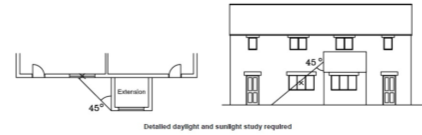
7.165Where the 45° test is not met, it may still be shown that natural light levels are acceptable, subject to checking using the BRE’s detailed tests, including:
- Vertical sky component;
- Daylight distribution / no skyline (where room layouts are known);
- Average daylight factor; and
- Annual probable sunlight hours.
7.166The same general principles will also apply in assessing the impact of new build residential development on existing dwellings neighbouring or close to the new proposal.
Comment point
7.167The proportion and scale of extensions and alterations should generally be subordinate to the original building. For the purposes of this Policy, 'original' means as existing on 1 July 1948 or in relation to a dwelling built after that date, as so built, unless the dwelling has subsequently been replaced. This is to avoid the impact of cumulative extensions over the consequent years.
7.168The overall balance and harmony of a street scene can aid the overall legibility. Proposals for extensions and alterations should reflect the reflect the form, scale and architectural style of the original building and area. This can be achieved by:
- Respecting the proportions, integrity and character of the original house;
- Using an appropriate roof form;
- Matching or reflecting materials and details; and
- Matching and reflecting window styles and positions.
7.169As with Policy SC1 above, where an innovative architectural approach is proposed, such schemes will be assessed on their merit. Contemporary designs and high-quality modern interpretations of distinctive and significant local characteristics will be welcomed where they are demonstrably appropriate to the site context and make a positive contribution to the wider environment.
7.170In circumstances where extensions or alterations are within the curtilage of a listed building, a building that is a heritage asset or a conservation area, it may be difficult to achieve an acceptable design. Where these proposals cannot be sited and designed in an acceptable way they will not be supported.
7.171Where a proposed extension site is in Flood Zone 2 or 3, a site-specific Flood Risk Assessment is required that is appropriate to the scale, nature and location of the development. Householder development is not subject to a flood risk sequential test or exception test but should still meet the requirements for Flood Risk Assessments. The Flood Risk Assessment should be proportionate to the scale of the proposal.
7.172Policy SC4 should be ready in conjunction with other key design policies in the plan including Policies SC1, SC2 and SC3.
Policy SC4: Design - Alteration and Extension of Dwellings
- Alterations and extensions to dwellings should:
- Reflect the scale, proportions, materials, roof line and detailing of the original building; and,
- Not have a detrimental impact on the street scene, either by themselves or cumulatively.
- Protect the residential amenity of neighbouring properties and avoid unacceptable overlooking and loss of privacy.
- Applications for extensions to dwellings will be supported where:
- The extension does not cause undue overshadowing of neighbouring properties and allows adequate natural light and ventilation to existing rooms within the building.
- Single storey extensions should be designed to fall within a 45-degree angle from the centre of the nearest ground floor window of a habitable room or the kitchen of the neighbouring property.
- In the case of two-storey extensions, the 45-degree angle is taken from the closest quarter point of the nearest ground floor window of a habitable room.
This applies to rear elevations of the neighbouring property and conservatories, if they meet standards for use as a habitable room. Patio or fully glazed doors will be treated as windows for this test.
- Single-storey flat-roofed extensions are well-designed, and the proposed extension would not be generally visible from a public place and would serve only to be supplementary to the main building. Use of intensive 'green/ blue' roofs will be encouraged. Two-storey flat-roofed extensions will generally not be supported, unless the host building itself is of a flat roof design.
- Loft conversions requiring dormer extensions will be in proportion to the existing roof, thus maintaining overall building proportions. They should avoid presenting a top-heavy and flat-roofed appearance. Planning applications for extensions in roof spaces which front a highway will ensure that the proposed structure avoids damage to the architectural and aesthetic character of the existing building and maintains the integrity of the street scene.
- The proposed scheme includes policy compliant biodiversity and greening interventions, such as Swift or other nesting boxes where appropriate.
- The extension does not cause undue overshadowing of neighbouring properties and allows adequate natural light and ventilation to existing rooms within the building.
- To maintain the visual quality of the street scene and allow adequate private amenity space:
- The width of the extension should be less than or equal to half the width of the original frontage of the building;
- The depth of the extension should be less than or equal to half the depth of the garden;
- The extension should respect the building line to all streets onto which the building faces;
- The extension should be subservient to the building;
- The extension should be of materials that complement those of the existing building;
- Fenestration should complement the proportions and alignment of fenestration in the existing building.
- Alterations and extensions to dwellings should not impact negatively on the amenity of other habitable buildings within the curtilage, for example self-contained annexes.
- Alterations and extensions to dwellings must include policy compliant flood risk adaptation and mitigation for all sources of flooding.
- Where there is potential for land instability, proposals should be informed by a suitably qualified structural engineers report.
- Alterations and extensions must respect the character of the host building and its location and should not result in unacceptable harm to heritage assets (whether designated or not) or their setting.
Policy SC5: Proposals Affecting the Significance and Setting of Heritage Assets
7.173The NPPF stipulates that the council should take into account the desirability of sustaining and enhancing the significance of all heritage assets when determining planning proposals. Therefore, conserving the heritage interest, character, and appearance of locally important as well as nationally significant heritage assets is a material consideration in assessing planning proposals. The level of consideration and weight given to their preservation should be proportionate to the asset’s significance.
7.174Non-designated heritage assets will be identified through early discussions with applicants and, in the case of archaeological sites through partnership working with the County Archaeologist.
7.175A key requirement of any proposal that may affect heritage assets is that the applicant demonstrates a detailed understanding of the significance of the heritage assets and the impact of their proposed development on both the heritage asset(s) and it’s setting in the form of a Heritage Statement. The detail contained within the assessment should be proportionate to the proposed works.
7.176The significance of a heritage asset is a measure of its cultural value to present and future generations because of its special interest. That interest may be archaeological, architectural, artistic or historic. Significance derives not only from the heritage asset’s physical presence, but also from its setting. Identifying and understanding significance will enable an applicant to assess the impact of a proposed development and to prepare an appropriate design that would preserve or enhance the heritage asset.
7.177The council will encourage proposals for sensitively designed, high quality developments that preserve or enhance the significance of heritage assets and their settings. The reason for this is that historic areas and their setting have a significant local distinctive character and appearance which is part of their special interest. Development proposals that are guided by these values, and which are designed using appropriate materials and details, will be supported by the council where all other material considerations are acceptable.
7.178Dependent on location, contemporary designs that utilise material and colour palettes to reflect local distinctiveness, and which respect the mass, scale, rhythm, and proportion of the prevailing historic context, will be supported by the council where all other material considerations are acceptable.
7.179In addition to local distinctiveness, proposals will need to take into account the local topography. The hilly nature of the town, intercut with valleys, means that there are many areas or buildings which have extensive settings as they can be visually prominent from a distance, or they can be appreciated from glimpsed views.This also applies to Hastings and St Leonards seafront, almost all of which is covered by conservation area designation. This area currently enjoys relatively unimpeded long views, which are a key element of area character. Proposals for development on or close to the coast must show that consideration has been given to the impact of new development on the setting of the Hastings and St Leonards seafront.
7.180Early identification of key views will be essential and in more complex cases a formal views analysis will be required. Views and visual considerations are part of an assessment of the impact of proposals on the setting of heritage assets. Therefore, applicants will need to show that their proposals take in to account both the impacts of views towards their development and on the setting of heritage assets.
Comment point
7.181The council’s objective is to retain existing heritage assets wherever possible. Where the loss of the whole or part of a heritage asset is permitted, the council must take reasonable steps to ensure the new development will proceed after the loss has occurred. Where consent is required for demolition of a heritage asset or building in a conservation area the council will only support this where detailed, well-designed proposals for the viable re-use of the site have been approved. Such schemes will need to be supported with robust evidence that there is a reasonable prospect of the development going ahead, in a timely manner, following the demolition. The council may seek to enter into an agreement, or impose a condition upon a decision, to ensure that demolition does not take place until a programme of works is agreed that ensures that development commences as soon as practical after demolition.
7.182Where the loss of the whole or part of a heritage asset is permitted, the council must take reasonable steps to ensure the new development will proceed after the loss has occurred. The council will only grant planning permission for the demolition of a heritage asset where detailed proposals for the viable re-use of the site have been approved. Such schemes will need to be supported with robust evidence that there is a reasonable prospect of the development going ahead, in a timely manner, following the demolition. The council may seek to enter into an agreement, or impose a condition upon a decision, to ensure that demolition does not take place until a programme of works is agreed that ensures that development commences as soon as practical after demolition.
7.183Relevant demolition in a conservation area requires an application for planning permission. This can include the removal of part of a building such as a significant architectural feature that provides a positive contribution towards preserving the character and appearance of a conservation area. Therefore, it is important that development proposals in conservation areas should seek to retain significant architectural features as part of the design to avoid the loss of significance and to preserve the historic area.
7.184There are 6 scheduled monuments in the town, which are identified on the Local Plan Policies Map. In addition, the Policies Map identifies various areas of the town recognised as being of particular archaeological importance. Heritage assets with archaeological interest are the primary source of evidence about the substance and evolution of places, and of the people and cultures that made them. The council will therefore seek to ensure that where proposals affect a known archaeological asset or an area or building having archaeological potential, the archaeological importance of the site is suitably examined and evaluated. Where possible, the council will encourage the preservation of significant archaeological remains in situ.
Policy SC5: Proposals Affecting the Significance and Setting of Heritage Assets
Proposals that would affect the significance or setting of designated or non-designated heritage assets will be supported where they:
- Show that they have responded to the distinctive topography of Hastings and considered significant townscape views.
- Demonstrates how the proposal relates to the asset and its setting.
- Respond sensitively to the historic context, street patterns, plot layouts, established building lines, boundary treatments, green space and landscaping, site levels, block sizes, siting, scale, height, massing, appearance, materials and finishes, and avoid the loss of significant architectural features.
- Provide clear and convincing justification for the development, show a full understanding of significance of the heritage asset, and do not result in unacceptable harm to the significance of the asset.
Policy SC6: Sustainable Development and Heritage Protection
7.185It is the council’s view that mitigating climate change and conserving heritage assets are compatible goals. This Policy aims to help applicants balance and reconcile these two objectives in a positive way, by promoting the role of heritage assets in achieving sustainable development in the Borough, and by encouraging development proposals that secure the sensitive adaptation of heritage assets to mitigate the challenges of climate change.
7.186To combat the threats posed by climate change, our heritage assets need to be made more resilient as they will be at a greater risk to water damage, flooding, changes to ground conditions resulting from increased rainfall or drought, and changes in sea levels, which may cause damage to historic features or undermine the structural stability of a building.
7.187Therefore, our heritage assets must continue to change and evolve if they are to contribute to a greener future and remain fit for purpose for present and future generations. Well-designed, sustainable proposals, based on a sound knowledge and understanding of heritage significance and traditional construction, both protect our built heritage, and help with progress towards achieving a low carbon economy and adapting to climate change.
7.188Most traditionally constructed, older buildings are inherently sustainable: they are long lasting, robustly constructed, generally built from low-carbon materials and technologies, and are easily repairable. Therefore, keeping existing buildings in good repair and active use is one of the most beneficial and sustainable ways to preserve our heritage assets and lower our carbon emissions.
7.189Buildings are one of the largest contributors of UK carbon emissions and can emit carbon dioxide throughout their whole lifecycle. Whole-life carbon is the sum of embodied and operational carbon emissions resulting from the construction and use of a building over its life (including its demolition).
7.190Embodied carbon emissions are generated during construction, repair, maintenance, alteration, or demolition of buildings, including carbon emitted through the extraction, processing, and transportation of materials.
7.191Adapting historic buildings appropriately to combat climate change does not just mean moving away from the use of fossil fuels and reducing carbon emissions, it also means adapting buildings in ways that protect the historic character and support the local economy. Many historic buildings are vernacular structures that can be maintained and repaired using locally sourced, durable, low-carbon materials. The use of locally sourced and locally manufactured materials, and the employment of local heritage craftspeople in carrying out specialist historic building repairs, is a sustainable approach that has local economic benefits, and which contributes to making beautiful and locally distinctive places.
7.192Work on an existing building to improve its energy efficiency, by making it easier to heat, to retain that heat for longer, and by replacing the use of fossil fuels with renewable energy sources is commonly referred to as retrofit. The council recommends that a retrofit project should be in accordance with the ‘whole-building approach’ advocated by Historic England that uses an understanding of a building in its context to find balanced solutions that save energy, sustain heritage significance, and maintain a comfortable and healthy indoor environment.
7.193When considering any retrofit works to a heritage asset the proposed works should:
- be effective in reducing carbon emissions without causing unintended consequences to the asset, such as causing damp and mould by impeding the breathability of the fabric.
- avoid harm to the significance of the asset. Where harm is identified, it must be reduced or mitigated by choosing retrofit options that cause the least harm possible.
- be a bespoke design for the individual building, as technical considerations and significance vary greatly from building to building.
7.194A whole building, fabric first approach prioritises repairs, insulation, draught-proofing, and ventilation before introducing Low or Zero Carbon technologies. This is because a building that leaks heat wastes energy, whether it is from a renewable source or not.
7.195Well-designed retrofitting proposals for heritage assets, and the installation of appropriate Low and Zero Carbon technologies, which help towards reducing carbon emissions and tackling the impact of climate change will be supported by the council. Development proposals that impact on heritage assets are more likely to gain support if their design is informed by an understanding of the impact of the proposal on the significance of the heritage assets they may affect.
7.196In assessing the benefits of renewables and retrofit for heritage assets the proposals need to be assessed for their potential impact on the significance of heritage assets and their setting. Any harmful impact on the significance of a heritage asset would require clear and convincing justification that demonstrates that the benefits would outweigh the harm caused.
Policy SC6: Sustainable Development and Heritage Protection
The council will support development that achieves a sensitive balance between reducing carbon emissions locally and the statutory requirement to give special weight to preserving significance and securing the long-term survival of our heritage assets. Therefore, to ensure a sustainable future for heritage assets, sustainable development proposals for heritage assets should:
- Use sustainable building materials that are appropriate to the individual building, and which help towards preserving the character and appearance of the heritage asset. Where possible, the materials should be traditional materials that are distinctive to Hastings.
- Adopt a whole building approach which incorporate measures to reduce energy consumption and / or generate energy supplies on site, provided the proposal would not result in unacceptable harm to a heritage asset.
- Where appropriate, incorporate measures to protect assets from increased physical threats such as flooding, land instability, increased rainfall, and overheating, provided the proposal would not result in unacceptable harm to a heritage asset.
Policy SC7: Changes to building elevations and roofs in Conservation Areas
7.197There are circumstances where planning permission is required to change the building elevations and roofs of historic properties in a conservation area. The architectural features on visible elevations and roofs can be key elements of historic streetscapes, contributing greatly to the character and appearance of a conservation area, and so enhancing its overall significance.
7.198Traditional windows and doors are crucial elements of historic streetscapes. Their size, style, proportions, detailing, opening arrangement and materials define the architectural style, period, and use of the building. Alterations to windows and doors can have a dramatic effect on individual buildings, and cumulatively, on whole streets and historic areas.
7.199Windows and doors are the architectural features most vulnerable to inappropriate alteration and replacement in historic buildings. Historically, traditional windows were predominantly timber vertical sliding sash windows with proportionate sections and apertures that had a distinctive vertical emphasis, and doors were predominantly made from solid timber, sometimes with four or six timber panels. Over time other features were introduced such as glazed upper panels, fanlights, and side lights. These important architectural elements should be preserved as they provide a positive contribution towards preserving historic buildings and areas.
7.200Traditional dormers or roof lights were located to provide a small amount of daylight and ventilation to the loft or attic rooms. Larger ones were sometimes used to light a stairwell. Lantern lights were often also used where more light was required to stairwells and other areas. Original dormers, rooflights and lantern lights can contribute to the building’s character and the wider street scene.
7.201As well as its shape and profile, the material used to cover a roof can contribute greatly to the significance, character and appearance of a building and the wider area. The hilly topography of Hastings means that the appearance of the roof often needs to be considered when looking down on the building from higher ground. Roofing material, will from time to time require replacement, having reached the end of its life. Where consent is required, permission will be given for replacement roof coverings where the material proposed is a close replica of the original roof covering in terms of materials, size, profile, pattern, and coursing. Alternative replacement roofing materials may be considered where the material satisfactorily reflects the existing material and would be used on a less prominent roof slope.
7.202Other significant features at roof level, include for example, dormers, chimney stacks, turrets, party wall upstands and decorative ridge tiles, all of which can provide a positive contribution towards preserving the character and appearance of heritage assets.
7.203These historic architectural features should be retained wherever possible, in order to preserve the significance of historic places. Where these features are incomplete or require replacement, the council will support proposals that include their repair and reinstatement so that the character and appearance of the building and the wider setting is preserved or enhanced.
7.204The introduction of a roof light can be one solution to providing natural daylight and ventilation to a room in a roof. It may be preferable to constructing a dormer, where it is important to retain the original roof profile, or where dormers would be out of character with the building.
7.205Due to the hilly nature of Hastings, roof lights, particularly when duplicated and arranged in a discordant fashion can have a negative impact on visible roofscapes in conservation areas. In these situations, roof lights should be kept to a minimum quantity and have a scale that is subservient and proportionate to the roof slope and the elevations below. To minimise their impact on the external appearance of the building and the wider area the roof lights should be restricted to roof slopes that are hidden from public view or positioned so that they do not dominate the roof slope.
7.206Where dormers are proposed they should have a built form that reflects the character of the building and the wider setting, be of a modest scale, normally only a single or pair per roof slope, set down from the ridge, set back from the face of the building, and positioned so that they do not dominate the roofscape. The dormer windows should be modestly sized in comparison to the windows on the main building elevations and reflect the window style of windows on the lower storeys of the building.
Policy SC7: Changes to existing building elevations and roofs in Conservation Areas
In conservation areas, the council will seek to maintain the form and appearance of original features including windows, doors, roofs, and other significant architectural elements where these contribute to the character of the building and the significance of the wider conservation area.
Historic architectural features should be retained and repaired. Where this is not possible, and where appropriate, they should be reinstated to match existing features.
To ensure building alterations and development would preserve the character and appearance of heritage assets and their setting they should be designed in accordance with the following:
- Windows, doors, and roof lights:
- Proposals for new windows or doors on existing elevations that are publicly visible within conservation areas will be expected to be a close replica of those originally fitted in the building in respect of size, form, appearance, proportions, materials, finishes, and opening arrangements.
- uPVC and aluminium replacement windows and doors would only be acceptable where clear and convincing justification is provided for their use, they would reflect the original design, and they are either:
- on building facades hidden from public view; or,
- part of a total replacement fenestration scheme on an isolated or detached building and where the replacements on the visible elevations do not harm the character and appearance of the conservation area. This does not apply to terraced or semi-detached buildings where the continuity of fenestration is important; or,
- slim section windows are proposed that accurately reflect the original design and that would not harm the character or appearance of the building or the area.
- In the case of replacement doors, the design must replicate the panel form and overall proportions of the original door.
- New roof lights will require clear justification and should be restricted to roof slopes that are hidden from public view or positioned so that they do not dominate the roof. They must:
- Sit flush with the roof covering;
- be kept to a minimum quantity and have a scale that is subservient and proportionate to the roof slope and the elevations below and;
- Be of traditional design in respect of size, proportions, appearance, materials (normally slender steel or cast-iron frames), finish, and opening arrangement.
- Proposals for new windows or doors on existing elevations that are publicly visible within conservation areas will be expected to be a close replica of those originally fitted in the building in respect of size, form, appearance, proportions, materials, finishes, and opening arrangements.
- Changes to roofs:
- Where planning permission is required, permission will be given for replacement roof coverings where the material proposed is a close replica of the original roof covering in terms of materials, size, profile, pattern, colour, and coursing. Alternative roofing materials may be considered acceptable where the proposed roofing materials would not harm the significance of heritage assets.
- Chimney stacks and other architectural roof features:
- Proposals should maintain the existing visible silhouette of the roof where this contributes to building character and is a positive feature within the conservation area.
- There is a general presumption in favour of retaining prominent chimney stacks, which make a positive contribution to the character and appearance of the conservation area.
- The council will support the retention, repair, or restoration of architectural features at roof level such as turrets, party wall upstands and decorative ridge tiles where they contribute to significance. Where these features are incomplete or require replacement, the council will support proposals that include their repair and reinstatement.
- Where the removal of chimney stacks and other architectural roof features is proposed, clear and convincing justification must be provided for the loss.
- Roof dormers
There are circumstances where dormers are not acceptable. Where acceptable new roof dormers should be:- of a design that reflects the character of the building and the wider setting;
- normally only a single or pair per roof slope;
- subservient to the existing roof and positioned so that they do not dominate the roofscape;
- are set down from the ridge and set back from the face of the building;
- Designed with windows that are modestly sized in comparison to the windows on the main building elevations and reflect the style of windows on the lower floors of the building.
Policy SC8: Shopfronts, Advertisements and Commercial Frontages
7.207Hastings’ shopfronts and commercial frontages are predominantly street facing elements with entrance doors, windows, and other significant features that contribute to the character and appearance of the host building and the wider townscape.
7.208New and replacement shopfronts and commercial frontages, both individually and collectively, can significantly impact on the streetscape. Therefore, these elements must be designed to reflect the character and appearance of the host building and the wider area. A standardised approach may not be acceptable, especially in conservation areas, where a more sensitively designed, traditional scheme that sits comfortably into the site context may be required.
7.209Historic shop fronts are traditionally constructed in timber, with slender, elegant, and ornate moulded details that add visual interest to the street scene. These architectural features, which are difficult to replicate using other materials, often provide the appearance of structural support to the upper floors of the host building and tend to be purpose made to fit large openings within the ground floor frontage of the host building. They have significant windows and doors, as well as other ornate architectural elements such as stallrisers, columns, facias, mullions, transom lights, pilasters, console brackets, panelled soffits and characteristic recessed entrances with decorative floor tiles.
7.210They can also include integral fabric awnings to provide shading to the window(s), and hanging signs, all of which add visual interest to the host building and help to preserve the character and appearance of the street scene and the wider area.
7.211Good quality, well-designed shopfronts and commercial frontages, that do not have vivid modern colours, and unmodified, garish, or detrimental corporate colour schemes and logos, can make a noticeable and positive contribution to the significance of a shopping area or street particularly when it is located within a Conservation Area. It can also provide a distinctive character and high-quality brand image for the business operating from the premises.
7.212Hastings has several locally distinctive shopping areas that each have a high concentration of attractive traditional shopfronts and commercial frontages, including Old Town, Hastings Town Centre, and St. Leonards, all of which are designated Conservation Areas.
7.213The decision on whether to repair or replace an existing frontage will depend on its age, quality, condition, its relationship to the host building and whether the original building’s use is to continue or change. Although, there is a presumption in favour of retaining an existing traditional shop front where it contributes to the quality and character of a shopping area, a high quality, well-designed contemporary replacement frontage could be acceptable if the design would contribute to the quality and character of a shopping area. However, for listed buildings and for buildings in Conservation Areas, the removal of an historic frontage would require clear and convincing justification.
7.214Wide and bulky fascia boards, and those manufactured from inappropriate reflective or textured materials can harm the character and appearance of a shop / commercial front and the wider townscape. Fascias must respect the character of the host building, generally be kept to a modest depth and be finished in a colour that is harmonious with the frontage. Security alarms, surveillance cameras, and exterior lights, can lead to clutter and should not generally be fixed to fascia. However, the use of small-scale LED lighting units and miniature cameras may be acceptable in certain circumstances.
7.215Signs can have a major impact upon the character and appearance of a shopfront, especially when they are amalgamated to span across multiple buildings. Signage on shopfront fascias must be kept to a modest scale and must reflect the character and appearance of the host building. Projecting or hanging signs that are of a good design quality and relate well to the size and scale of the shop façade will be acceptable when the need for them is supported by clear and convincing justification. Where projecting signs are acceptable, traditional painted hanging signs with appropriate lettering and symbols are recommended. Proposals for projecting box signs will be assessed on size, appearance, design quality, type of illumination, materials and finishes, and positioning.
7.216The use of widespread, poorly designed illumination can be detrimental to the visual character of a shopfront, the host building, and the wider townscape. Illumination of frontages in sensitive locations, such as Conservation Areas and on listed buildings, should be mostly from the street lighting or achieved through sensitively located internal lights within the frontage window or host building.
7.217New and replacement shopfronts and commercial frontages should be designed to provide full access for all users. Where this would cause harm to a heritage asset’s significance, full access for all users should be weighed against the need to preserve significance, a range of options should be explored, and a balanced approach to access will be required.
7.218The deterrence of shop break-ins and vandalism to shop windows require appropriate security measures. However, solid security shutters on the outside of shopfronts are discordant elements that obscure the shopfront and have a deadening effect on the street scene. The council will support designs that make the security measures integral to the shopfront design such as using laminated security glass, internally mounted open lath lattice roller shutters, and reinforced stallrisers. In less sensitive locations, other approaches may be acceptable.
Policy SC8: Shopfronts, Advertisements and Commercial Frontages
The council will require a high standard of commercial frontage design, particularly for proposals in Conservation Areas and/or affecting listed buildings.
Where an existing frontage contributes to the character and visual amenity of the building or area, this should be kept and repaired in a like-for-like manner using traditional materials, which is usually timber, with purpose run mouldings that match the existing, traditional sections.
Proposals for new shopfronts and commercial frontages, or the replacement of existing, will be supported where:
- they are well-designed, respect historic plan form and openings, include appropriate architectural detailing and features that reflect the age and character of the host building, and are free of visual clutter. They must also respect the host building’s symmetry, vertical or horizontal emphasis, appearance, scale, materials and finishes, character, and upper floor fenestrations to form an integral, harmonious facade.
- High quality, well-designed contemporary frontages are proposed that preserve or enhance the character and quality of a building or Area.
- Fascias respect the character of the host building, have a colour finish that is harmonious with the frontage, and have a height that is proportionate to the frontage below.
- Measures such as security alarms, surveillance cameras and exterior lights, are generally not fixed to the fascia. The use of small-scale LED lighting units and miniature cameras may be acceptable on frontages in less sensitive locations.
- Signs should be kept to a minimum quantity and preserve the significance of the street scene and signage information limited to the name of the business, the nature of the business, and the street number.
- In the case of traditional frontages, they are finished with traditional rich, recessive paint colours.
- The shop frontage spans across several individual buildings the identity of the individual building or façade is maintained.
- External illumination is integral to the overall design of the frontage, discreetly sited on the building and has a stable light source (non-flashing), with an intensity that does not cause harm to the setting.
- Access is provided for all users, and that any harm caused to a heritage asset’s significance is minimised and supported by clear and convincing justification.
- Designs for security measures are integral to the design.
Policy SC9: The High Weald National Landscape and Other Areas of Landscape Value
7.219The High Weald National Landscape (NL) covers approximately 18% of the Borough and has the highest status of protection nationally in relation to landscape and scenic beauty.
7.220The NL closely follows the Borough’s administrative boundary to the north but to the east takes in the whole of Hastings Country Park Nature Reserve and the Hastings Cliffs Site of Special Scientific Interest and Special Area of Conservation. Hastings Country Park Nature Reserve represents the only place the NL is exposed to the sea.
7.221Major developments should not take place in the NL save in exceptional circumstances.
7.222In addition, the Combe Haven Valley and Combe Valley Countryside Park, in the west of the Borough, is recognised locally as a distinct landscape character area which will be protected and enhanced.
7.223Development that is proposed in the High Weald NL, or affecting its setting, will need to have regard to the potential impact to the landscape character. Development proposals within the NL need to have regard to the purposes of the NL designation and will need to demonstrate how the proposal protects and enhances the landscape in accordance with NPPF policy.
7.224Any development that is proposed in the Combe Valley or Combe Valley Countryside Park will need to have regard to the potential impact to the landscape character.
7.225A suitable report will be required to support relevant planning applications. Assessments will demonstrate an understanding of the impact of any potential development, both within areas of landscape value and in their locality. Landscape and Visual Impact Assessment reports, assessments of impact on scenic beauty, and Design and Access Statements are all useful tools in this regard. Any scheme presented to the Local Planning Authority must reflect the findings of the landscape assessment and appropriate design of mitigation measures should be incorporated.
7.226In relation to the NL, such assessments should specifically set out how proposals have been informed by the NL Management Plan and the defining components of character set out in the Management Plan that inform the natural beauty of the NL, and, where relevant, other High Weald design guides.
Policy SC9: The High Weald National Landscape and Other Areas of Landscape Value
- The High Weald National Landscape (NL) and other areas of landscape value; including the Combe Valley countryside Park, are displayed on the Policies Map. The inherent visual qualities and distinctive character of these areas will be protected. Development should be limited in scale and extent, in terms of the proposed footprint, height and massing and appropriate in terms of its nature and location.
- Where development proposals have the potential to impact on a protected landscape or an area of landscape value, a landscape assessment will be required to understand the level of impact. Where impacts are identified proposals should incorporate the recommendations of this assessment.
- Within the High Weald NL, the scale and extent of development should be limited, and designed in a way that reflects its nationally designated status as landscape of the highest quality. Development in the NL should conserve and enhance the landscape and scenic beauty of the area, with reference to the components of natural beauty set out in the High Weald NL Management Plan. Development proposals should be supported by a Landscape Assessment demonstrating how the scheme makes a positive contribution to the objectives set out with the Management Plan.
- Land within the setting of the High Weald NL will need to take into account the potential impact on the natural beauty of the NL in its location and design.
Policy SC10: Habitat Protection, Biodiversity and Net Gain
7.227Biodiversity and well-functioning ecosystems are critical for human existence, economic prosperity, and a good quality of life. They are essential in providing food, energy, shelter, and medicines; sustaining water and soil quality; regulating the earth’s climate; and providing opportunities for recreation, recuperation, and inspiration. Yet the UK is one of the most nature-depleted countries in the world. Since the 1970’s, 41% of all UK species surveyed have declined while 15% of species within the UK are said to be threatened with extinction.
7.228Proposals will be expected to submit ecology reports appropriate for their scale and context. During the validation process reports may be requested which are relevant for the development proposed. Should Preliminary Ecological Appraisals reveal that further surveys are required these will also be expected to be submitted to the council.
7.229Some areas of the Borough that are particularly important for their contribution to their wildlife habitat should be protected. Local Nature Reserves (LNR) protect wildlife habitats and the natural heritage, but they also have a broader community role.
7.230Local Wildlife Site (LWS) is a non-statutory designation applying to a site of Borough-wide importance. The designation seeks to provide recognition of the wildlife value of these sites to the local community and, where possible, to prevent significant damage arising from development.
7.231Areas of biodiversity and important habitat often overlap with areas designated for their geodiversity value such as the Hastings to Pett Beach SSSI. Hastings is comprised of sandstone, mudstone and clay beds with alluvial deposits in areas that are currently or historically riparian in nature. This geological framework is an important component to local habitats, and contribute to the varied landscape, natural heritage, hydrological regime and topography of the borough as well as in many cases literally providing the foundation for our built environment.
7.232Proposals must consider that an intervention in one location may impact negatively on another due to how geological systems function, and whether mitigations within a proposal site might have negative effects elsewhere. The council’s approach to geodiversity is set out in Policy SC15
7.233Government is committed to delivering more and better habitats for biodiversity and demonstrating measurable gains from development through the Statutory Biodiversity Metric. The Environment Act contains a mandatory minimum 10% biodiversity net gain condition for planning permissions. Biodiversity net gain is an approach to development, and/or land management, which leaves the natural environment in a measurably better state than beforehand.
7.234Development that adopts a biodiversity net gain approach seeks to make its impact on the environment positive, delivering improvements through habitat creation or enhancement after avoiding or mitigating harm.
7.235Development proposals should contribute to and enhance the natural and local environment by minimising impacts on and providing net gains for biodiversity. The council will expect development proposals to demonstrate they are using the Statutory Biodiversity Metric and that the proposals will have positive gains for biodiversity and the natural environment with a minimum 10% threshold for biodiversity net gain. Preliminary Ecological Assessments will only be accepted where it is determined there would be no significant Ecological effects, no mitigation is required, and no further surveys are necessary.
7.236The council will expect all developments to comply with the British Standard BS 42021:2022 ‘Integral Nest Boxes, selection and installation for new developments’ by installing integral swift bricks within new housing developments and other suitable developments. The Policy is structured to provide applicants with the information needed when submitting a planning application. When planning for biodiversity net gain and habitat protection, consideration should also be given to how this may relate to the delivery of other local plan policies that seek to protect and enhance the natural environment.
Policy SC10: Habitat Protection, Biodiversity and Net Gain
Habitat Protection
- Where proposals would result in harm to statutory or non-statutory designated habitats, the public benefits of the development shall be weighed against the harms to, and the significance of the nature conservation interest. Schemes will only be support where the public benefits the significantly and demonstrably outweigh the harm to affected nature conservation interest.
- Development proposals (other than where loss or degradation of habitat would be negligible such as a change of use or building alteration) will be required to demonstrate biodiversity net gain and will be accompanied by appropriate ecological appraisals showing the potential impact of the proposed development on habitats and species.
Biodiversity
- Development proposals will demonstrate how the proposed development will use the following hierarchy:
- avoid harm to biodiversity through site selection and sensitive design; or,
- Where avoidance is not possible, mitigate impacts to reduce harm as far as practicable; or as a last resort,
- Only compensate for residual impacts where avoidance and mitigation are demonstrably unachievable, and compensation delivers measurable ecological value.
- Where proposals will have an adverse impact, they must demonstrate:
- That the proposal minimises the adverse impacts and there are no reasonable, less damaging solutions,
- The design and layout of the scheme maximises onsite mitigation.
- Proposals will only be supported where they can demonstrate all the following:
- The proposal has been informed by ecological information and constraints and opportunities relating to onsite and adjacent biodiversity.
- The proposals include integral swift and bird bricks which comply with British Standard BS 42021:2022 Integral Nest Boxes, selection and installation for new developments.
- 10% biodiversity net gain is quantifiable and measurable utilising the most up to date Statutory Biodiversity Metric developed by Natural England and the Department of Environment, Food and Rural Affairs and is achievable on site in the first instance or off-site where net gain cannot be achieved on site.
- Where agreed by the council that biodiversity net gain cannot be achieved on site, suitable off-site compensation will be secured to deliver biodiversity enhancements.
- That appropriate mechanisms are legally secured to reflect the cost of monitoring biodiversity net gain.
- Where development is permitted, the council will impose appropriate conditions or seek a legal agreement to secure the protection, enhancement, compensation, and management of the conservation interest of any site affected, directly or indirectly by development proposals or appropriate off-site compensation to ensure biodiversity net gain is achieved.
- Proposals which seek to implement or enhance any of the objectives of an Adopted Nature Recovery Strategy will be supported. Where a proposal would negatively impact the objectives of an Adopted Nature Recover Strategy the proposal will be resisted unless material considerations outweigh the attributed harm. Where development is proposed which conflicts with an Adopted Nature Recovery Strategy the developer should seek to remove, reduce and mitigate the harms.
Policy SC11: Trees and Woodland
7.237Trees and woodlands are essential parts of our natural landscape and ecosystem services, supporting wildlife, mitigating the effects of climate change and contributing to our well-being.
7.238Native woodlands in the UK are isolated, in poor ecological condition and show a decline in woodland wildlife. Ancient Woodland is the oldest, most ecologically diverse, and important woodland habitat in the UK. It is estimated up to 70% of the UK’s Ancient Woodland has been lost or damaged. All Ancient Woodlands are unique, are distinctive to their locality and cannot be replaced once lost. Hastings has an extensive tree and woodland cover, much of it designated as Ancient Woodland.
7.239Development affecting Ancient Woodland, ancient trees and veteran trees is a material planning consideration. National Planning Policy places great weight on the protection of irreplaceable habitats advising that development resulting in the loss or deterioration of irreplaceable habitats such as Ancient Woodland should be refused.
7.240The council will protect our woodlands and Ancient Woodlands from harm and encourage suitable planting and replacement of trees if they are adversely affected by development.
Policy SC11: Trees and Woodland
- Trees, woodland and hedgerows will be protected where they are:
- Protected by a Tree Preservation Order (TPO)
- In a conservation area
- Ancient Woodland
- In historic parks and gardens
- Within an area recognised for its biodiversity importance
- The removal of trees and hedges will only be considered acceptable where it is in the interests of good arboriculture practice, or the proposed development outweighs the landscape and amenity value of trees or hedges affected.
- Where there is unavoidable loss of trees, replacement trees will be planted at a ratio of 3:1* and will be required to be planted and maintained on site. Where on-site provision is not possible, new/replacement provision should be located in the first instance in the Green and Blue Infrastructure network as defined in the council’s Green and Blue Infrastructure Strategy*.
- Development resulting in the loss or deterioration of Ancient Woodland will be refused, unless there are wholly exceptional circumstances, or projects proposed are of national significance, and a suitable compensation strategy developed.
- Development proposals next to woodland will require a buffer area. Buffer areas should be in line with Natural England’s standing advice.
- Where development is permitted, the council will impose appropriate conditions or seek a legal agreement to secure the protection, enhancement, compensation and management of the hedgerow, tree and woodland interest of any site affected, directly or indirectly by development proposals or appropriate off-site compensation to ensure the towns treescape is not adversely impacted by development.
*Hastings Borough Green and Blue Infrastructure and Biodiversity Net Gain Strategy 2022
Policy SC12: Green and Blue Infrastructure
7.241Good quality green and blue infrastructure (GBI) within our Town can make a positive contribution to improving health and wellbeing, water management, nature recovery and resilience to and mitigation of climate change and can help address environmental decline.
7.242The Hastings Green and Blue Infrastructure and Biodiversity Net Gain Strategy[xliii] has identified a network of GBI across the borough. These include statutory and non-statutory ecological sites, together with parks, open spaces, playing fields, woodlands, street trees, allotments, private gardens, green roofs and walls, sustainable drainage systems (SuDS) and soils. The network also includes rivers, streams, other water bodies, which can be collectively referred to as ‘blue infrastructure’.
7.243Policy SC12 supports the overarching vision derived from the strategy to protect, develop and enhance a network of multi-functional, highly connected green and blue infrastructure across Hastings Borough, designed to incorporate climate adaptation, is financially sustainable, benefits wildlife and Hasting Borough's diverse local community[xliv].
7.244The purpose of SC12 is to protect existing GBI ensuring that its integrity and connectivity is retained, restored, and enhanced and to deliver new GBI which will support sustainable development and address corporate priorities to make space for nature[xlv]. New development will contribute to the protection and enhancement of open spaces through sensitive development proposals and financial contributions.
7.245For major developments, the council will require developers to design schemes in accordance with recognised standards, for example Building with Nature[xlvi] or the National Design Guide[xlvii].
7.246Biodiversity Net Gain contributions are a key resource in enhancing and extending the GBI network, as well as contributing to the Local Nature Recovery Strategy (LNRS)[xlviii]. The council will work with key partners to deliver coordinated action for an enhanced and connected network of wildlife rich habitats, species recovery, reduced carbon emissions, water quality improvements, natural flood risk management and recreation.
7.247GBI features should be maintained for the lifetime of the intervention to ensure they continue to deliver their intended environmental, social, and functional benefits. The council will require all major development proposals to be supported by a maintenance and monitoring plan, proportionate to the scale and complexity of the GBI. This should be secured by a condition or legal agreement.
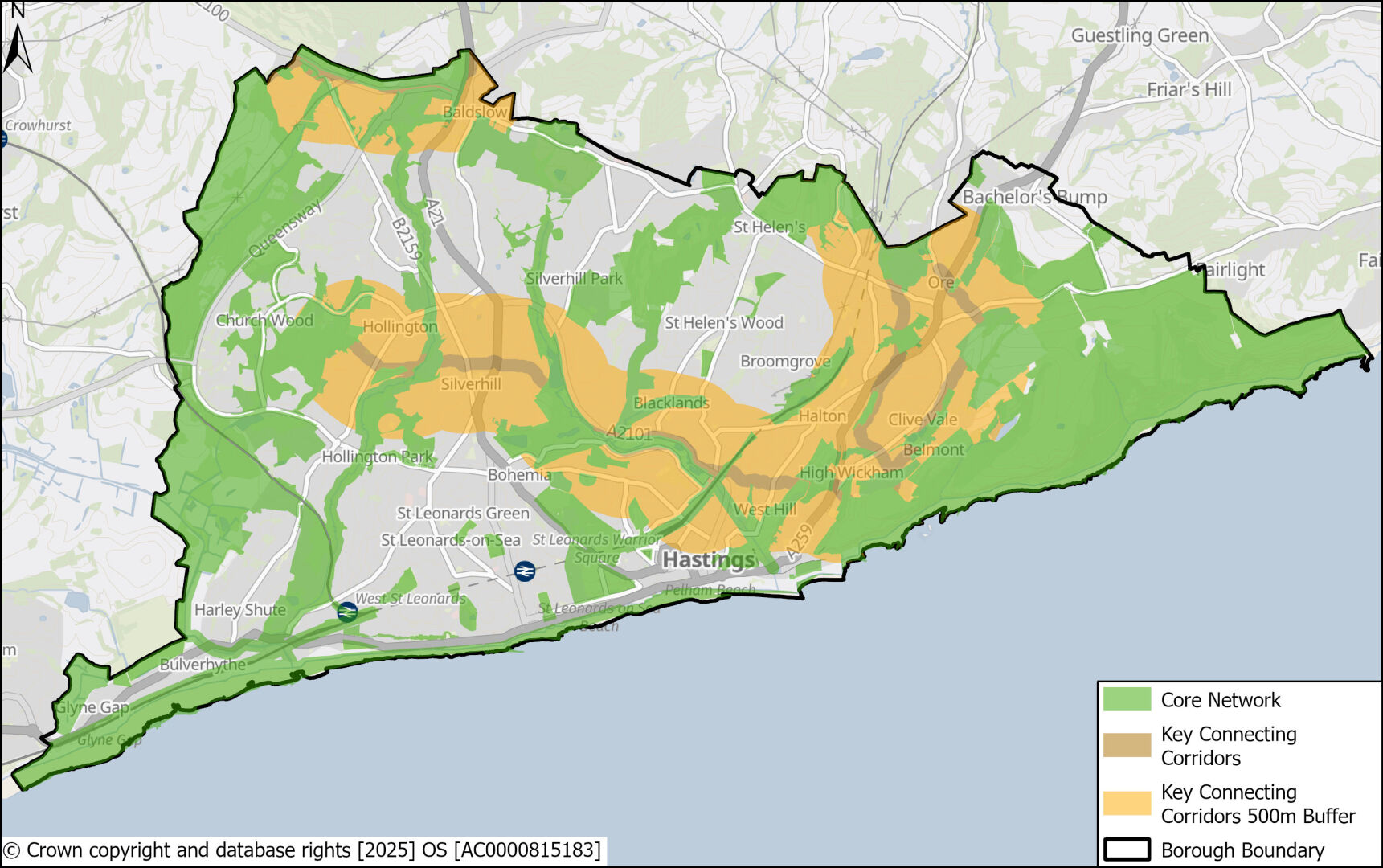
Policy SC12: Green and Blue Infrastructure
- Development within the core GBI network must retain, restore, protect, and enhance existing GBI on-site to support climate change adaptation and mitigation, and deliver benefits to wildlife, habitats, ecosystem services and the health and wellbeing of the local community. Schemes should be designed in accordance with recognised standards such as the Building with Nature Standards.
- Development outside of the core GBI network that extends, strengthens or creates new connections will be supported, particularly where it contributes to:
- The creation of new green corridors
- The delivery of priorities identified in the Green and Blue Infrastructure Strategy and Local Nature Recovery Strategy (LNRS)
- Proposals for onsite Green and Blue Infrastructure schemes must be accompanied by an agreed maintenance and management plan for the lifetime of the intervention. This will be secured by condition or legal agreement.
Policy SC13: Urban Greening Factor
7.248The Urban Greening Factor (UGF) is a planning tool used to quantify and improve the provision of green and blue infrastructure (GBI) particularly in urban areas. It supports the inclusion of a diversity of GBI to create a range of benefits such as reducing heat, absorbing pollutants from the air, reducing storm water run-off, and promoting biodiversity.
7.249The UGF is distinct from the Biodiversity Metric, which measures ecological benefits. While the Biodiversity Metric focuses on habitat quality and distinctiveness, the UGF promotes a broader range of green and blue infrastructure benefits and promotes the retention of existing high-quality GBI. Both tools should be used for relevant applications, and applicants are encouraged to identify where BNG and UGF interventions can be co-designed to deliver multifunctional outcomes, such as species-rich Sustainable Drainage Systems (SuDS), native tree planting, or wildflower green roofs.
7.250The UGF is calculated by assigning a score to all the surface cover types. All UGF surface types should conform to the guidance and specifications set out in Table 2 of Natural England’s Urban Greening Factor for England User Guide. The resulting UGF score for sites should meet or exceed the target factor score as set out in this Policy and should not result in a reduction in score compared to the site’s undeveloped baseline score.
7.251It should be noted that the UGF is not a tool to measure the biodiversity benefits of greening proposals, and not all urban greening may be inherently beneficial for wildlife. Equally, the scoring threshold could potentially be met with interventions that do not deliver in line with locally set green and blue infrastructure priorities if the only consideration is the overall score achieved. In order to ensure that biodiversity and locally set green and blue infrastructure gains may be maximised within developments where the factor is applied, interventions should be prioritised that deliver both high UGF scores and align with the ten objectives of the council’s Biodiversity and Green and Blue Infrastructure Strategy and the Building With Nature Standards.
7.252The UGF should be considered from the earliest design stage. This includes where appropriate, at the pre-application stage. The urban greening factor tool is used to assess and quantify the amount and quality of urban greening surface cover that a scheme provides, increase the level of greening in urban environments and provide much needed linkages between isolated areas of existing green and blue infrastructure.
7.253The UGF seeks a locally set minimum score for both residential and commercial sites that are capable of accommodating major development, to be assessed using the Natural England Urban Greening Factor for England tool and supplementary guidance. The UGF affords developers some flexibility as to the interventions that may be used to reach the specified level of urban greening, provided that locally set objectives within the council’s Green and Blue Infrastructure Strategy are addressed.
7.254The resulting UGF score is then compared with the target UGF score for the development site set by the Policy and used to evaluate whether the development's urban greening proposal meets the defined target.
7.255Minor developments are capable of delivering a range of UGF interventions onsite that are appropriate to the scale, location and type of development for which permission is sought. Examples include green roofs and attenuation measures or other interventions that deliver multiple benefits.
7.256It is essential that Green and Blue Infrastructure delivered through Urban Greening is properly maintained so that it continues to fulfil the functions and meet the standards of quality defined within this Policy. The Policy seeks an appropriate financial and stewardship plan for the lifetime of the development, such as a Landscape and Green Infrastructure Management and Maintenance Plan.
Policy SC13: Urban Greening Factor
- All major development proposals must, and any minor development proposals within the key connecting corridors and their 500m buffer should, demonstrate that:
- The proposal will meet or exceed an Urban Greening Factor of 0.4 (for residential) or 0.3 (for commercial development*) and;
- There should be no net loss against the baseline undeveloped site score.
- Minor development proposals outside of the key connecting corridors and their 500m buffer should seek to incorporate elements of high scoring urban greening appropriate to the site.
- Onsite Urban Greening should be maintained for the lifetime of the UGF measures. Major development proposals must demonstrate this through an agreed maintenance and management plan. This may be secured by condition.
*Mixed used development scores should be based on the use with the greatest square meterage surface area (Natural England, Urban Greening Factor for England User Guide, 4.5, 2023)
Policy SC14: Provision, Enhancement and Retention of Sports and Recreation Facilities
7.257The importance of good access to high quality open spaces, sports and recreation facilities to the health and well-being of communities is well recognised. There are also economic benefits of parks and green spaces in terms of creating employment, promoting economic activity and encouraging inward investment across an area by providing a draw and destination for visitors.
7.258As new development proposals in the Borough come forward, we need to ensure that development addresses any potential impact arising from additional pressure on existing open space, sports and play provision and provides for the needs of the growing and changing population. To understand current provision and to identify future needs for open space, sports and recreation provision, a Strategic Open and Play Space Assessment[xlix] and a Playing Pitch and Built Facilities Strategy[l] have been undertaken. The studies have identified a need to protect all forms of provision, improve the quality and value of existing provision, improve the maintenance of provision and a need to increase the provision for specific activities in order to support current and future residents.
7.259Open space refers to all publicly accessible open spaces within the town, including those used for informal sports and play, equipped play and outdoor socialising. Together with sports facilities, this Policy refers to:
- Parks and gardens
- Natural and semi-natural green space
- Allotments
- Cemeteries and churchyards
- Provision for children and young people (as primary & secondary typologies)
- The beach and seafront promenade
- Natural turf and artificial turf pitches for cricket, football, hockey and rugby, including associated infrastructure
- Indoor and outdoor built sports facilities, including tennis and bowls
7.260The protection and enhancement of existing open space, play provision and sports facilities is important in order to ensure it remains accessible and continues to fulfil its established recreational function and deliver best value.
7.261Existing open space, sport and recreation provision should not be built on unless proposals include, for example, the consolidation of multiple lower quality or value facilities into a single high-quality, high-value offer; or the onsite or offsite provision of a significantly enhanced replacement facility. It is recommended that consultation mechanisms are used to inform the design of reprovided or consolidated facilities equipped play facilities where possible.
7.262Opportunities for people participate in growing their own produce can be a contributing factor to supporting healthy lifestyles, helping to promote physical activity, reducing stress, increasing community cohesion, aiding healthy eating, and relieving symptoms of some serious illnesses. Formal allotment sites are therefore protected. The council recognises that other less formal opportunities for people to participate in food growing. Such as community food growing schemes. Where community food growing proposals constitute development, the council will consider such proposals, including as a productive meanwhile use for spaces identified for future development.
7.263It is recommended that the potential for the presence of polluted ground conditions be taken into account where any proposal involving the cultivation of items intended for human consumption is brought forward, including the potential for pollution as a result of runoff upstream.
7.264Open spaces, sport and recreation provision have multifunctional benefits. They contribute to the green and blue infrastructure network, can help deliver benefits for nature, the management of surface water, and support active travel. Proposals affecting these facilities will therefore only be supported where they do not adversely impact on other benefits and functions or where these can be sufficiently mitigated.
7.265Inclusive sport and leisure facilities play an important role in addressing inequalities, improving quality of life and enhancing community interaction. We recognise that it is essential for all residents to have access to a range of leisure opportunities and the importance of maintaining a geographical distribution of facilities to meet local community needs.
7.266The Hastings and Rother Playing Pitch and Built Facilities Strategy (2023) provides a current and projected level of supply and demand for sports facilities in Hastings which will help inform any future developments. The Strategy is updated regularly to ensure that the information within it remains up to date.
7.267Protecting the existing stock of playing fields and sports pitches is also important to maintain the health and wellbeing of local people, and in light of increasing pressures for development.
7.268Ensuring all residents have access to good quality sport and leisure facilities continues to be an important goal for the council and its partners. Participation in sport has rebounded well following the negative impact of Covid-19 and the council’s joint Playing Pitch and Built Facilities Strategy with neighbouring Rother District Council.
7.269The strategy emphasises the importance of enhancing current facilities to meet current and future participation needs, particularly to support growing participation from women and girls. Likewise, built sports facilities will require ongoing maintenance and enhancement, particularly due to the age and configuration of some facilities no longer meeting local needs to the extent that they have in the past. To address this need, contributions will be sought from developments most likely to accelerate these trends in participation due to their size and scale.
7.270Hastings largest built leisure facility, with over 80% of its swimming offer, is Summerfields Leisure Centre. Summerfields is over 40 years old, with its most recent refurbishment activity in 2005. Work is now ongoing to identify options for the future, including the potential for a replacement or further refurbished facility, ideally consolidating the facilities currently operated within Summerfields and Falaise Gym. Due to the sub-regional destination status of the current facilities, any replacement facility should be developed with consideration given to the overall offer with neighbouring Rother District.
7.271It is recognised that in exceptional cases, the loss of a sporting facility may be unavoidable – for example, where a facility will be replaced, consolidated, there is no longer demand or an ancillary function is necessary to support its continued operation. Re-provided facilities should enhance the quality and accessibility of the facility.
Policy SC14: Provision, Enhancement and Retention of Sports and Recreation Facilities
Sports and recreation facilities are identified in the most up-to-date Open Space and Play Strategic Assessment and the Playing Pitch and Built Facilities Strategy.
Retention and Enhancement
- Development which seeks to maintain or enhance existing sports and recreation spaces will be supported. This includes:
- Parks and Gardens
- Natural and Semi-Natural Green Space
- Amenity Green Space
- Equipped play
- Built sports facilities
- Playing pitches
- Allotments
Preventing and Managing Loss
- Development on land with important amenity value including those identified on the policies map as Multifunctional Open Spaces, Allotments and Local Green Spaces will not normally be supported.
- Development resulting in the loss of equipped play facilities will only be permitted where:
- Replacement equipped play is re-provided onsite, and is of enhanced quality and accessibility; or,
- Replacement equipped play is provided in a suitable offsite location, is of equivalent or enhanced quality and quantity and will be which will be made available prior to the loss of the original; or,
- The development is for alternative or consolidated and improved provision of equipped play, the benefits of which can be demonstrated to clearly outweigh the loss of the original provision.
- Development resulting in the loss of outdoor or indoor (civic*) sports or recreation facilities will only be permitted where:
- A replacement facility is re-provided onsite, and is of enhanced quality and accessibility; or,
- A replacement facility is provided in a suitable offsite location, is of equivalent or enhanced quality and quantity and will be made available prior to the loss of the original; or,
- The development is for alternative or consolidated facility for typologies 1e and/or 1f the benefits of which can be demonstrated to clearly outweigh the loss of the original provision; or,
- The proposed development is ancillary to the current facility and will not adversely impact the continued use of the site for sports or recreation.
*Public indoor leisure facilities available to all residents
Policy SC15: Ground Behaviour, Geodiversity and Land Stability
7.272The full and effective use of land may be difficult to achieve due to the challenges and problems associated with ground behaviour. As a result of Hastings’ natural geology, hydrology and long history as a settlement, there is the potential for challenging ground behaviour throughout the borough that may lead to instances of instability if not properly assessed and mitigated during the development process.
7.273The land that becomes unstable may result in creep, landslides, subsidence, ground heave, collapse or other hazard. As well as presenting an immediate hazard to people living, working in or visiting areas experiencing the acute effects of unstable land, the impacts can also extend beyond the immediate area of incident. For example, materials entering water bodies such as lakes, rivers, ponds, streams, the sea as a result of these effects can introduce pollutants that impact water quality or exacerbate flooding due to reducing storage capacity of the water body.
7.274In coastal areas like Hastings, the effects of land that has become unstable are often most noticeable along cliff faces, or where the effects appear suddenly as opposed to where they make themselves known gradually over time. Land can become unstable due to intrinsic factors (general physical characteristics of the location) and triggering factors (such as extreme rainfall). As a result of climate change some of these triggering factors will intensify during the lifetime of the plan.
7.275National Planning Policy sets out the need for planning policies and the decisions they inform to prevent new and existing development from contributing to, being put at unacceptable risk from, or being adversely affected by land instability. It also places development at the heart of providing a solution to problem areas of land instability through the potential for a well thought out proposal to remediate and mitigate unstable land where appropriate.
7.276National Planning Policy places the responsibility for securing a safe development on the developer and/ or landowner[li]. It also provides clarity that the impact of climate change should be considered as part of any proposal[lii]. Adequate site investigation should be undertaken before a proposal is brought forward, to inform decision making.
7.277The planning practice guidance confirms that before a detailed planning application is prepared, a site needs to be assessed in the context of surrounding areas where subsidence, landslides and land compression could threaten the development within its anticipated life or damage neighbouring land or property. Such information could be provided to the planning authority in the form of a land stability or slope stability risk assessment report[liii]. Stability reports may be combined with drainage and/ or contamination reports where appropriate.
7.278Therefore, a safe development is one that considers not only the safety of the development itself, but the potential wider impacts. Failure to do so may present a risk to life, habitat, property and infrastructure[6].
[6] This is independent of the requirement under Part A of the Building Regulations, which relates only to the stability of a structure itself and not the surrounding area.
Understanding which sites require assessment
7.279Locations with the potential for poor ground conditions will require assessment. The gradient of a slope should not be used as the sole basis for investigating ground behaviour, although the presence of a slope within the site or surrounding area can help to define the scope of preliminary assessments.
7.280Planning Practice guidance identifies a range of data sources that may help to inform an understanding of ground behaviour, including but not limited to:
7.281Information on previous uses contained in the National Land Use Database.
7.282British Geological Survey Data, including the National Dataset on landslides, artificial ground and borehole data.
7.283For the avoidance of doubt, the term ‘poor ground conditions’ may include, but is not limited to:
- Poorly consolidated, or historic and unrecorded made ground and fill material;
- Soft, weak and wet natural soils[7];
- Subterranean voids or cavities, both natural and artificial;
- Shallow or deep historic mining or mineral extraction;
- Soils at risk of shrink-swell, including where this is due to the effects of trees;
- Historical railway, defence or other spoil locations;
- Recent or historic landslides;
- Faults or subsurface shear;
- Where 1 or more retaining structures are present.
[7] Including compressible ground, collapsable deposits, soluble rocks, running sand.
7.284Landslide Activity Risk Areas (LARA) are areas in which landslides have recently taken place, remain active or there is reason to believe they will become active in the near future. This includes locations where Article 4 Directions restricting development due to the need to prevent landslides are in force. Proposals at any scale in LARAs will need to incorporate remediation measures in the majority of cases.
7.285There are a limited number of exceptions to this Policy, which include:
- Changes of use (unless the change involves residential development);
- Variation or removal of conditions, unless these conditions relate to ground behaviour or land stability;
- Applications for listed building consent;
- Lawful Development Certificates;
- Tree works requiring planning consent that do not involve the felling of trees.
7.286Some small-scale works will not require Planning Permission or Building Regulations Approval. Before starting on such works, residents and businesses are strongly advised to take appropriate professional advice.
7.287Assessments and reports relating to ground behaviour and land stability must be prepared by an appropriately qualified and experienced geotechnical engineer with chartered membership of a relevant professional institution appropriate to the scale of proposed development (PPG 09), such as RoCEP, ICE, the Geological Society or IMM.
7.288When undertaking assessments of ground behaviour and land stability, it is important that the potential impacts of climate change, including soil and materials deterioration, over the lifetime of the proposed scheme are taken into account. This includes, but is not limited to, those that constitute imposed, wind and environmental loads and those that may result in increased ground movement due to changes in the shrinking, swelling or freezing of the subsoil – insofar as the risk can be reasonably foreseen.
7.289The resulting proposal should therefore incorporate appropriate or special design features as needed following these assessments in order to ensure it can safely tolerate both current and foreseeable future ground conditions also taking into account the temporary condition of the site during construction.
7.290BS EN 1997-1 and its annexes provide the national standard for geotechnical aspects of the design of buildings and civil engineering works. The standard sets out the recommended approach to the design requirements, the design situation and the durability of proposals. All calculations must be able to demonstrate an appropriate Factor of Safety. It is recognised that in some cases, alternative calculations that yield more conservative results than BS EN 1997-1 may be preferable, and these will also be acceptable provided they can be verified by the council.
7.291Active systems are areas where evidence shows geological activity is present- for example, areas with or in the locality of a landslide that is still ongoing to any extent. The proposed development must be able to evidence to the satisfaction of the council that it will not exacerbate any existing issues.
Comment point
7.292As a result of survey and assessment, remedial works may need to form part of a development proposal where stability issues or ground behaviour concerns have been identified. For the safety of all affected parties, schemes of remedial work must be submitted to the council and approved prior to commencement of development. Where remedial works include elements that will require ongoing maintenance and/ or management, a plan for how this will be achieved must likewise be submitted and approved.
7.293To ensure the continued safety of all effected parties, all remedial works must be completed prior to occupation phase of the development. This will be secured by condition.
7.294A framework for the content of a Land Stability report is set out in the Planning Practice Guidance. It is expected that as a minimum, the structure of land stability reports should conform with this format. A non-technical summary should form part of any report.
7.295The temporary condition of a site[8] should be considered as part of any engineer’s report alongside the permanent condition. Measures to safeguard the stability of a proposal site in its temporary condition should be set out and approved by the council as part of the Construction Management Plan.
[8] The condition of the site during construction.
7.296Due to the history and geology of the borough, the impacts of climate change and human activity, there is the potential for changes to ground behaviour in areas of the borough that are already developed. It is important that householders seeking to further develop their properties are aware of and able to manage foreseeable risks to land stability in a proportionate way that will demonstrate their proposal to be safe for the householder, others in the locality, and future occupiers.
7.297In order to achieve this, the advice of a chartered structural engineer and/ or other appropriate specialists[9] should be sought early on in the design process and their advice regarding site ground behaviour should be incorporated into designs at an early stage. This should be evidenced through an engineer’s report at application stage. There is no prescribed format for this report.
[9] This may include geotechnical or flood risk specialists.
7.298The Planning Practice Guidance identifies that in some cases, a Local Planning Authority may need to consider removing permitted development rights in areas of land instability. Where evidence indicates that such a step should be taken, the council will seek to bring forward Article 4 directions to prevent harm that may be an unintended consequence of permitted development rights.
Policy SC15: Ground Behaviour, Geodiversity and Land Stability
- Development proposals for major and minor applications will be supported in areas with the potential for poor ground conditions or slope instability, and within Landslide Activity Risk Areas where the proposal demonstrates that:
- Ground behaviour and land stability have been assessed by a suitably qualified and experienced geotechnical engineer, taking into account both the proposal site and the context of the wider area, and the potential impacts of climate change;
- A land stability report as a result of this assessment has been submitted and agreed prior to approval of a scheme;
- Poor ground conditions or instability will not result in compromised structural integrity, as evidenced through appropriately detailed ground investigations, stability calculations, remedial design calculations where necessary, appropriately prepared reports and a stability declaration form all prepared by a suitably qualified and experienced geotechnical engineer;
- The development as proposed can tolerate the ground conditions for its lifetime and maintain stability without causing adverse effects or impairment;
- Design calculations conform with BS EN 1997-1, and with an appropriate demonstrable Factor of Safety. Alternative calculations to a standard more conservative than BS EN 1997-1 will also be acceptable;
- Where an active system is identified, it can be demonstrated that the proposed development will not exacerbate any land or slope stability issues, both on site and in the surrounding area and there will be no risk to a water body including groundwater and aquifers;
- Where a scheme of remedial work is required, it has been submitted and agreed prior to commencement and carried out prior to completion and occupation. Where appropriate, details of maintenance and management plans for the lifetime of the development must also be submitted and agreed. This will be secured by condition;
- All remedial works have been completed in line with any approved remediation scheme prior to occupation. This will be secured by condition.
- Land stability reports must include as a minimum a review of sources of geological information used to inform the report, site history, site inspection, the results of any necessary intrusive site investigations, assessment of land stability risks (including those arising from potential impacts of climate change during the lifetime of development) and mitigation measures.
- All major and minor development proposals must provide a construction management plan including details of how ground behaviour relevant to the temporary condition of the site will be addressed and mitigated.
- Proposals for alteration or extension of dwellings must be able to demonstrate that designs are informed by an engineer’s report to confirm that the proposal can tolerate the ground conditions for its lifetime and that any foreseeable threats to both the proposal site and surrounding area can be remediated prior to completion.
- If suitable remediation cannot be provided, or the relevant reports indicate that there will be an unacceptable adverse impact on sensitive receptors which cannot be adequately prevented, avoided, and/or mitigated then planning permission will be refused.
- Where land is potentially subject to instability, the council may seek to remove permitted development rights in the interests of human health or environmental risk.
Policy SC16: Flood Risk and Drainage
7.299Much of the Borough is vulnerable to flooding from a range of sources, the risk of which is expected to worsen over the lifetime of the plan due to the effects of climate change. Policy SC16, together with National Planning Policy, National Flood Management legislation[liv] and the most up to date Strategic Flood Risk Assessment (SFRA)[lv] provides the basis for assessing, avoiding, mitigating and adapting to the risks from all sources of flooding.
7.300Due to the dynamic nature of flood risk, the SFRA and other technical guidance will be updated regularly where new evidence relating to the risks of flooding is identified. The Level 1 SFRA includes maps that identify the current and future risk of flooding from watercourses, the sea, surface water, groundwater, sewer flooding and tidal flooding. It also identifies areas that comprise the functioning floodplain.
7.301The Level 1 SFRA is not a fully comprehensive document, and therefore under certain conditions as set out in Policy SC16, proposals for non-major and major development may need to be accompanied by a site-specific Flood Risk Assessment. All development will need to provide drainage plans, regardless of size.
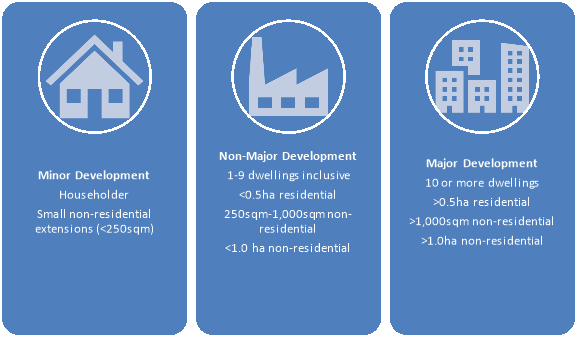
7.302A Flood Risk Assessment will be required for non-major and major development in flood zone 1 where certain size, drainage or flood vulnerability criteria as set out in Policy SC16, Practice Guidance on Flood Risk and Coastal Change and Guidance on Flood Risk Assessment in Flood Zone 1 apply[lvi].
7.303Flood Zone 3b will be protected as the functional floodplain, and its capacity to attenuate periodic flood events must not be compromised. Essential infrastructure that has passed the Exception test and water-compatible uses will be permitted within Flood Zone 3b, provided the development is designed and constructed to:
- Remain operational and safe for users in times of flooding;
- Result in no net loss of floodplain storage;
- Not impede water flows; and
- Not increase flood risk elsewhere.
7.304Unless it is otherwise directed by adopted technical guidance, the Environment Agency or Policy SC16, all Flood Risk Assessment s should follow the Environment Agency’s Standing Advice[lvii].
7.305The council may require a sequential test to be performed for any development proposals in flood zone 2 or 3, with the exception of:
- Site allocations where the sequential test has already been performed at plan making stage for the proposed use and there have been no significant changes to flood risk in the intervening period;
- Changes of use for existing buildings;
- Minor development[lviii].
7.306In some cases, it may be appropriate to apply the sequential test to non-major and major development proposals in flood zone 1 where there are flooding issues in the area of the development as identified in the Strategic Flood Risk Assessment (SFRA)[lix].
Comment point
7.307Sustainable drainage systems (SuDS) should be designed to manage surface water run off so that it mimics natural run off rates as closely as possible. Well-designed SuDS can help to avoid flooding at site level, attenuate and reduce flows to limit or improve the wider impacts of flooding, filter pollutants from surface water run-off and provide biodiversity and amenity benefits. CIRIA guidance for the design and delivery of SuDS should be closely followed when proposals are developed[lx].
7.308National Planning Policy advises that SuDS should seek to discharge into the ground through infiltration where it is possible to do so. Due to complex interactions between the groundwater table, the bedrock geology and the overall topography of the Borough it is unlikely that infiltration SuDS will be acceptable[lxi] unless it is demonstrated through a Building Research Establishment Digest 365 (BRE365) infiltration test, or other agreed testing process.
7.309Policy SC16 therefore directs applicants to a hierarchy of alternatives that should be considered in the order in which they have been presented. Under certain conditions, where the site itself or the surrounding area may have the potential for land instability, pollution or a high groundwater table, discharge into a surface water body may not be acceptable due to increased risk of environmental or flood hazard.
7.310Proposals for sites with these characteristics should conduct hydrological monitoring to inform designs. The monitoring period will usually be for six months from October – April. Sites with the potential for drainage systems to be below groundwater levels at times must be built in accordance with standards such that the risk of infiltration is minimised. This must be demonstrated by air testing of joints and at manholes as per the sewers for adoption document, or Building Regulations with the most conservative option recommended.
7.311It is recommended that work with the relevant organisations (the Lead Local Flood Authority, sewerage undertaker, Environment Agency, or internal drainage body) takes place at the earliest possible point when designing drainage plans and SuDS.
7.312Major developments provide an opportunity to ensure that surface water management measures and SuDS are well integrated into the development as a whole, potentially incorporating existing natural features within the site such as boundary landscaping or ponds. Well integrated SuDS can provide multifunctional benefits, including shade, habitat, active travel opportunities, amenity green space, and increased mental and physical wellbeing of future occupiers.
7.313Sustainable Drainage Systems (SuDS) are required for all new developments. The council will collaborate with neighbouring authorities and the Lead Local Flood Authority to ensure a unified approach to SuDS requirements, addressing cross-boundary concerns.
7.314Existing flood water management measures make an important contribution to controlling runoff rates and preventing flooding, both individually and cumulatively. Loss of such measures will therefore be resisted.
7.315To mitigate the loss of existing management measures, areas of hardstanding must incorporate surface water capture. Additionally, if the proposal is for a driveway that would require planning permission, at least 50% soft landscaping must be retained in order to safeguard natural surface water management processes and preserve green corridors[lxii].
Comment point
7.316To reduce the risk of sewer flooding, proposals should reuse or discharge grey and foul water to a foul or combined sewer and surface water managed through the following hierarchy:
- Rainwater harvesting and re-use
- Greywater capture and re-use/recycling
7.317before considering drainage to a surface water only sewer. This should be confirmed with the statutory sewerage undertaker prior to commencement. Where evidence demonstrates that all other options have been applied (or tried) and the statutory sewerage provider confirm the approach, discharge into a combined sewer may be acceptable.
7.318National Planning Policy advises that development should not result in increased flood risk elsewhere. It should be noted that in some areas of the borough, the hydraulic gradient sits above ground level. In these locations, new connections to the surface water culvert will not be appropriate as this may result in the introduction of flooding to areas that previously did not experience issues. In these locations, connections will not usually be supported nor agreed by Southern Water and alternative drainage solutions should be sought[lxiii].
7.319Some small-scale works will not require Planning Permission or Building Regulations Approval. Before starting on such works, residents and businesses are strongly advised to take appropriate professional advice. Extensions and patios/other home improvements increasing the area of impermeable surface must contact Southern Water to agree plans to manage the additional surface water runoff from the development without connecting this to the foul or combined network. Works planning to build within three metres of a public sewer must contact Southern Water to negotiate build over consent or agree a sewer diversion, regardless of whether a grant of Planning Permission is required[lxiv].
Comment point
7.320Where a proposal seeks to change the use of an existing premises, in many cases there will be a limited impact on flood risk. However, in some cases a change of use may result in the intensification of greywater discharge into the sewerage system. For example, a change from a commercial premises to a major residential development.
7.321Many of the greatest opportunities for this type of change or partial change of use are within the Hastings Central Regeneration Area, where existing sewer capacity is already experiencing incidents of exceedance during 1 in 30 rainfall events. Therefore, the capture and management of surface water is critical in ensuring that such development is sustainable and safe for its lifetime.
7.322Where a change of use proposal will result in a net increase in the volume of greywater being discharged to the sewer, compensatory surface water capture and management solutions equal to the net increase should be provided in addition to separating grey and foul water sewers from surface water sewers. This may take the form of on- or off-site mitigation measures and will be secured for the lifetime of the development by legal agreement.
7.323Surface water management measures will generally require a maintenance and management schedule, to ensure that they continue to operate as intended for their lifetime. Such a plan must be agreed by the council and secured by condition in order to safeguard their operation throughout their lifetime.
7.324As a coastal location, Hastings experiences elevated flood risk. There are areas of the borough that benefit from existing flood defences, which require maintenance or enhancement over their lifetime. Access and easements should therefore be provided to facilitate this by ensuring development is set back from existing defences and watercourses. Where a development site is adjacent to or defended by flood or sea defences, it will be expected to contribute to the maintenance, enhancement and management of these defences during its lifetime where appropriate. This may be secured through legal agreement. The lifetime of residential development is assumed to be 100 years, and 75 for non-residential development[lxv] .
Comment point
7.325It is important to ensure that risk to people or property is not increased during the construction of an approved development. Uncontrolled site flooding or surface water runoff can be a danger both to those accessing the site during development and to people and property positioned downstream. This risk comes not only in the form of the immediate flooding created through excess water, but also from the potential to spread site pollutants that have not yet been remediated.
7.326The technical standards provided through the British Standards framework, which should be used to develop solutions to flood risk following the granting of planning permission and prior to commencing development. Plans to avoid, manage and mitigate all sources of flooding and to mitigate and manage surface water runoff should be submitted to the council prior to commencement. This will be secured by legal agreement.
7.327The accumulation of debris within the sewer system can reduce capacity, cause damage to sewers and result in sewer flooding if capacity is sufficiently reduced. Sewers can be exposed temporarily during construction, resulting in an accumulation of silt, or allowing debris to enter the system. Highway gullies surrounding a site and unprotected drainage chambers can likewise be vulnerable to the introduction of silt or debris. Plans to avoid, manage and mitigate silt debris from entering the sewer system through openings, chambers, gullies or other openings should be submitted to the council prior to commencement as part of the Construction Management Plan.
Policy SC16: Flood Risk and Drainage
Flood Risk Assessments for non-major and major development
- A Flood Risk Assessment will be required as part of a planning application for any development in flood risk zones 2 and 3. Sequential and Exception Tests may also be applied.
- A Flood Risk Assessment will be required as part of a planning application for development in flood risk zone 1 that is:
- More than 1 hectare; or,
- Has been identified within the most up to date Strategic Flood Risk Assessment as being at increased flood risk in future; or,
- Where it could be affected by other sources of flooding (for example surface water); or,
- A change to a more vulnerable use and it is at risk from any source of flooding; or,
- Identified as having critical drainage problems.
- Flood Risk Assessments must incorporate flood threshold checks.
- Flood Risk Assessments should follow the Environment Agency’s Standing Advice.
Surface Water Management and Sustainable Drainage Systems (SuDS)
- Proposals must incorporate Sustainable Drainage Systems (SuDS) and manage surface water run off to ensure there is no increase to runoff rates and flood risk is not increased elsewhere.
- Major developments should ensure that water management and drainage systems form an integral part of the built form and landscape design[10], and seek to safeguard existing natural or engineered surface water management measures and drainage routes.
- Proposals involving the loss of existing natural or engineered surface water management measures will be resisted. To prevent the long-term impacts of cumulative loss:
- New areas of hardstanding must include or be offset by appropriate compensatory surface water management measures;
- The council will only support applications for parking in front or rear gardens where at least 50% soft landscaping is retained.
- Designs for surface water management should follow this discharge hierarchy:
- Store rainwater close to the point of collection, ideally in conjunction with urban greening interventions for reuse on site;
- Attenuate to slow the flow of surface water prior to;
- Discharge directly into surface water bodies (see 9), or, if evidence demonstrates all options have been exhausted and this cannot be achieved sufficiently to prevent surface water run-off from the site;
- Attenuation measures to slow the flow of surface water prior to;
- Discharge directly to the public surface water sewer system, subject to agreement from infrastructure providers;
- Discharge directly into the public combined sewer system, subject to agreement from infrastructure providers.
- Where measures designed to discharge into a surface water body impact upon:
- Land that may be subject to instability; or,
- Polluted land; or,
- Sites identified as containing a high groundwater table.
- Drainage designs that seek to discharge into a surface water body will require appropriate hydrological and hydrogeological monitoring before approval.
- Drainage designs that discharge directly into the ground (infiltration) will not normally be supported, except where it is demonstrated to be acceptable using an agreed testing process.
- Drainage designs that seek to connect to the surface water sewer system in areas where its hydraulic gradient is above ground level will not normally be supported to prevent the creation of new flood points.
- Proposals must not negatively impact on the functionality of the surface water drainage system, nor prevent future maintenance or enhancement work from taking place.
- Proposals involving change of use that would result in a net increase of greywater discharge should seek to ensure that surface water offsetting equal to the increase is provided. This may be secured through both onsite or off-site provision either down or upstream where this will alleviate pressure on the affected sewer system.
- Drainage designs must be accompanied by an agreed maintenance and management plan for their lifetime, to be secured by condition.
General Principles
- Development adjacent to or protected by flood and/or sea defences will be required to protect the integrity of existing defences, contribute to new defences where appropriate and be set back from the banks of watercourses and their defences to allow their management, maintenance and upgrading including Natural Flood Management measures.
- All non-major and major development proposals must provide a construction management plan detailing:
- Flood avoidance, management and mitigation measures in line with BS 8533 or their successor; and,
- Surface water management and mitigation measures in line with BS 8582 or their successor; and,
- Measures to prevent the silting of, or introduction of debris to, sewers, drainage chambers or gullies.
[10]GBI study 6.5.4 (role of boundary treatments); and P46 ‘integrate water management systems’
Policy SC17: Coastal Change Management
7.328It is understood that development in the coastal strip can be a complex undertaking, with a number of different consenting processes in place. In addition to supporting sustainable development, this Policy aims to simplify the process by providing clear guidance where the Local Planning Authority is acting as first point of entry in line with the provisions of the Coastal Concordat for England[lxvi].
7.329Hastings is located on the South-East Coast, with approximately 12km of coastline, 5km of which is a developed frontage protected by sea walls and groynes which help to retain the shingle beaches. 2.2km of the developed frontage forms part of a two-tier concrete promenade from Carlisle Parade in the East to Marine Court in the West.
7.330A further 5km of coastline to the East of the developed area is composed of sandstone and clay cliffs, which are designated a Site of Special Scientific Interest (SSSI). The remaining 2km to the West is low lying and includes an area of functioning flood plain within the Combe Valley Countryside Park SSSI.
7.331The Borough has two areas of beach serviced by lifeguards in the high season to which visitors and residents are principally directed for leisure use: Pelham Beach, which is a specially designated family beach, and Marina which is popular for both bathing and water sports. To the East of the Borough is the fishing quarter, home to Europe’s largest beach-launched fishing fleet and associated plant, machinery, storage and commerce.
7.332Hastings lifeboat station is situated on the beach to the West of the Harbour Arm at The Stade and currently houses one Shannon Class and one D Class lifeboat, as well as associated plant and machinery.
7.333Hastings seafront includes both a large portion of the resort area and number of heritage assets, many of which hold Listed Asset status including the Grade II listed Carlisle Parade Carpark, shelters and sunken gardens, some of which is within the subterranean area created through the construction of the seawall. Nine of the Borough’s eighteen conservation areas intersect the seafront.
7.334The resort area is also located on the seafront and caters to both residents and visitors. Attractions include the built and natural heritage character and historic context of the town, the beach, play spaces, amusements, aquarium, beach huts, bars, restaurants and cafes. Access to the resort area is provided through the main A259 trunk road that runs parallel to the seafront and National Cycle Route 2 that runs alongside the A259. Four carparks for use by residents and visitors and providing a total of 1,041 spaces are positioned to the South side of the A259: Rock-a-Nore (450 spaces), Pelham Place (276 spaces), Marina (97 spaces) and Grosvenor Gardens (7 spaces). An additional two subterranean carparks Carlisle Parade (171 spaces) and The Pier (40 spaces) occupy space under the A259, behind the promenade.
7.335Other infrastructure and assets that occupy space within the coastal strip include the Ashford – Brighton railway line, utilities infrastructure, public conveniences and changing spaces (including accessible Changing Places provision), medical facilities and storage.
7.336This economically, ecologically, historically and infrastructurally important area is likely to undergo significant change during the lifetime of the plan and beyond, accelerated by the effects of climate change including sea level rise and extreme weather events. The National Planning Policy Framework recommends that areas likely to be impacted by the effects of physical changes to the coast over both short and long-term time periods should be designated as a Coastal Change Management Area (CCMA)[lxvii].
7.337A review of evidence related to flood risk and coastal change identifies the potential for Hastings shoreline and intertidal area to be significantly impacted by the effects of coastal change between 2025-2105[lxviii]. This will include loss of parts of the beach and increased impact on or loss of built and natural seafront assets, including car parking spaces, visitor attractions, conference facilities, subterranean assets, play spaces, sports facilities and active travel routes. Impacts could include these assets being inaccessible for periods of time due to safety concerns, increased marine pollution through inundation and retreat of water from polluted surfaces, damage to facilities and loss of business income due to periods of closure either for safety reasons or to remediate damage to premises.
7.338The designated CCMA extends from Fairlight Cliffs (East of Coastguard Lane) to Glyne Gap on the border with neighbouring Rother. The CCMA area includes existing buildings and infrastructure and is shown on the Policies Map.
7.339In line with the National Planning Practice Guidance, new residential development including change of use would be inappropriate in the CCMA and therefore proposals will not be permitted[lxix]. In order to minimise constraints to new residential development as a result of this designation, care has been taken to designate only those areas with the greatest physical, economic, infrastructural and social risk as a result of coastal change and to avoid existing sites currently in use as dwellinghouses.
7.340Essential infrastructure as identified in Annex 3 of the NPPF is appropriate in a CCMA provided any negative impacts on coastal change or the safety of the infrastructure itself arising from coastal change can be appropriately managed. This includes impact further along the shoreline as well as in the immediate area.
Comment point
7.341In areas of the CCMA already at risk of severe impacts of coastal change within the next 20 years, certain types of development may be appropriate provided it can be demonstrated that the development will be safe throughout its lifetime and will not have unintended harmful impacts on coastal change. This would include development directly linked to coastal tourism such as beach huts, cafes, car parks, holiday parks and short-let caravan or camping sites. In all cases, permissions would be time limited to reflect their temporary nature and the need to remediate the site once the permission expires. There is the potential for permission to be renewed provided, once again, the development can be made safe throughout its lifetime.
Comment point
7.342In the medium and long term (21-100 years), other time limited development linked to the coastal strip such as hotels, shops, offices or leisure activities that will provide economic and social benefits to the community may be supported as long as it can be demonstrated that it will be safe throughout its intended lifetime, can be appropriately remediated once the permission expires, and will not have unintended harmful impacts on coastal change. There is the potential for permission to be renewed provided, once again, the development can be made safe throughout its lifetime.
7.343An important part of the character of Hastings comes from the natural environment and built heritage. The CCMA interacts with a number of conservation areas and heritage assets, and the preservation of these assets through adaptation and mitigation against the impacts of sea level rise and coastal change will be important both economically due to their value to the tourist economy and in order to preserve the character and amenity of the seafront.
Comment point
7.344Many natural assets, including amenity green space, Local Wildlife Sites, and formal gardens may be able to be adapted to mitigate and manage the negative impacts of coastal flooding in particular while still fulfilling their core function preserving local amenity and providing habitat.
7.345There is also potential for development in the CCMA to impact on a number of designated sites within the intertidal or coastal area, including the Combe Haven and Hastings Cliffs to Pett Beach SSSI, the intertidal Marine Conservation Zone (MCZ) and the Dungeness, Romney Marsh and Rye Bay Special Protection Area (SPA). A proportionate assessment of ecological impact should be included as part of any proposal, alongside or as part of a coastal change vulnerability assessment to ensure the development is protected from the effects of coastal change during its lifetime and will not result in harm to intertidal or coastal habitats.
7.346Where a proposal includes coastal and/ or flood defence works, Natural England should be consulted at an early stage in order that any identified potential environmental impact on marine designated sites will be addressed.
7.347As coastal change progresses over the lifetime of the plan and its successors, existing uses within the CCMA may become unsustainable and unviable in their current location due to the impacts of coastal change. Being able to direct the relocated assets to locations outside of the CCMA and guaranteeing the reinstatement of the existing site ensures the use continues to be supported and pollution of Marine habitats from abandoned sites is avoided.
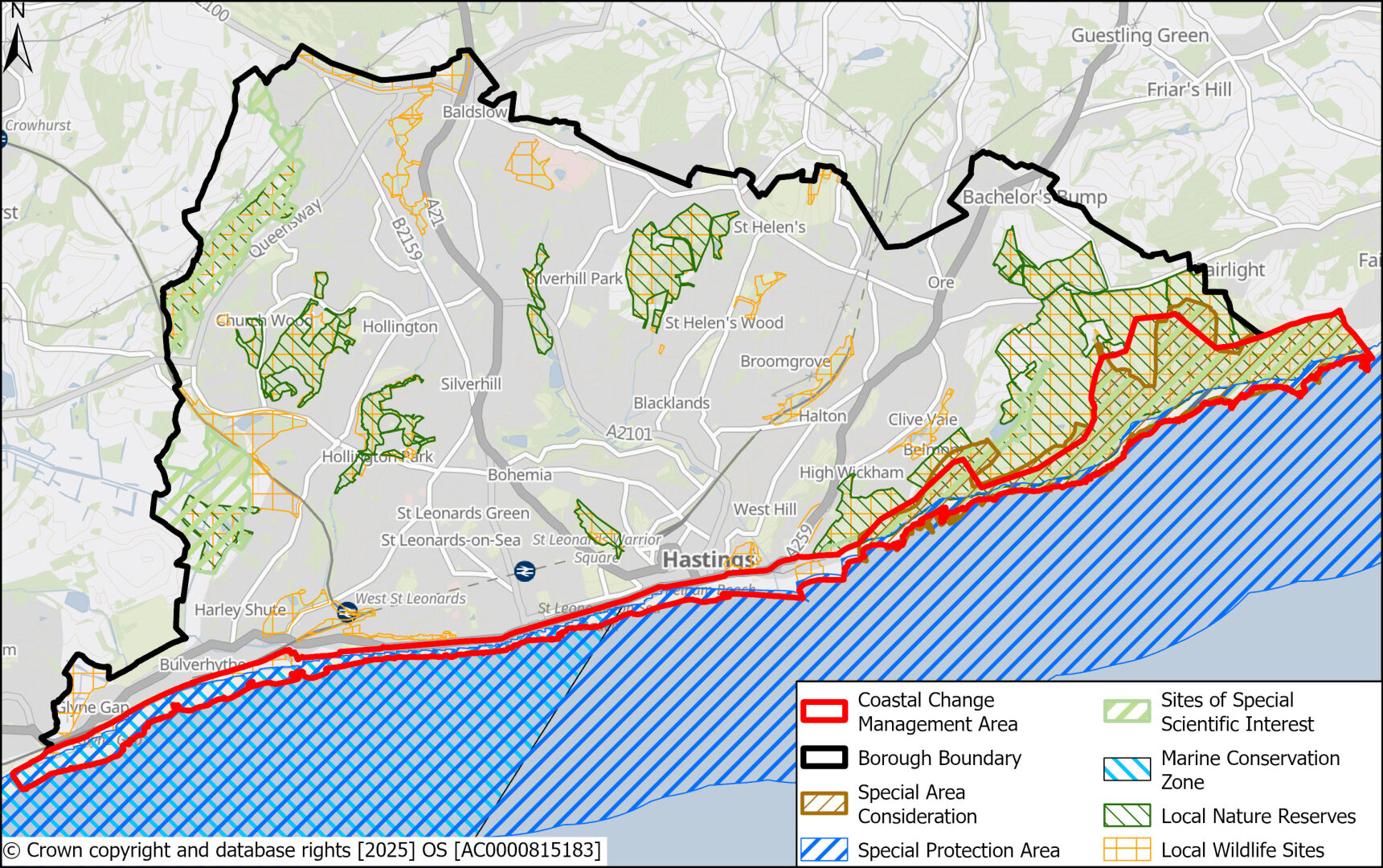
Policy SC17: Coastal Change Management
- The Fairlight Cliffs to Glyne Gap Coastal Change Management Area (CCMA) as identified on the policies map will be a material consideration in the determination of planning applications.
- New residential development, including changes of use, will not be permitted in the CCMA.
- Essential infrastructure may be permitted in the CCMA provided there are clear plans to:
- Manage any impact on Coastal Change arising from the development; and
- Ensure it is safe over its planned lifetime.
- Other development may be permitted in the CCMA where it is supported by a proportionate coastal change vulnerability assessment and, where necessary, an ecology report which demonstrates that development will:
- Be safe over its planned lifetime without increasing risk to life or property and does not require new or improved coastal defences;
- Not restrict natural processes, communities or the character or designations responding to the impacts of climate change;
- Not accelerate the rate of shoreline change elsewhere;
- Not result in harm to coastal and intertidal habitats.
- Proposals to conserve natural and built heritage assets within the CCMA will be supported provided that:
- The character of the asset is conserved or enhanced and;
- The proposal incorporates appropriate adaptation and mitigation measures.
- Applications to relocate development outside of the CCMA will be supported provided:
- The existing development is lawful;
- The site for the proposed development is outside of the CCMA as shown on the policies map;
- The type, scale and location of the proposed development is consistent with other policies within this plan;
- A site restoration plan for the existing development within the CCMA is provided.
Policy SC18: Pollution and Hazards
7.348Development has the potential to result in negative environmental impacts both during construction and when occupied. New development can also be impacted by existing pollution and hazards. Pollution and hazards can include pollution from airborne particles, contaminated land, and also hazards created by additional risks to property, the environment and people such as flooding, misconnections, or harm to habitats.
7.349It is not just obviously hazardous substances that can result in the pollution of land, air or water. Any substance that is not naturally found within an environment has the potential to cause pollution. Even natural substances are capable of polluting where they are out of their normal environment[lxx].
7.350Development can have impacts on air quality during the demolition and construction phase through the release of dust and particles and then ongoing once development is completed in the form of emissions from transport movements and loss of existing green infrastructure. There is also the potential for negative impacts on occupiers of completed developments through airborne contaminants as a result of pre-existing uses in the nearby area, such as roads or industrial processes. Where air quality is negatively impacted it can result in serious harm to health and wellbeing, including loss of life.
7.351Air quality in Hastings is generally good, with the 5-year trend indicating a decline in NO2 concentrations. However, air quality fluctuates, and applications should be guided by the most recent available data. Particular focus will be placed on improving air quality and mitigating the effects of poor air quality for everyone, as this will contribute to UN Sustainable Development Goal 3 ‘Ensure healthy lives and promote well-being for all at all ages’.
7.352Land that may already be polluted can carry risks to health, and in some cases and soils are the final destination for polluting substances. Some of these pollutants break down in soil over time, while others cannot be removed without active remediation. Pollutants also have the potential to accumulate in soil over long periods[lxxi], meaning that some pollution may arise from historic uses, or be present due to natural processes. This means that the last known use of the land may not be the only indicator of the presence of pollutants.
7.353Land that is found to be polluted can require different levels of remediation depending on the proposed use of a site, and care should be taken to ensure that land within the proposal site and in the surrounding area that is currently free from contaminants is protected from their introduction both during construction and after completion. The borough has complex hydrological and hydrogeological interactions, and therefore the potential for land to be polluted is not limited to previously developed land, and ground investigations should take place except where the site is unlikely to be polluted, and the development and associated environment is not sensitive. Protecting land from pollution contributes to the UN Sustainable Development Goal 3 ‘Ensure healthy lives and promote well-being for all at all ages’.
7.354Where a proposal includes a use that is potentially polluting, involves the storage of hazardous substances, or may produce contaminated water, environmental permits or compliance with wider regulations may be necessary in addition to the granting of planning permission[lxxii].
7.355Any liquid waste produced by a business, industrial process or building site may be considered trade effluent, including groundwater dewatering and building site discharges.
Comment point
7.356Contaminated water should not be disposed of through any drain without first ensuring the appropriate environmental permit or trade effluent consent (temporary consents can be granted by the statutory wastewater undertaker for construction activity) is formally agreed for the nature of discharge that the contaminated water relates to. Surface water drains should be protected from site run-off at all times as these can lead directly to water courses, causing pollution[lxxiii].
7.357Protecting surface water and groundwater quality contributes to the UN Sustainable Development Goal 6 ‘Ensure access to water and sanitation for all’, to Goal 14 ‘Conserve and sustainably use the oceans, seas and marine resources for sustainable development’ and to Goal 3 ‘Ensure healthy lives and promote well-being for all at all ages’. This may mean carrying out work over and above that required to make the land suitable for the proposed development and to protect human health.
7.358In Hastings, surface water and groundwater interactions are complex, with much of the Borough highly vulnerable to surface pollutants entering groundwater through the aquifer[lxxiv]. Pollutants can likewise enter watercourses or surface water sewers through overland flow, inadequate filtration or improper discharge practices. Both the Combe Haven and Hollington Stream are currently classified as having ‘poor’ water quality[lxxv]. Groundwater quality is currently classified as ‘good’, and this standard should be maintained.
7.359Proposals should seek to improve water quality[lxxvi] where possible and prevent pollution from entering watercourses or groundwater through natural solutions, engineered solutions or a combination of both. Watertight foul systems are crucial for preventing leakage in areas vulnerable to pollution and ground deformation as a result of infiltration, such as locations with a high groundwater table. Examples include the use of fusion jointed MDPE pipes and mass concrete surrounds to inspection chambers, which can prevent ground water infiltration and are easy to maintain.
7.360Hastings benefits from a number of designated sites that are vulnerable to the effects of both water quantity and quality. These include the Marline Valley Woods SSSI, an ‘irreplaceable habitat’ made up of ancient ghyll woodland, sandstone outcrops and low-lying meadow and Combe Haven SSSI, which includes fen vegetation, alluvial meadows and reedbed. The Combe Haven SSSI also includes areas of functioning flood plain.
7.361Due to the compact nature of the Borough, development has the potential to fall within the Impact Risk Zone (IRZ) of one or more SSSI. The SSSI IRZs can help identify whether a proposal is likely to affect a SSSI and choose whether to seek pre-application advice from Natural England.
Comment point
7.362Development in Hastings has the potential to impact the water quality of the Dungeness, Romney Marsh and Rye Bay Special Protection Area (SPA) due to the complex hydrological interactions serving the area.
7.363The South of the borough borders the South Marine Plan area and includes a designated Marine Conservation Zone (MCZ)[11] protecting both habitats and species. In addition to impacts on habitat, much of the economic and cultural prosperity of the south marine plan areas is reliant on water quality.
Comment point
7.364Due to the geography and topography of the Borough, watercourses and surface water can discharge directly into the MCZ in a number of locations. Likewise, tidal influences can impact on groundwater and create areas of ‘tide locking’ under certain conditions. This creates the potential for flooding, the introduction of marine pollution to rivers and groundwater, and land pollution to rivers and seas as floodwater recedes[lxxvii]. The SFRA identifies these interactions as becoming significant at the bottom of the Combe Haven catchment, within the SSSI.
7.365In line with the South Marine Plan[lxxviii], proposals should seek to manage impacts on, and in preference improve, water quality and the habitats and species which benefit water quality through the ecosystem service they provide.
7.366Development near major hazard sites (including high pressure gas mains) and overhead electricity distribution lines can carry considerable risk of injury or death, not only to those working on site during the development process, but also to others. Therefore, the council will need to notify appropriate bodies where development related to or nearby to these uses.
7.367Every year, people are killed or seriously injured when they come into contact with overhead distribution lines. Proposed developments within 10m of overhead distribution lines should be able to demonstrate compliance with GS6 guidance or its successor[lxxix]. Where it is intended that buildings should be positioned under the current route of a distribution line, alternative routes for the line should be examined with the owner of the infrastructure.
7.368Major hazard sites refer to sites and infrastructure around which Health and Safety Executive consultation distances to mitigate the consequences to public safety of major accidents may apply. The council will consult with the HSE where a proposal within the Consultation Distance (CD) of major hazard installations, complexes and pipelines and where it involves:
- Residential development of any size;
- More than 250 sqm of Retail or non-specific Class E floorspace;
- More than 500 sqm of Office floorspace;
- More than 750sqm of industrial floorspace;
- Transport links, including major road and railways;
- A material increases in the number of persons working within, or visiting, a CD where the proposed development is within the CD;
- Other types of development that may result in an increased likelihood of a major accident or incident.
7.369For high pressure gas mains (operating pressure between 7bar – 16bar), the guidance set out within the Pipeline Safety Regulations 1996 (PSR)[lxxx] or their successor should be observed and followed appropriately. The location of underground pipelines should be considered when carrying out building, excavation or dumping or other such work, as such activities may either cause damage to pipelines or prevent access to them for maintenance purposes.
Policy SC18: Pollution and Hazards
- Development will minimise and mitigate pollution and hazards and seek to improve air and water quality during both the construction and operation phases of development. To protect human health, wildlife, water and land quality, development is required to:
- Meet or exceed the standards set out in the Air Quality and Emissions Guidance for Sussex, including promoting the use of low or zero emission transport and reducing the reliance on private motor vehicles;
- Incorporate appropriate pollution control measures where necessary to protect ground and surface waters, and;
- Incorporate appropriate measures where necessary to remediate or protect land from pollution or contamination.
- Applicants must supply convincing supporting evidence appropriate to the scale and nature of the proposal that any actual or potential pollution or hazard can be overcome through appropriate remedial, preventative or precautionary measures.
- To protect and enhance air quality, an Air Quality Impact Assessment (AQIA) must be provided alongside proposals for:
- Major development;
- Development within or with the potential to impact on an Air Quality Management Area;
- In an area close to exceeding the Air Quality Objectives;
- B8 storage and distribution use class with a floorspace of 500sqm or more;
- Development that is located close to areas of wildlife sensitivity;
- Other commercial uses with high volumes of transport-related movements.
- Development proposals should undertake site investigation for contaminants, except where there is unlikely to be contamination or pollution, and the development and associated environment is not sensitive. This should be evidenced through suitable ground investigation reports. Where land is found to be contaminated or polluted, remediation proposals must be agreed before permission is granted.
- Development proposals involving contaminating uses or processes, including the storage of potentially contaminating substances or materials, may not be acceptable within or in close proximity to populations and environmentally sensitive locations, including water quality sensitive designated sites.
- To protect water quality, development proposals must:
- provide extensive drainage plans for the site;
- incorporate multifunctional SuDS systems wherever possible and appropriate to do so;
- phase occupation of the development with any reinforcement of the local sewer network identified as needed to provide capacity for the new development. Early engagement with the statutory wastewater services provider is encouraged;
- be accompanied by the appropriate environmental permits and/or trade effluent consents, where necessary including grease and sediment traps where the proposal creates contaminated washwaters[12];
- include an oil separator where the proposal creates a risk of oil contamination[13].
- Proposals for locations with high groundwater should also ensure they install a watertight foul system in their development.
- Development proposals should consider the location of overhead distribution lines and major hazard sites, including high pressure gas mains. The council will consult with the Health and Safety Executive and other relevant bodies where development is proposed within 10m of an overhead distribution line or within the Consultation Distance of a major hazard site.
- Proposals for buildings under overhead distribution line routes must observe the following hierarchy to prevent risk to occupiers:
- Replace with underground cables; or if not possible,
- Permanently divert the distribution line; or if not possible
- Allow appropriate levels of clearance as set out in the ENA Technical Specification 43–8 Overhead Line Clearances.
- Easements to provide access to major hazard sites and distribution lines will be maintained at all times.
- All major and minor development proposals must provide a construction management plan including details of how any risk of pollution and hazard relevant to the temporary condition of the site will be addressed and mitigated.
- All major and minor development must provide a maintenance and management plan in relation to any pollution mitigation measures for the lifetime of the system.
- Evidence provided with applications in relation to this Policy must be from a relevant and suitably qualified professional.
[12] Food preparation/ production/ commercial kitchens, commercial laundries, commercial cleaning services, hairdressing, pet grooming.
[13] As defined:
- car parks larger than 800m2 or for 50 or more parking spaces
- smaller car parks that discharge to a sensitive environment, such as a marsh that has been designated as a nature reserve
- vehicle maintenance areas
- roads
- refuelling facilities
Policy SC19: Environmental Nuisance
7.370Development can result in a number of negative environmental impacts, both during development and after the development is completed. These collectively and individually are referred to as pollution, hazards and environmental nuisance within the policies of this plan. Environmental nuisance can include unwanted, inappropriate, excessive or harmful light, odour, noise and vibration. Flooding, landslide, pollution and hazards are covered in more detail elsewhere within this plan.
7.371Noise nuisance takes the form of unwanted sound and includes vibration. Noise can arise from construction activities involved in the delivery of new development or be ongoing as an attribute of the occupied premises or use. In order to protect amenity, proposals will need to include a suitable assessment and propose acceptable mitigations[lxxxi]. Where a development is proposed close to an existing source of noise or vibration – for example, near a railway line or a live music venue – then the developer as the agent of change will need to show how they will mitigate for this while still delivering an appropriate level of amenity for occupiers[lxxxii].
7.372Unwanted odours can likewise impact on the amenity of occupiers. As with noise, there the potential for unwanted odours from construction activities involved in the delivery of new development or be ongoing as an attribute of the occupied premises or use. In order to protect amenity, offensive odour producing uses will need to demonstrate an acceptable scheme of mitigation measures can be adopted. Where a development is proposed close to an existing source of odour – for example, waste treatment works, livestock or commercial food processing – then the developer as the agent of change will need to show how they will mitigate for this while still delivering an appropriate level of amenity for occupiers[lxxxiii].
7.373Sensitive development within 500m of the Wastewater Treatment Works (WTW) should carry out an odour assessment in consultation with Southern Water to agree the 1.5 OdU contour, within which no sensitive development should be located[lxxxiv]. The assessment should be carried out to determine and agree and area of adequate separation between the works and any sensitive development[lxxxv].
7.374Light pollution takes the form of unwanted, inappropriate or excessive artificial lighting. It can be a source of annoyance to people, harmful to wildlife and undermine enjoyment of the countryside or the night sky. Development proposals should ensure that lighting schemes are appropriate for the development, and that where there is the potential for harm that appropriate mitigations are in place. A lighting assessment may be a useful tool for major developments to inform a suitable lighting scheme.
Comment point
7.375All development with external lighting should meet or exceed Institution of Lighting Professionals guidance for the environmental zone in which the development is set to take place – not what it will become. By limiting external lighting to 3000k CCT (correlated colour temperature), harmful impacts on invertebrate pollinators are reduced as are the negative impacts on nesting birds and bats where lighting of 500 lumens or more is fully shielded. Reducing blue light can minimise light spill into protected areas such as Local Wildlife Sites, SSSIs and neighbouring homes. Light spill can further be reduced by ensuring that external lighting is in the right place and on at the right time, and through appropriate glazing solutions. A lighting plan for both the use of site illumination during construction and the mitigations that are proposed for the completed and occupied development will ensure that harmful impacts of excessive lighting are avoided throughout.
7.376The High Weald National Landscape Area of Outstanding Natural Beauty Planning Technical Advice Note: Dark Skies in the High Weald[lxxxvi] provides detailed guidance for planners and developers on delivering good lighting design and should be used alongside this Policy when considering lighting schemes.
Policy SC19: Environmental Nuisance
- Development will minimise and mitigate environmental nuisance during both the temporary and permanent condition of development. To protect human health and wildlife, development is required to:
- Control and mitigate odour, noise and vibration arising from both the construction and occupation of the development and any impact on neighbouring uses;
- Minimise and mitigate light intrusion where this would otherwise result in nuisance or loss of amenity and demonstrate that all opportunities to reduce light pollution have been taken.
- Proposals that are likely to result in a new source of noise or vibration when operational, will require an agreed noise assessment and report following the approach set out in the Planning Noise Advice Document: Sussex 2021 or its successor. Mitigation proposals for noise and vibration must be agreed before permission is granted.
- Proposals that are likely to result in a new source of offensive odour when operational, will require a mitigation strategy which must be agreed before permission is granted. Mitigations where development is proposed within 500m of existing Wastewater Treatment Works must be developed on the basis of an odour assessment undertaken in consultation with Southern Water.
- Proposals that may be negatively impacted by the effects of existing sources of odour, noise or vibration must provide suitable mitigations that will not in themselves compromise the amenity value of the proposal, to be agreed before permission is granted.
- Proposals should avoid or mitigate the impact of light pollution by:
- Limiting outdoor lighting to 3000k CCT (correlated colour temperature) or less, except where specific standards require a higher CCT, and;
- Fully shielding any outdoor lighting above 500 lumens, and;
- Avoiding light above the horizontal, and;
- Applying suitable mitigation measures, such as proxy sensors or timers, and;
- Avoiding outdoor lighting with a high spectral content of blue light, and;
- Reducing light spill from interiors where possible through use of suitable glazing.
- A lighting plan for both the temporary and operational condition of the proposed development must be agreed before permission is granted.
- All major and minor development proposals must provide a construction management plan including details of how any risk of environmental nuisance relevant to the temporary condition of the site will be addressed and mitigated.
Policy SC20: Community Facilities
7.377Community facilities include buildings used or last used by local people for community purposes. This can include community halls, community centres, meeting rooms, youth centres, social clubs and church halls. Other community facilities, such as open space, built sports facilities and playing pitches are covered in Policy ID2.
7.378The council will seek to protect community facilities and support their extension or enhancement to ensure they remain able to meet the needs of local communities both now and in the future.
7.379Community facilities include buildings used or last used by local people for community purposes. This can include community halls, community centres, meeting rooms, youth centres, social clubs, libraries, day nurseries, isolated retail premises or parades outside of the town centre hierarchy, public houses, church halls and other facilities as defined in National Planning Policy. Other types of community facilities, such as open space, built sports facilities and playing pitches are covered in Policy SC14.
7.380Grassroots community facilities primarily provide access to social capital for the communities they serve and also enable diverse groups to access community organisations and services. The ability to access social capital is an important component in levelling up communities and reducing deep-seated generational inequality. Maintaining access to physical locations is important. An online gathering place is not a community hub.
7.381In some cases, the role of a community hub may be either formally or informally performed by a commercial facility including public houses, local shops, or social clubs. Day nurseries provide a broader role, allowing children below mandatory school age to build social capital and enabling their parents and carers to access employment or educational opportunities beneficial to the economic wellbeing of the household.
7.382A shortage of day nursery places in Hastings has been identified through the IDP process. Although day nurseries currently sit within use Class E, and are considered a town centre use, it is beneficial for day nurseries to be located in areas outside of the town centre hierarchy near to schools, community centres, workplaces, and residential areas. However, it is understood that not every Class E use would be appropriate in these locations without causing harm to amenity. To protect the supply of day nursery accommodation, preserve amenity and support the function of the town and district centres, new day nurseries will have changes of use to others within their class restricted by condition.
7.383Access to community facilities should also be viewed in the context of the council’s duty under s149(3) of the Public Sector Equality Duty and proposals that may impact negatively on protected characteristic communities must demonstrate how this impact will be mitigated. Where a proposal may result in loss of a community facility, applicants are encouraged to work with the community to understand its value to local people and identify appropriate mitigation measures.
7.384In some cases, as part of a wider development proposal, existing social infrastructure may be reprovided in order to optimise the layout or to consolidate a number of smaller infrastructure elements into a single provision. Where this is the case, the reprovided social infrastructure must continue to meet the local needs of the community it serves, and replacement facilities should be occupied prior to the operational loss of the original. Where a temporary provision is provided during the construction phase, the operational loss is considered to be the cessation of activity within the temporary premises.
7.385For proposals that would result in the outright loss of a commercial community facility, information demonstrating that the use is no longer viable must be provided alongside evidence of an appropriate marketing campaign.
7.386Viability assessments should demonstrate that:
- the existing or recent business is not financially viable, as evidenced by trading accounts;
- for the last three years in which the business was operating as a full-time business;
- a range of measures were tried during this time to increase trade and diversify use;
- the potential for the property to extend the range of facilities offered at the site has been fully explored;
- for public houses, the CAMRA Public House Viability Test, or a similar objective evaluation method, has been employed to assess the viability of the business and the outcomes show that the public house is no longer economically viable.
7.387Marketing campaigns should demonstrate:
- That the facility has been marketed for a minimum of 10 consecutive months;
- Flexibility of tenure;
- It has been marketed by an agent specialising in this type of facility;
- It has been marketed with a high-quality campaign, including the use of accurate interior and exterior photos that reflect the current condition and detailed particulars including estimated potential turnover, dimensions, access and restrictions;
- That there are detailed records of enquiries relating to the premises over the marketing period.
Policy SC20: Community Facilities
- Proposals for the provision of new community facilities or enhancement and/or extension of existing facilities will be supported, provided that the development is acceptable in terms of location, design, access and impact on the locality.
- To safeguard opportunities for sufficient early years provision, day nurseries permitted in line with this Policy will be secured through a planning condition. This will have the effect of removing changes to other uses within the same planning use class without a planning consent.
- Planning applications involving the loss of a community facility will only be permitted where it can be demonstrated that the existing community use is either:
- no longer required; or
- proposals for its replacement are included in the application; and
- that negative impacts on protected characteristics under the Equalities Act 2010 have been identified and mitigated where the facility is predominately used by a protect characteristic community.
- Applications that would result in the loss of a commercial community facility must demonstrate that it is no longer commercially viable and cannot be made so.
- Where a proposal includes the replacement of a community facility, the replacement facility should reach occupation phase prior to the operational loss of the existing facility. This may be secured by condition.
- Proposals involving the loss of a shop or service outside of defined commercial areas will not usually be supported due to the vital role they play in community cohesion and placemaking.
Part four - Infrastructure and Delivery
7.388To ensure development in Hastings is sustainable, the plan must show that the infrastructure needs of new developments are identified, and steps are taken to ensure that these needs are met. Infrastructure is a broad term and covers a range of areas including:
- Schools, education and skills provision;
- Libraries;
- Open space, play facilities;
- Playing pitches and sports facilities;
- Waste and recycling;
- Burial plots;
- Transport infrastructure, including roads, rail, foot and cycle paths;
- Primary healthcare, like hospitals and Drs surgeries;
- Emergency services, like police, fire and ambulance;
- Electricity, gas, water and sewerage.
7.389The Infrastructure Delivery Plan (IDP) is the council’s assessment of the infrastructure needs arising from the development proposed in the plan and identifies priority projects that will need to come forward to enable sites to come forward if it is not in place already.
7.390The IDP is developed with a range of partner agencies and infrastructure providers named within the document and is a living document, with regular updates at different points in plan making and annually thereafter.
7.391Where a site or broad location is identified as having specific infrastructure requirements above and beyond the global requirements set out within the policies of this plan that apply to all sites, it is set out in the site Policy itself. An example would be a requirement for a new playpark on a site instead of a financial contribution.
Policy ID1: Planning Obligations
7.392In order to deliver the level of growth associated with Policy SP1, the Plan must also facilitate the delivery of necessary infrastructure, services and facilities required to support the level of growth over the plan period. All new development has a responsibility to contribute towards the cost of new infrastructure.
7.393Infrastructure is often funded by developers either through planning obligations or the Community Infrastructure Levy. Planning obligations, also known as developer contributions or Section 106 agreements, are bespoke agreements made between the Council and the developer where the developer either delivers new infrastructure or contributes to funding infrastructure to meet the needs resulting from that development. The Council does not currently have a Community Infrastructure Levy in place, so any development contributions required will be secured through Section 106 Legal Agreements supported by section 278 highway agreements led by the Highway Authority, or planning conditions as appropriate.
7.394Infrastructure is provided by a range of organisations. As part of the Local Plan preparation process, the Council engaged with infrastructure providers and undertook a number of studies to understand the range of infrastructure needed to support the Spatial Strategy as set out in SP1. As part of this work, an Infrastructure Delivery Plan (IDP) has been prepared which identifies the infrastructure required to support the Plan’s delivery.
7.395The IDP is an iterative and ‘live’ document. It will be updated on a regular basis, in accordance with most recent infrastructure service provider plans and updated evidence. Liaison with the service providers will continue beyond the adoption of the Plan.
7.396The Council and other infrastructure providers, will identify and secure sources of funding to support the delivery of necessary infrastructure, including public sector monies and grant funding. However, there is an expectation that developers contribute towards or potentially deliver infrastructure improvements where these are required to make a development proposal acceptable. Funding may take the form of on and off-site physical infrastructure or a financial contribution depending on the needs of the development.
Affordable Housing
7.397There is a high proportion of residents that require some type of affordable housing. As such, affordable housing must be provided on all developments or delivered elsewhere through financial contributions. Contributions agreed in this way through Section 106 agreements will go towards the delivery of council homes.
7.398Where agreement has been reached during the planning application stage on providing less than the full on-site affordable requirement, any reduced affordable housing contributions will be subject to a review mechanism. Property markets do experience change at both the local and national level.
7.399The viability of a scheme may therefore be notably different by the time of implementation due to changes in market conditions; and uncertainties in relation to aspects of a viability assessment at the application stage. In considering viability matters, regard will be had to best practice, particularly as set out in National Planning Practice Guidance (NPPG).
7.400In order therefore, to ensure that the maximum reasonable level of affordable housing is provided, and that other plan requirements are met, the council will require a viability review mechanism through planning condition/obligations on all residential / mixed use schemes which do not meet the affordable housing requirement and / or policy requirements in full at the time permission is granted. Viability reviews will determine whether a development is capable of providing additional affordable housing or meeting other unmet policy requirements.
Securing Small Site Contributions (Less than 9 dwellings)
7.401Changes to the CIL Regulations in 2019[lxxxvii] now allow for more than five contributions to be pooled together, this is an important change in securing Section 106 funding from smaller sites.
7.402The council is pursuing a strategy of significant densification as set out within the Spatial Strategy. Due to the existing built form and character of the borough, it is anticipated that a substantial quantity of smaller sites will come forward during the life of the plan both as site allocations and as Windfall. The Spatial Strategy acknowledges that smaller sites may be capable of delivering at densities in excess of the Density Zone (Strategic Policy 1 (SP1): Directing Growth – a Spatial Strategy) in which they are located.
7.403An important pillar of the Spatial Strategy is ensuring that all policies within the Plan reinforce the need to achieve appropriate densities. No Policy, alone or cumulatively, should restrict, discourage, or incentivise delivery at densities that would fail to contribute positively to housing need. Financial mechanisms in the plan must not reward under‑utilisation of land, and where a site is viable, policies should favour effective land use.
7.404Due to the level of development small sites are expected to deliver over the lifetime of the plan, their cumulative infrastructure needs are likely to result in additional impacts and stress on local systems that together may require contributions towards improving local infrastructure that should be pooled to ensure their effect is mitigated.
7.405Additionally, the acute need for affordable housing in the borough supports a strategy that fully explores the cumulative potential for all development to contribute to meeting this need.
7.406The factors set out above weigh in favour of seeking developer contributions for both essential infrastructure and affordable housing on proposals for less than 9 dwellings. For affordable housing, this will always take the form of a financial contribution towards to the delivery of new council homes.
7.407Accordingly, small sites will not be exempted from the requirements of Policy ID1 and SP2, except that SP2(7) will not apply in light of the financial contributions approach set out above.
Exemptions
7.408Self-Build and Custom Housebuilding applications are exempt from tariff-based and affordable housing contributions, provided that they meet the definition of Self-Build and Custom Housebuilding as set out in the Regulations or defined by the Secretary of State. A condition or legal agreement will be used to secure their use as Self-Build housing and should the premises cease to be occupied as such within a 3-year period, the full complement of developer contributions will be required.
Contributions required by East Sussex County Council
7.409With regards to active travel and the development of healthy places, the general strategy is set out in the East Sussex Local Transport Plan 4. East Sussex County Council, as the Highway Authority and their partners, place an emphasis on walking, wheeling and cycling and access to public transport provision, alongside road improvements. Consequently, to help improve connectivity by these modes, the East Sussex Local Cycling and Walking Infrastructure Plan (LCWIP) has been developed to guide development proposals alongside the East Sussex Bus Service Improvement Plan (BSIP).
7.410The IDP prepared to support this Local Plan includes highway and sustainable transport projects identified by the County Council. These may be subject to revisions in terms of prioritisation and available funding but have the potential to be provided or co-funded through planning obligations. The potential sustainable transport infrastructure measures or on-site provision that proposals for major development may be required to provide or contribute towards will be considered on a site-by-site basis. Potential measures include, but are not limited to, public transport and schemes to enable improvements to connectivity for walking, wheeling and cycling, and highways works.
7.411If highway related improvements are necessary, the County Council’s preferred approach is to seek measures and/or infrastructure for delivery both within and off-site.
7.412Contributions towards highways, walking, wheeling and cycling, and passenger transport, may be requested by East Sussex County Council and are calculated on a site-by-site basis. There is no minimum dwelling threshold for contributions towards these measures.
7.413For major development proposals the County Council will request a transport report / statement / assessment to include a non-motorised user (NMU)/active travel related audit to establish what the ‘site’ requires to support pedestrians and cyclists. Regard should be had to Active Travel England: planning application assessment toolkit - GOV.UK (www.gov.uk).
7.414Contributions towards education provision, waste and public rights of way are also administered by East Sussex County Council and are calculated on a per dwelling basis for developments of 15 dwellings or over.
7.415Table 8 sets out indicative contributions which may result in a cost (financial or otherwise), although in relation to the legal test associated with developer contributions, and where justified additional/alternative cost factors may need to be taken into account in deciding the required contribution.
Policy ID1: Planning Obligations (Section 106)
The council will seek to ensure that the right infrastructure is in place at the right time support new development. This will be achieved as follows:
- Using planning obligations to address the impacts of development in line with policies set out in this Local Plan. The Council will seek planning obligations where necessary such as those set out in Table 14 below.
- Where a Section 106 Agreement is entered into the Council will secure proportionate and reasonable fees associated with the monitoring of any planning obligation in addition to the Council’s legal costs incurred in drafting and completing the Section 106 Agreement.
- All payments secured by planning obligations will be index linked to the construction index or inflation index (as appropriate for the obligation) from the date of agreement to the date when payments are due.
- Other planning obligations may be sought to secure Policy requirements set out in this Local Plan and to mitigate the specific impacts of development in line with the legal tests set out in the Community Infrastructure Levy Regulations (2010) (as amended).
- Onsite obligations will be managed and maintained by an accountable body for the agreed period, as defined in any Section 106 Agreement. Fees for inspections of onsite measures and maintenance and management plans will be paid by the developer and recovered through the Section 106 Agreement.
- Updating of the Infrastructure Delivery Plan and monitoring the implementation, including setting out the infrastructure needed, the lead agencies responsible for providing it, and the timescales for delivery.
- Requiring that if any such sums are not paid by the Due Date then the Owner shall thereafter be liable to pay to the Council or the County Council (as relevant) interest on the same calculated on a daily basis at a daily rate of 1/365th of the annual rate of interest of 4% per annum greater than the Bank of England base rate in force from time to time from the Specified Date to the date of payment thereof.
- Where, for reasons of site-specific viability, independently verified evidence funded by the applicant stating that the full complement of obligations cannot be met has been agreed by the Council, the Council will require the applicant to enter into a review mechanism, secured via a planning condition and/or a planning obligation.
- Affordable housing contributions arising from small sites delivering 9 or fewer dwellings will be exempt from the Policy requirement to deliver onsite affordable housing set out in SP2(7) and will fulfil affordable housing delivery obligations in the form of a commuted sum.
Table 14: Indicative planning obligations by threshold
|
Type of development |
Planning Obligation[14] |
|
|
|
|
|
|
|
|
*Excluding Self-Build and Custom Housebuilding.
[14] The source, nature and extent of the relevant obligation are found in, or can be ascertained from, the documents or legal sources in brackets in cases where it is appropriate to specify.
[15] For employment, skills and labour, the commercial floorspace threshold is 1,000sqm.
Policy ID2: Access, Services and Parking
7.416When new development is proposed, the ways that people move on and through a site are important considerations. The provision of car parking in developments must not lead to vehicles having an overbearing effect on the streetscape. The impact on existing transport networks from a proposed scheme is also an important matter. Dependent on the scale of a proposal, there should include clear access to and routes for alternative modes of transport to the car.
7.417Design and Access Statements are a prerequisite of certain planning applications. They should explain how proposals are capable of successful integration onto a particular area. Consideration should go beyond the strict boundaries of the site to showing and understanding of how people move between different places and how various uses connect together.
7.418Proposals for major schemes as defined in the DMPO are likely to require travel plans in line with East Sussex County Council’s existing guidance: ‘Transport Assessments, Transport Statements and Transport Reports Guidance for Development Proposals in East Sussex’ (October 2009) and ‘Travel Plans for Development Guidance for Developers’, (February 2020), or any successor guidance.
7.419Where existing transport infrastructure is inadequate to meet the needs of new development, planning conditions or development contributions will be used to ensure that developments are made acceptable through securing the provision of necessary improvements. Designs that put further reliance on travel by private car alone will be discouraged. The promotion of active travel measures and increased use of sustainable forms of transport to help reduce carbon emissions and support health and wellbeing are critical to this Local Plan. Where relevant, proposals will be expected to contribute to improved transport infrastructure, particularly for walking, wheeling, cycling and public transport.
7.420Car clubs are increasingly playing a role in reducing dependence on car ownership by giving member's access to a car for essential journeys without the need to own one. Car clubs can contribute towards reducing congestion, parking problems and local pollution levels.
7.421Car clubs function efficiently through complementing other sustainable travel modes, rather than a standalone solution and act as an incentive for households to reduce car ownership. Car clubs should be considered early in the planning process and normally in combination with the preparation of a site or company travel plan.
7.422Particular consideration might need to be given to roads in the town that are, as yet, unmetalled, as further development that uses these roads for access could create a situation that would lead to their deterioration.
Policy ID2: Access, Services and Parking
All development should ensure access, car parking and servicing has been efficiently and creatively integrated into the scheme, minimising land occupancy and ensuring a safe and attractive environment for people walking, wheeling and cycling. Car parking provision should not dominate, unduly shape the design of new development or impact negatively on highway safety and accessibility. Development proposals will be supported where:
- Safe access into and within the development for all users is provided, and where required by East Sussex County Council, a Transport Assessment / Statement / Report and Travel Plan is provided to support the proposal.
- In respect of major development:
- streets have been designed to show a street hierarchy where pedestrian movement is prioritised first and private motor vehicles last;
- streets are tree lined;
- street furniture and signage are included only when necessary for reasons of safety, orientation or comfort of residents and visitors and does not cause an obstruction to pedestrian movement;
- street lighting, where provided, should be provided is angled and shielded to avoid light pollution;
- pedestrian access is provided from the site to public footpaths or cycle networks, in cases where they are situated adjacent to a development site, in order to ensure the development is permeable and to enable walking, wheeling and cycling;
- communal and shared parking areas and pathways through the site are overlooked to ensure natural surveillance.
- Parking, servicing areas, refuse and cycle stores are provided in a manner that is accessible to all. Steps or steep slopes to these areas should be avoided to ensure the development is functional.
- Parking, turning, servicing areas and footpaths are functional, safe for users, close to the homes they serve and use the least amount of space possible on site whilst meeting County Council standards for parking space dimensions (including disabled parking spaces), turning and visibility set out in ‘Guidance on parking at new developments’ or any successor document. A Road Safety Audit should be used, where appropriate, to demonstrate safety for users and functionality.
- On-site secure cycle parking facilities are provided in line with East Sussex County Council’s ‘Guidance on parking at new developments or any successor document.
- No more than one car parking space is provided for each dwelling. The only exception to this will be where one of the following apply:
- The site is in the ‘Low Car Parking Area’ (see 7);
- The Highway Authority considers street parking on the surrounding road network to be at capacity;
- The extent and manner of displaced parking on the roads would prevent access / turning by emergency vehicles or refuse collection vehicles;
- It is demonstrated through a Transport Assessment that car parking is necessary to support safety on the highway network.
- Car parking will be restricted for residential and office development in the ‘Low Car Parking Area’ as defined on the Policies Map. Within a 400m radius of Hastings railway station and bus interchange, no new parking should be provided except disabled bays unless one of the following apply:
- The Highway Authority consider the street parking on surrounding road network to be at capacity;
- The extent and manner of displaced parking on the surrounding road network would prevent access / turning by emergency vehicles or refuse collection vehicles;
- It is demonstrated through a Transport Assessment that car parking is necessary to support safety on the highway network.
- Accessible parking for disabled people should be provided in accordance with guidance contained in Inclusive Mobility: a guide to best practice on access to pedestrian and transport infrastructure (DfT, Jan 2022)’ or any successor document.
- Consideration should be given to car club use on residential and non-residential developments, where proposals are likely to generate a large number of travel movements which triggers the requirement for a Transport Assessment / Statement, or where they meet travel plan objectives. Where appropriate spaces should be available for car club vehicle parking along with car club membership within the agreed car parking provision. In the ‘Low Car Parking Area’, minimal car parking spaces may be provided for car clubs. The council may also look for contributions to enable the establishment of a car club(s).
- On unmetalled carriageways, the road will be brought up to an acceptable standard remain private, or brought up to an adoptable standard capable of adoption by the Highway Authority. This requirement will be secured through a legal agreement.
- Where proposals are likely to generate a large number of travel movements which triggers the requirement for a Transport Assessment / Statement, or where they meet travel plan objectives consideration should be given to car club provision.
- Where appropriate, spaces should be available for car club vehicle parking within the agreed car parking provision.
- In the ‘Low Car Parking Area’, where 7(d) applies, car parking spaces may be provided for car clubs.
- The council may seek financial contributions to enable offsite car club infrastructure.
Policy ID3: Open space, Sports and Recreation
7.423Development of varying types will lead to increased recreational pressure on local facilities. This includes not only market and affordable housing, but also employment generating development, and houses in multiple occupation. Seeking contributions from a variety of development types ensures that open spaces and equipped play spaces can continue to deliver a safe and welcoming environment for all users even with increased pressure.
7.424Primarily bedded care provision will generally be exempt from open space and play contributions. Such exemptions however will be conditional on appropriate ‘private space’ being made available and maintained to the satisfaction of the council to meet those residents’ needs and will be secured by legal agreement.
7.425Open space, equipped play and informal recreation sites including allotments were assessed through the Strategic Open Space and Play Assessment 2020, and a local standard was identified for both quantity and value. Quantity is shown in Table 15. The assessment showed that while most of the Borough had good access to open space, pockets of deficiency could be found throughout, and this deficiency was likely to increase throughout the lifetime of the plan if not addressed.
Table 15: Quantity standards
|
Type |
Proposed standard per 1,000 population |
|
Parks and Gardens |
0.78 |
|
Natural and Semi-Natural Green Space |
5.77 |
|
Amenity Green Space |
0.21 |
|
Allotments |
0.125 |
|
Provision for Children and Teenagers |
0.155 |
7.426Similarly, the Assessment identified that parts of the Borough with older style developments and at the Rother fringes had deficiency of access to local equipped play and that large areas of the borough were deficient in doorstep play at existing population levels. By contrast, some newer parts of the borough had a surplus of equipped play, but to a low-quality standard making the case for potential consolidation in order to direct resources toward developing a higher quality offer across a smaller number of sites.
7.427Different typologies of open space and informal recreation have different standards for quality, quantity and accessibility and therefore developer contributions should seek to mitigate negative impacts across all typologies.
7.428Open Space and Play contributions will be calculated using the developer contributions self-assessment tool and will be secured by legal agreement. Further information on developer contributions, including guidance on the use of the self- assessment tool, can be found within the Developer Contributions Schedule.
Playing pitches and built leisure facilities
7.429Existing sites for investment and maintenance are identified through the Playing Pitch and Built Facilities Strategy Action Plan.
7.430The strategy emphasises the importance of enhancing current facilities to meet current and future participation needs, particularly to support growing participation from women and girls. Likewise, built sports facilities will require ongoing maintenance and enhancement, particularly due to the age and configuration of some facilities no longer meeting local needs to the extent that they have in the past. To address this need, contributions will be sought from developments most likely to accelerate these trends in participation due to their size and scale.
7.431To calculate playing pitch requirements and costs for new on-site or new off-site facilities, Sport England’s Playing Pitch Demand Calculator should be used.
Policy ID3: Open space, Sports and Recreation
- Development will be required to contribute to the capacity, quality, usability and accessibility of existing Open Space, Sports and Recreation facilities where development will increase demand.
- Financial contributions for open space and equipped play facilities will be sought from:
- Residential development, including Houses in Multiple Occupation and Residential Institutions.
- Employment generating uses of 2,500sqm or more.
- Financial contributions for sports facilities will be sought from:
- Developments capable of accommodating 40 or more dwellings;
- Houses in multiple occupation and residential institutions accommodating 40 or more residents.
- Financial contributions for open space and equipped play facilities will be sought from:
- Developer contributions will be secured through legal agreement.
References
[xxii] NPPF, 2024, Para 63
[xxx] NPPF, 2024, para 85
[xxxi] NPPF, 2024, para 86d
[xxxvii] NPPF 2024, para 85 and 86
[l] Playing Pitch and Built Facilities Strategy
[lii] NPPF, 2024, Para 197
[liii] Planning Practice Guidance, 2014, Land Stability, 006 Reference ID: 45-006-20140306
[lv] Hastings SFRA L1 (October 2024)
[lviii] Planning Practice Guidance, Flood risk and coastal change - GOV.UK Para 0.51
[lix] https://www.gov.uk/guidance/flood-risk-assessment-the-sequential-test-for-applicants.
[lxi] Hastings SFRA L1 (October 2024)
[lxv] PPG Flood Risk and coastal Change 006 Reference ID: 7-006-20220825
[lxvii] NPPF, 2024, para 183-186
[lxviii] Hastings SFRA L1 (October 2024); South Foreland to Beachy Head SMP South Foreland to Beachy Head SMP11 | Shoreline Management Plans; NCERM National Flood and Coastal Erosion Risk Management Strategy for England - GOV.UK.
[lxix] Flood risk and coastal change - GOV.UK 073 Reference ID: 7-073-20220825
[lxxi] Land and soil pollution — widespread, harmful and growing — European Environment Agency (europa.eu)
[lxxii] Pollution prevention for businesses - GOV.UK (www.gov.uk) Oil Storage Regs, Hazardous Substances Authority.
[lxxiv] Groundwater vulnerability dataset (2017), DEFRA
[lxxv] Environment Agency
[lxxvi] NPPF, para 187, limb e
[lxxvii] Strategic Flood Risk Assessment , October 2024.
[lxxviii] South Marine Plan, Policies S-WQ-1 and S-WQ-2.
[lxxxii] NPPF, 2024, para 200
[lxxxiv] The National Policy Statement for Wastewater (4.3.14)
