
Hastings Local Plan Draft Local Plan Preferred Options (Regulation 18)
Other elements in this consultation
5. Development Potential Areas and Regeneration Areas
5.1As part of the council’s overall spatial strategy, a number of areas have been identified that have the potential to deliver larger scale or locally important growth.
5.2Unlike site allocations, these areas are at an earlier stage of consideration and require some additional steps to be taken to fully understand their development potential, including site investigation and detailed master planning.
5.3This section introduces one Development Potential Area and three regeneration areas.
5.4The Development Potential Area, Land at Breadsell, is a location that straddles the boundary with neighbouring Rother to be investigated to understand its potential.
5.5The three Regeneration Areas are Hastings Central Regeneration Area, which is a location identified for large-scale regeneration, the Former Convent of Holy Child Jesus Regeneration Area, which is an area identified for heritage-led regeneration and Land at St John’s Road Regeneration Area, which is identified for rationalisation and enhancement of the existing railway access and play space while potentially incorporating other uses.
5.6Both Regeneration Areas require additional strategic interventions to maximise their regeneration potential.
Development Potential Area Policy 1 (D1): Land at Breadsell
5.7The land at Breadsell (Figure 2) comprises some 24ha agricultural Land which. This greenfield area of land is located in the west of the borough adjacent to the High Weald National Landscape Area of Outstanding Natural Beauty and the Marline Valley Woods Site of Special Scientific Interest (SSSI) and abuts the boundary with Rother District Council.
5.8Investigations to date have established that a significant amount of ecohydrological and geohydrological monitoring is required in order to establish the acceptability of the principle of development on the site.
5.9The site’s location means that access and impact upon the nearby Marline Valley Woods SSSI is a key issue. The Rigare Study 2009 ‘scoping level hydrological and hydrogeological assessment of a proposed housing development site, Breadsell Lane, Hastings’, indicates that a development would likely lead to impacts upon the nearby Marline Valley Woods Site SSSI. The report sets out that significant work is required to demonstrate how the development would impact the SSSI which will require a lengthy period of ecohydrological monitoring.
5.10Proposals to develop the site will be required to demonstrate that appropriate ecohydrological and geohydrological monitoring of the SSSI has been undertaken in accordance with a monitoring programme which is agreed between Hastings Borough Council and Natural England and identifies the conditions required to support the existing ecosystem as well as a scheme of mitigation which replicates the current conditions in perpetuity.
5.11The access is located within the neighbouring Rother District Council and any development would be contingent upon the approval of the access by the neighbouring Local Planning Authority. Further work will therefore be required to ensure the site is fully accessible as the site access is located within the neighbouring Rother District Council and is therefore dependent upon the neighbouring Local Planning Authority approving the site access.
5.12In addition to the above, the site is located adjacent to the High Weald Area of Outstanding Natural Beauty. The impact upon the nearby protected landscape would therefore need to be fully assessed in accordance with the ‘Landscape Sensitivity to Residential, Commercial and Solar Development within Hastings’ document. The site is characterised as having high sensitivity to high density development. Therefore, any development would need to have regard to its potential landscape impacts and mitigate any unacceptable harms.
5.13This Local Plan therefore identifies the site as a Development Potential Area and broad location for future growth.
5.14As part of bringing the site forward the council considers that a masterplan should be submitted and approved by the local planning authority prior to a planning application for development coming forward.
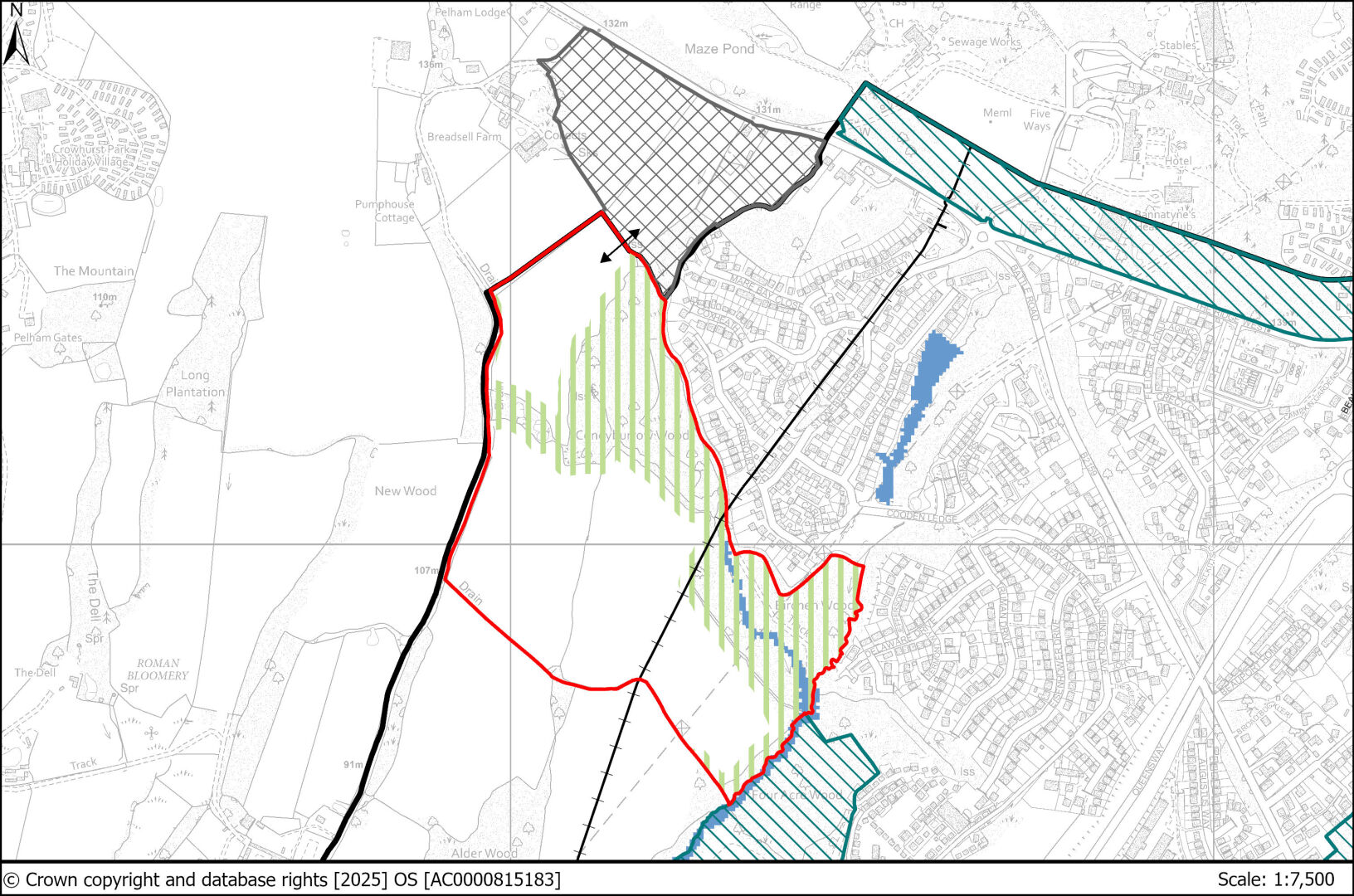
Development Potential Area Policy 1 (D1): Land at Breadsell
Use: Residential
Minimum Density Range: 30-45 dwellings per hectare
Minimum Indicative Capacity (net additional dwellings): 360 - 540
Site Area (net developable): 12.03ha
In order to establish the acceptability of the principle of development on this site, it will be necessary to undertake an assessment of the ecological impact of any proposed development on the adjacent Marline Valley Woods SSSI. The proposals should include an agreed monitoring programme of the adjacent SSSI which sets out the requirements of the species and habitats contained within, the programme should then provide mitigation to replicate the current conditions within SSSI to avoid any undue harm to the protected site.
Subject to the above proposals for development on this site should:
- Provide 40% affordable housing in line with Policy SP2.
- Submit a landscape sensitivity analysis, with landscape mitigation measures incorporated into the proposal to avoid unacceptable harm.
- Ensure scheme and construction access is via A2100 subject to agreement with relevant bodies.
- Maintain and enhance the existing hedgerows within site excluding where access is required which should be reprovided elsewhere on the development site.
- Create a layout which incorporates a landscape buffer zone along the western boundary of the site and adjacent to the Marline Valley Woods SSSI.
- Provide a connection to the sewerage system at the nearest point of adequate capacity, as advised by Southern Water and ensure future access to the existing sewerage and water supply infrastructure for maintenance and upsizing purposes.
- Include walking and cycling links to ensure local connectivity, including to local community infrastructure, green spaces and public transport provision, taking into account site topography.
Regeneration Area Policy 1 (R1): Hastings Central
5.15Hastings Town Centre is positioned at the top of the Borough’s retail hierarchy and is materially larger in terms of floorspace than the other town centres in the Borough. It includes around 550 non-residential public and private premises including shops, offices, educational space, leisure uses, visitor accommodation and municipal buildings, all set within a square mile. It is the physical, economic and social ‘heart’ of Hastings, sustaining more than 20% of the town’s jobs (c.6,000 jobs), it performs an important retail role in the sub-region, and includes the Town’s main transport hub.
5.16Located between the town centres of The Old Town to the east and St Leonards to the west, these two centres provide a complementary role to Hastings Town Centre. Collectively these centres, with their distinctive characters, offer a diverse range of shopping and leisure experiences.
5.17Significant regeneration has taken place in the town centre since 2000s with the delivery of office, education and health facilities and a new railway station. More recently has been the success of the Trinity Triangle Heritage Action Zone (HAZ) located in the eastern part of the Town Centre boundary.
5.18A catalyst for the continued regeneration of the Town Centre is the Town’s Fund programme, running to 2026. The investment provided by the Towns Fund will see the revival of Hastings Town Centre with investment in key heritage assets, buildings in the town centre and improvements in the public realm. To continue driving the regeneration of the Town Centre throughout the Plan period, the council will develop a dedicated regeneration plan as part of Pride in Place. With £20 million in endowment-style funding already confirmed from the government, the plan will set out local priorities identified through extensive engagement with communities across the borough, supporting long-term, locally led regeneration through to 2034.
5.19The regeneration activity already delivered through the Town’s Fund (to 2026) has created opportunities to further invest in the Centre that reflect the council’s wider, long-term ambitions. A critical part of taking the regeneration of the Town Centre forward, in addition to the policies set out here, is the continued collaboration between the council and Homes England on specific sites within the town centre. This partnership is expected to remain central to the delivery of regeneration initiatives, including as the new Sussex Mayor comes into power in May 2026. Working in partnership, the council aims to coordinate and manage key interventions and unlock wider investment opportunities from both the public and private sectors.
5.20Shopping habits are changing, and Hastings Town Centre needs to continue to change and evolve. Our retail needs assessment shows very low growth forecast for retail needs in Hastings over the coming years, and the same study indicates that the strategy for both convenience and comparison goods floorspace in Hastings should instead be focused upon making qualitative improvements to the town centre offer. Similarly, whilst there is a modest amount of growth expected for net additional food and beverage floorspace, this can be accommodated via the general turnover of units in the town centre and encouraging provision in redevelopment schemes in the centre.
5.21As well as changes to high street retailing, the Plan needs to take in to account other issues such as new ways of working, and a pressing need for more homes. Taken together, these factors can be harnessed to support Hastings town centre over the Plan period. The council wants to encourage a mix of uses in appropriate locations which will ensure the Town Centre remains vibrant and attractive to residents, visitors and investors. The vision is to build on the strengths of the town centre; to make it an even more attractive place to live, work and visit; to offer a town centre experience that cannot be found online, and to encourage a thriving daytime, evening and night-time economy.
5.22The council has identified a number of regeneration sites which offer potential for redevelopment or conversion. This includes a range of sites in terms of cleared sites ready for development, vacant and currently occupied buildings:
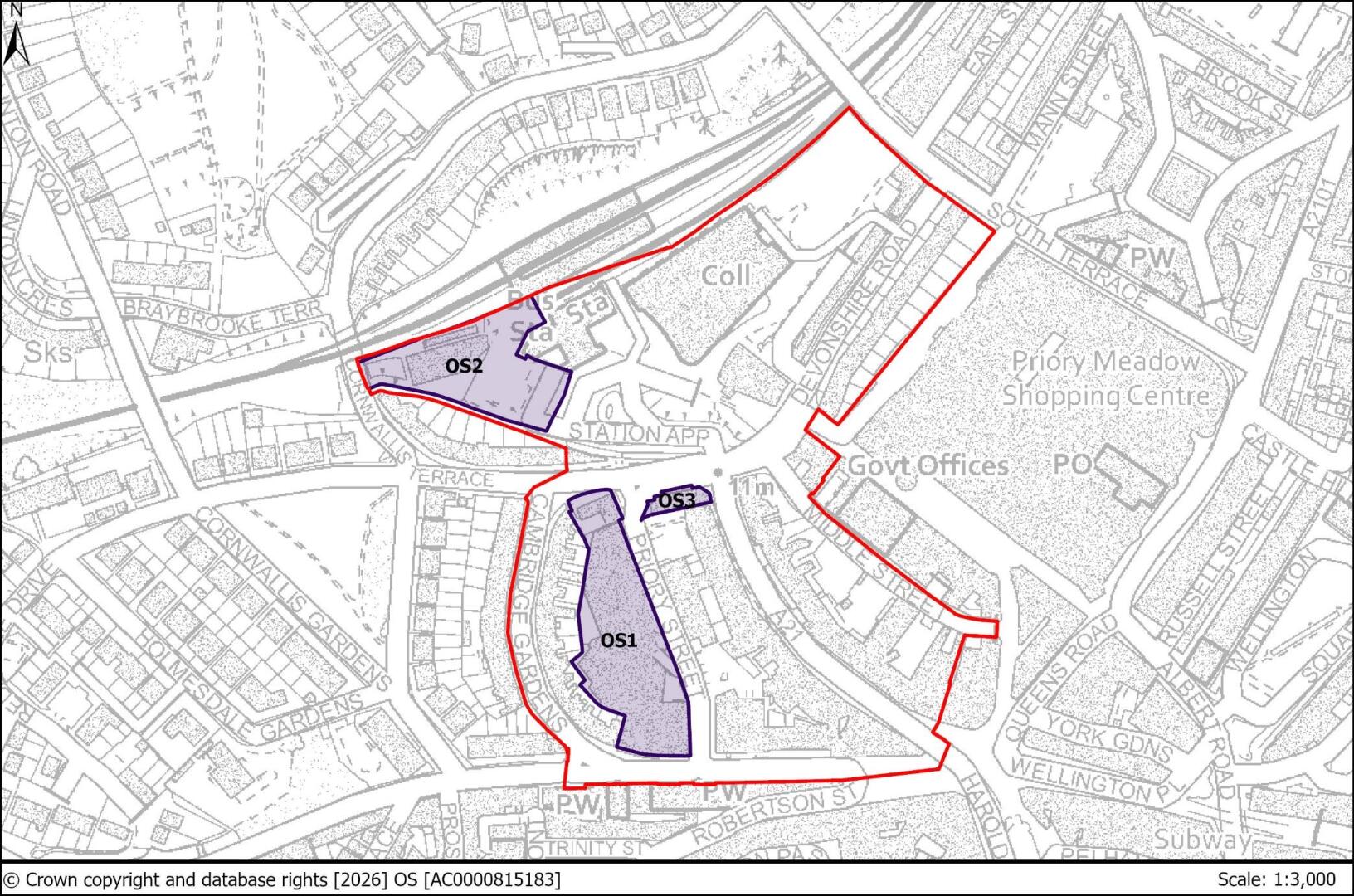
Station Area
5.23This area includes Hastings Railway Station and Priory Quarter which has been the focus for education and office development adjacent to the station and extending along Havelock Road. Significant regeneration has taken place in this area since 2000. The council wants to see the regeneration of this area continue, including the redevelopment of Queensbury House and Priory Street, to create new economic and residential spaces.
5.24The whole area has the potential to act as an attractive gateway to Hastings. Opportunities exist for public realm improvements, and the reconfiguration of public spaces, enhancing this area’s offer as a pedestrian hub and as an important access point to the town centre. There is potential to create linkages to the wider Town Centre area.
5.25The council will work with developers and partners to bring forward mixed use development and public realm improvements.
5.26Development will need to address the following key objectives:
- Improving town centre connectivity;
- Delivering new and enhanced employment generating uses;
- Support the regeneration of Hastings Town Centre through provision of land uses that complement the main town centre uses;
- Create high quality homes in the heart of Hastings.
5.27The Gateway area contains three opportunity sites as shown in Figure 3:
- OS1: Priory Street Car Park, ESK and Gizmo
- OS2: Station Approach car park and Royal Mail Delivery Office
- OS3: Queensbury House, Havelock Road
5.28Table 5 sets out Council’s anticipated uses for these sites. Policy R1 sets out the strategy and guiding principles for their redevelopment. In line with the flexibility established within Policy R1, the council is expecting significant intensification to be achieved in Hastings town centre.
Table 5: Station Area sites and anticipated uses
|
Site Ref |
Site Name |
Potential uses and indicative capacity |
|
OS1 |
Priory Street Car Park, ESK and Gizmo |
This site offers strong potential for mixed-use development and intensification. Its proximity to the primary shopping area, transport hub and further education facilities, means it could provide a range of employment spaces, and other town centre uses such a leisure. Residential use, as part of a mixed-use development, would also be suitable. A high-quality design and public realm improvements will be important along with active frontages to Priory Street and Cambridge Road Summary: Mixed use including residential, business, leisure c.10,000sqm of commercial space c.160 residential units |
|
OS2 |
Station Approach car park and Royal Mail Delivery Office |
This site is located next to the station plaza, and provides the opportunity to create an appealing, attractive gateway to Hastings. The site is capable of supporting a mixed-use scheme with retail, leisure and residential uses. Redevelopment of the Royal Mail site will have to take account of the relocation of its existing operation. Summary: Mixed use including retail, business and residential c.10,000sqm of commercial space c. 92 – 115 residential units |
|
OS3 |
Queensbury House, Havelock Road |
The redevelopment and/or reuse of Queensbury House has the potential to provide a range of business and commercial floorspace, including and food and drink and residential. Summary: Mixed use including business/leisure, and residential and retail c.4,000sqm of commercial space c. 20 – 40 residential units |
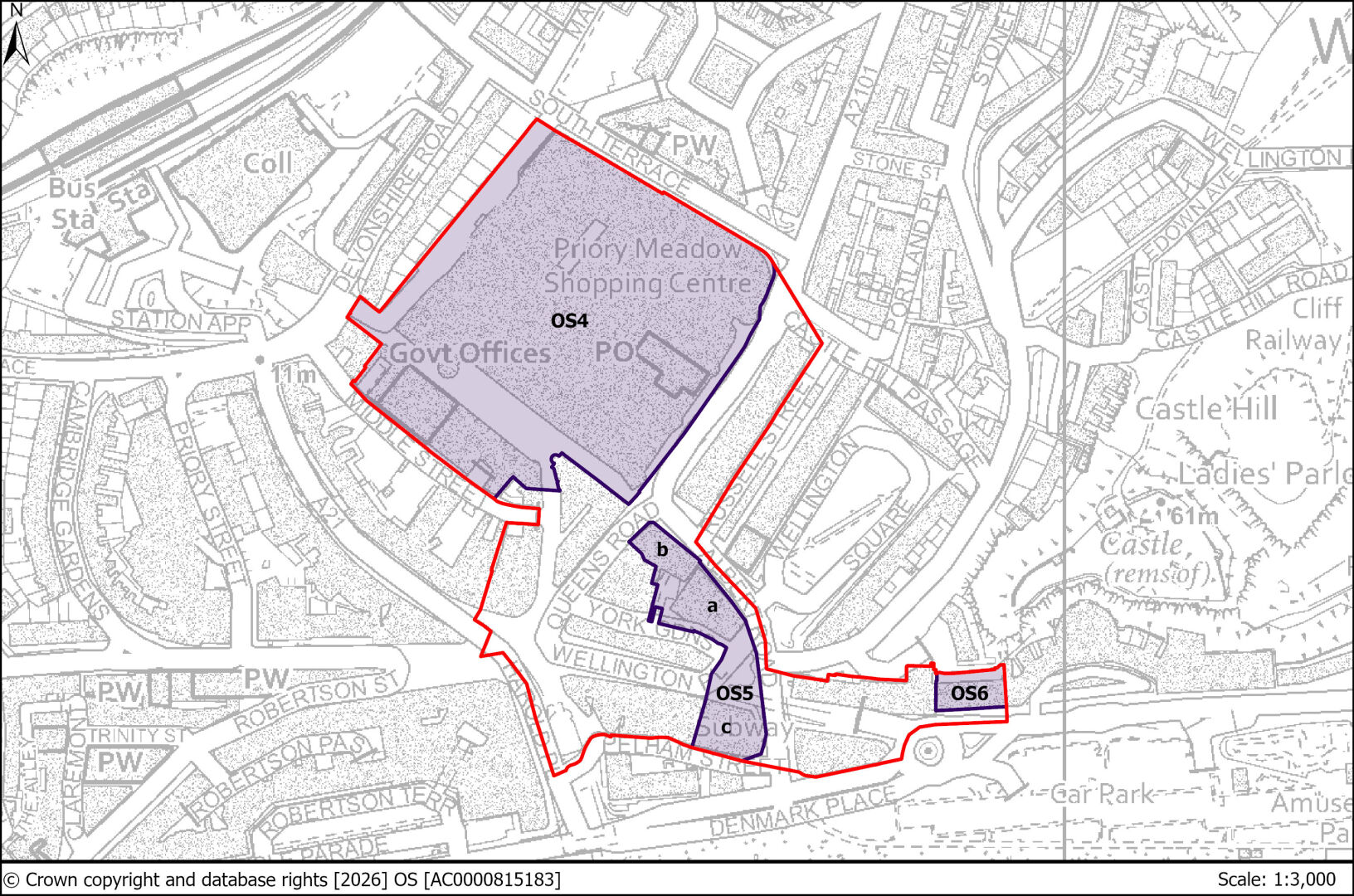
Hastings Central Plaza
5.29There continues to be an opportunity to revitalise the Town Centre’s primary shopping area, with additional investment in retail and leisure development particularly in key gateway locations closer to the seafront. This will encourage more shopping and leisure footfall to benefit the centre’s vitality.
5.30Hastings Central Plaza is an area of Hastings Town Centre (as shown in Figure 4), taking in the lower part of Queens Road, Wellington Place, Albert Road, Station Approach, Priory Meadow, Castle Street and Breeds Place. It is a busy shopping area. The streets are lively with shoppers and visitors attracted by the mix of multiple retailers and independent traders. There is a vibrant retail and leisure presence, including cafés and restaurants also have a strong presence. Castle Street is a key pedestrian gateway linking the seafront to the Town Centre Shopping Area.
5.31A key objective is to attract high quality commercial investment, increase pedestrian flows between the seafront and the primary shopping area and creating an attractive and vibrant shopping and leisure destination, increasing dwell time and drawing residents and visitors from a wide catchment. Residential uses on upper floors and community related uses may also be appropriate as part of mixed-use development schemes.
5.32This regeneration area has the potential to provide an enhanced leisure, cultural and entertainment offer. The look and feel of the area needs to be reinvigorated to create a high-quality destination attracting new investment as well as visitors. The public realm needs to be enhanced and where possible, trees and other nature-based solutions incorporated to soften the hard landscaping, providing shade and capturing surface water close to the source.
5.33New development in this area should:
- improve the quality and variety of town centre uses;
- deliver high quality design and associated public realm;
- redevelop key sites to increase capacity within the town centre;
- raise the overall standard of design, including shopfront design, creating attractive and vibrant streets.
5.34The following sites have the potential to be redeveloped and are shown in Figure 4.
- OS5:
- Corner of Wellington Place and Albert Road
- Cinema, Queens Road
- 1-7 Wellington Place
- OS4: Priory Meadow
- OS6: Muriel Matters House, Breeds Place
5.35Table 5 sets out Council’s anticipated uses for these sites. Policy R1 sets out the strategy and guiding principles for their redevelopment.
Table 6: Hastings Central Plaza sites and anticipated uses
|
Site Ref |
Site Name |
Potential uses and indicative capacity |
|
OS5a |
Corner of Wellington Place and Albert Road |
This site is located in a prominent position within the Primary Shopping Area. The current building is divided between comparison retail floorspace and leisure uses. The building was originally developed as a large convenience store and is of poor design making a negative contribution to the streetscape and conservation area. To ensure the vitality of the town centre is maintained and strengthened, the council will support the redevelopment or remodelling of this site to deliver an exciting building of high quality at the eastern end of Wellington Place, for retail or leisure use. Office or residential uses may be acceptable on upper floors as part of a mixed-use development. In addition, the redevelopment of site OS5(a) offers the potential to enhance the public space located at the junction of Albert Road and Wellington Place. This area currently lacks a clear function and detracts from the setting of Wellington Square and Hastings Castle. |
|
OS5b |
Cinema, Queens Road |
This site is located in a prominent gateway position within the Town Centre, connecting Priory Meadow’s central plaza with the wider centre and seafront, and is located within the primary shopping area. The building was constructed as the Gaiety Theatre and is a striking building in Italianate red brick and stone. It is currently operating as a cinema with a 4-screen multiplex facility. Leisure uses are an important element of the town centre, and the council will continue to support cinema provision at this site. The council will support the enhancement of cinema facilities on this site or as part of a mixed-use development scheme incorporating site OS5(a). In the event of the reprovision of the cinema on a suitable alternative site within the town centre, the council will support the redevelopment of the site to incorporate retail and leisure uses. Development proposals for this site: - should be predominantly for cultural, leisure or retail; - should seek to retain the existing building |
|
OS5c |
1-7 Wellington Place |
The redevelopment of this site will form an important part of the vision to transform this part of the primary shopping area into a high-quality destination enhancing this gateway location between the town centre and the seafront. The current building negatively impacts the town centre streetscape and conservation area. The council will support the redevelopment or remodelling of this site to deliver an exciting building of high quality that will act as an ‘anchor’ at the eastern end of Wellington Place. The redevelopment of this site together with Policy OS5(a) should raise design standards in this part of the town centre. Residential uses may be acceptable on upper floors as part of a mixed-use development scheme. The council will support the redevelopment of this site for a mix of uses including comparison retail, leisure provision, restaurant, café uses, and residential uses will be acceptable as part of a comprehensive scheme. The site provides the opportunity to deliver a new high quality landmark building marking the entrance to the town centre from the seafront. |
|
Summary: |
Mixed use including retail, residential, sport and leisure, cinema, food and drink. c.3,500 sqm c. 84 – 105 residential units |
|
|
OS4 |
Priory Meadow |
Priory Meadow is located in the central part of the primary shopping area. It caters for comparison shopping and accommodates a high proportion of the Town’s national retailers. Maintaining the quality and variety of the retail offer will be important. So too is the need to encourage new leisure uses to attract people to the centre at different times of the day and evening. The council will explore with the centre owners and developers the opportunities to increase the quantity, quality and range of offer in the centre. This includes increasing storeys and potentially introducing residential and other town centre uses on upper storeys. Summary: Mixed Use c. 130 residential units |
|
OS6 |
Muriel Matters House |
Muriel Matters House is a seafront multi-storey office building which offers potential for conversion or redevelopment. Retention of some office space is compatible with a variety of town centre uses including residential. Whilst an active ground floor frontage should be retained. Summary: Mixed use c. 25 – 35 residential units |
Regeneration Area Policy 1 (R1): Hastings Central
5.36To support the council’s objective to promote economic growth, Policy R1 provides maximum flexibility to enable the delivery of new and mixed-use development with a focus on job creation with the objective of expanding the draw of the town beyond just traditional retail.
5.37Where these uses contribute to the vitality of the Town Centre, well designed, ‘meanwhile uses’, that is temporary changes to the use of a building, may have a role in supporting the area in the short to medium term. Residential development could also be part of the town centre mix.
5.38The historic townscape of the centre, with multiple listed buildings and Conservation Area status will require sensitive design and adaptive reuse. A fabric-first approach is essential to safeguard heritage assets while enabling contemporary uses. The compact nature of the Town Centre offers excellent accessibility by public transport and active travel. This creates high potential for intensification, with a significant uplift in average densities, adaptive reuse, and mixed-use development within existing built form. Growing the permanent residential community in Hastings Town Centre will contribute to the vitality and viability of the town centre, bringing people into the town at different times of the day, increasing footfall and supporting a more vibrant evening and night time economy.
5.39It will be important however, to provide a balance between protecting the town centre from the loss of those characteristics which make it a vibrant town centre and encouraging more residential development. Residential uses at ground floor level within the primary shopping area would be harmful to the overall vitality of the centre, both in terms of fragmenting retail and commercial uses, and also by creating incompatible living conditions for potential occupiers by compromising residential amenity.
5.40Hastings Town Centre is inhibited by transport and public realm issues. Parts of the primary shopping area have been pedestrianised, but there is a lack of consistency in design, use of materials, and street furniture. Improving the attractiveness and useability of the public realm in conjunction with changing our approach to parking in an area with high transport accessibility is key part of our strategy.
5.41Policy R1 sets out the council’s strategy for revitalising Hastings Town Centre.
5.42The Policy sets out the council’s strategy for Hastings Town Centre and is intended to act as a guide to inform the design and delivery of new development. Not all of the criteria will be relevant to every development proposal. In line with the flexibility established within Policy R1, the council strongly encourages pre-application engagement to establish suitable uses for each of the identified sites.
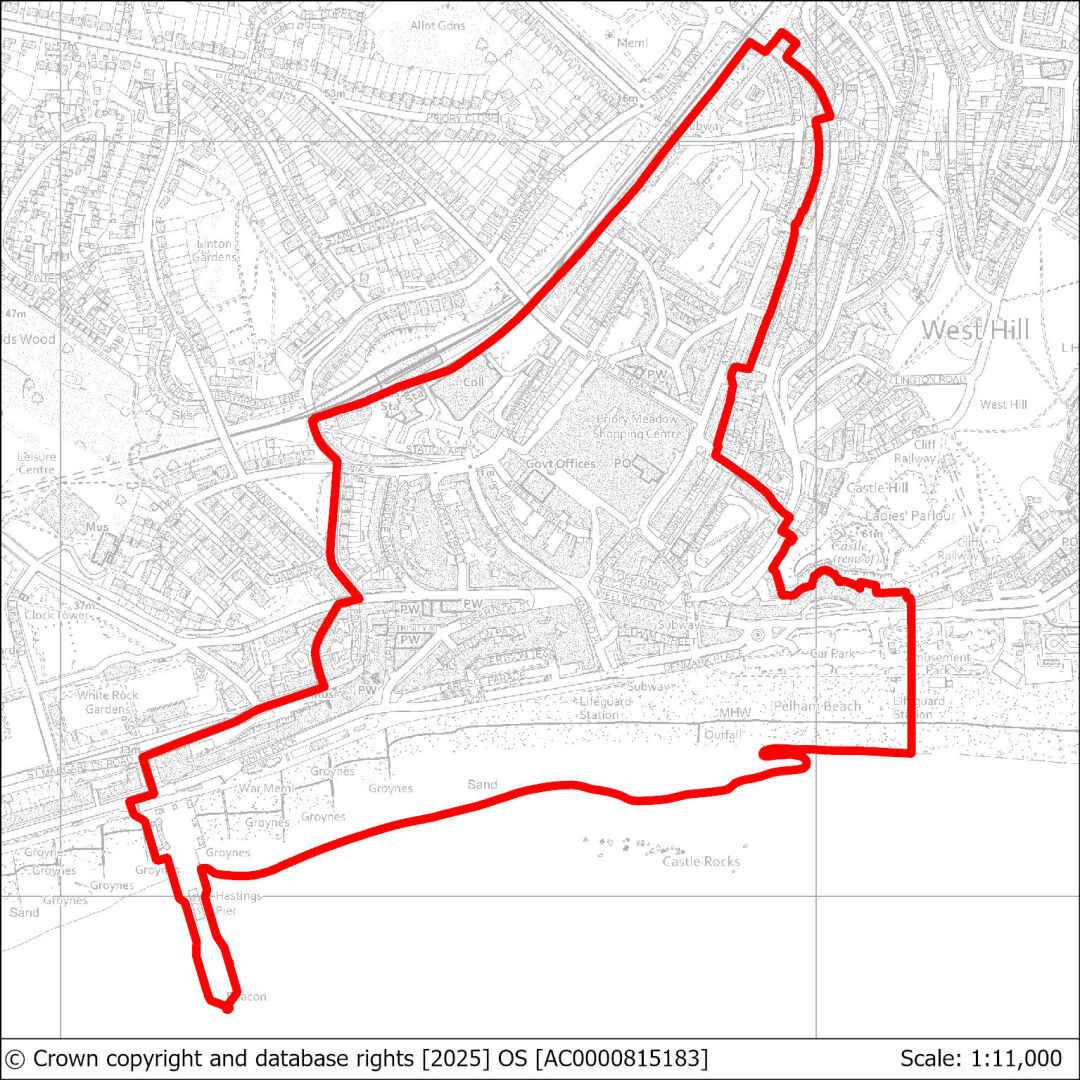
Regeneration Area Policy 1 (R1): Hastings Central
- The council will support a variety of land uses in Hastings Central to encourage a mixed-use vibrant town centre and will support the development of:
- Employment generating uses, including: retail, office, light industry, studios, leisure, cafés, restaurants, visitor facilities (including hotels), education facilities and where appropriate drinking establishments.
- Residential uses, including student accommodation for institutions located in Hastings and Rother, providing they do not prejudice the commercial function of the area. In the Primary Shopping Area, residential uses will only be acceptable at first floor level and above.
- Non-residential Uses that support active frontages at ground level to enliven the street environment
- Opportunity sites have been identified in the Station Area and the Hastings Central Plaza. These sites provide the opportunity for intensification and expansion to enhance the retail and leisure offer, support the local economy, promote tourism and provide residential accommodation.
General Principles
New development should make a positive contribution to improving the town centre’s viability and vitality, support the creation of a safe, attractive, accessible and high-quality environment, improve the overall mix of land uses in the centre and enhance connectivity, both within the centre and to adjoining areas. This will be achieved by:
- Requiring all schemes to demonstrate a quality of design that makes a positive contribution to the character of the Town Centre, including proposed buildings and the public realm.
- Ensuring the most effective use of land through the promotion of high-density development where appropriate, and the redevelopment of cleared, vacant or underused sites to increase commercial capacity within the Town Centre.
- Improving the connectivity and legibility between the different areas of the Town Centre, including the seafront.
- Recognising the rich historic environment in the Town Centre and ensuring that proposals conserve and where appropriate enhance the significance and setting of important heritage assets.
- Raising the quality of streets and public realm including enhance the quality of the natural environment by investing in and establishing new green and blue infrastructure.
- The introduction of residential uses as part of commercial-led mixed-use development to support and sustain the vibrancy of the town centre and the evening economy.
- Improving pedestrian and cycle access, traffic circulation and management.
5.43The Policy sets out the council’s strategy for Hastings Town Centre and is intended to act as a guide to inform the design and delivery of new development. Not all of the criteria will be relevant to every development proposal. In line with the flexibility established within Policy R1, the council strongly encourages pre-application engagement to establish suitable uses for each of the identified sites.
Regeneration Area Policy 2 (R2): Former Convent of the Holy Child Jesus, Magdalen Road
5.44This 4.76ha former Convent site is a nationally important heritage site, containing a unique collection of Grade II* and Grade II listed buildings in an enclosed landscaped setting. Many of the buildings on the site have been underused for many years and have lacked regular maintenance and repair. Of key concern is the Grade II* listed chapel which is on Historic England’s national Heritage at Risk Register.
5.45The Convent is situated on top of the sea cliffs and as a result there is a high degree of visibility from within the site to other parts of the Borough, and out to sea, and corresponding townscape views from other parts of the Borough towards the site. The site is also within a conservation area and within the setting of several other listed buildings on Magdalen Road.
5.46The council wishes to ensure that development proposals at this site secure the repair, restoration and long-term sustainable future of the Convent buildings. In addition, given the historic sensitivity of the site and its high visibility in the wider townscape, development proposals should be heritage led and based on a thorough understanding of the significance of the buildings and the surrounding landscape and any heritage features within it.
5.47As a result of this, the council considers that the most appropriate route to bring forward a suitable form of development on this site would be through the joint production of a development brief with any owners/prospective developers, prior to them making an application for planning permission.
5.48This is a complex site and without the rigour of a development brief it is not possible to understand and identify the quantum and form of any new development required to secure the future of the listed buildings and to deliver a viable and sustainable solution for the site as a whole in terms of its heritage value. A development brief will both signal a proactive approach and help unlock development potential.
5.49A development brief for the site should:
- be prepared in association with relevant stakeholders and the council and be informed by comprehensive consultation and engagement with the wider community;
- be informed by a heritage assets statement enabling a detailed understanding of the heritage of the site and its wider Conservation Area and townscape context;
- be based on a thorough understanding and agreement on the condition of the existing buildings and the appropriate form and standard of repair and restoration required;
- identify options for appropriate uses for the site;
- Identify the quantum and form of any new development that may be required to secure the future of the listed buildings and to deliver a viable and sustainable solution for the site as a whole.
5.50The Local Planning Authority will liaise closely with Historic England on any scheme submitted including the sharing with them of any viability assessments or financial assessments submitted to support any development proposals.
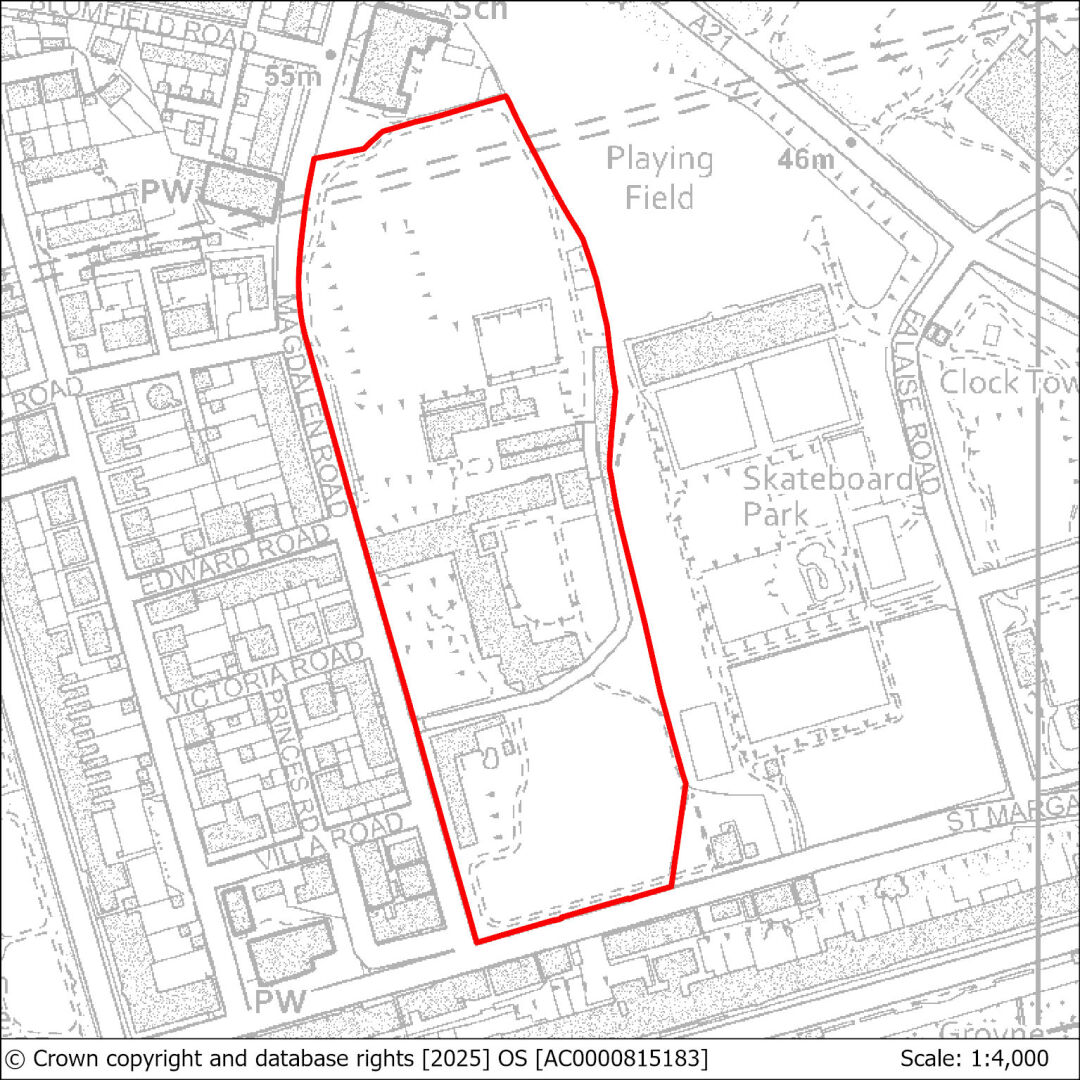
Regeneration Area Policy 2 (R2): Former Convent of the Holy Child Jesus, Magdalen Road
- A comprehensive heritage and landscape led approach is required for the development of the site that secures the repair, restoration, active reuse, and on-going care and maintenance of the former Convent buildings and their associated gardens and the respectful protection and potential enhancement of the Nuns' Cemetery.
- As the site has the potential to support the Borough’s requirements for new housing including affordable housing, appropriate residential development is acceptable in principle on the former playing fields. A variety of uses, including residential, may be acceptable for the conversion and re-use of the listed buildings, though preference will be given to those uses/mixes of uses that best achieve the retention of the historic buildings’ significance and their associated garden setting as well as providing opportunities to increase public benefits.
- Proposals should be in accordance with a Masterplan and development brief that has been adopted by the Council.
- Proposals for development which secures the significance and the long-term viable use of the existing listed buildings as a group will be supported. Development will be required to:
- minimise any harm to heritage assets within the site and where possible, seek opportunities to enhance the significance of the site through the development proposals;
- provide a design and layout that is locally distinctive, is of a high-quality using contextual materials, as well as improving or restoring a network of landscaped greenspaces and pedestrian and cycle links to the adjoining areas, that are safe, legible and sustainable;
- protect the setting of the nearby listed buildings and the character and appearance of the Magdalen Road Conservation Area
- precisely define the impact of development at the outset, through the granting of full, rather than outline, planning permission;
- secure the heritage objectives and public benefits through the use of a Section 106 agreement or by other enforceable means;
- deliver / achieve the repair and restoration of the heritage assets to an agreed standard (based on accurate evidence) as early as possible in the development process, and in any event, before completion or occupation of any new build development on the site;
- deliver public benefits to the wider community such as regular access to the Grade II* listed Pugin chapel.
Regeneration Area Policy 3 (R3): St Johns Road
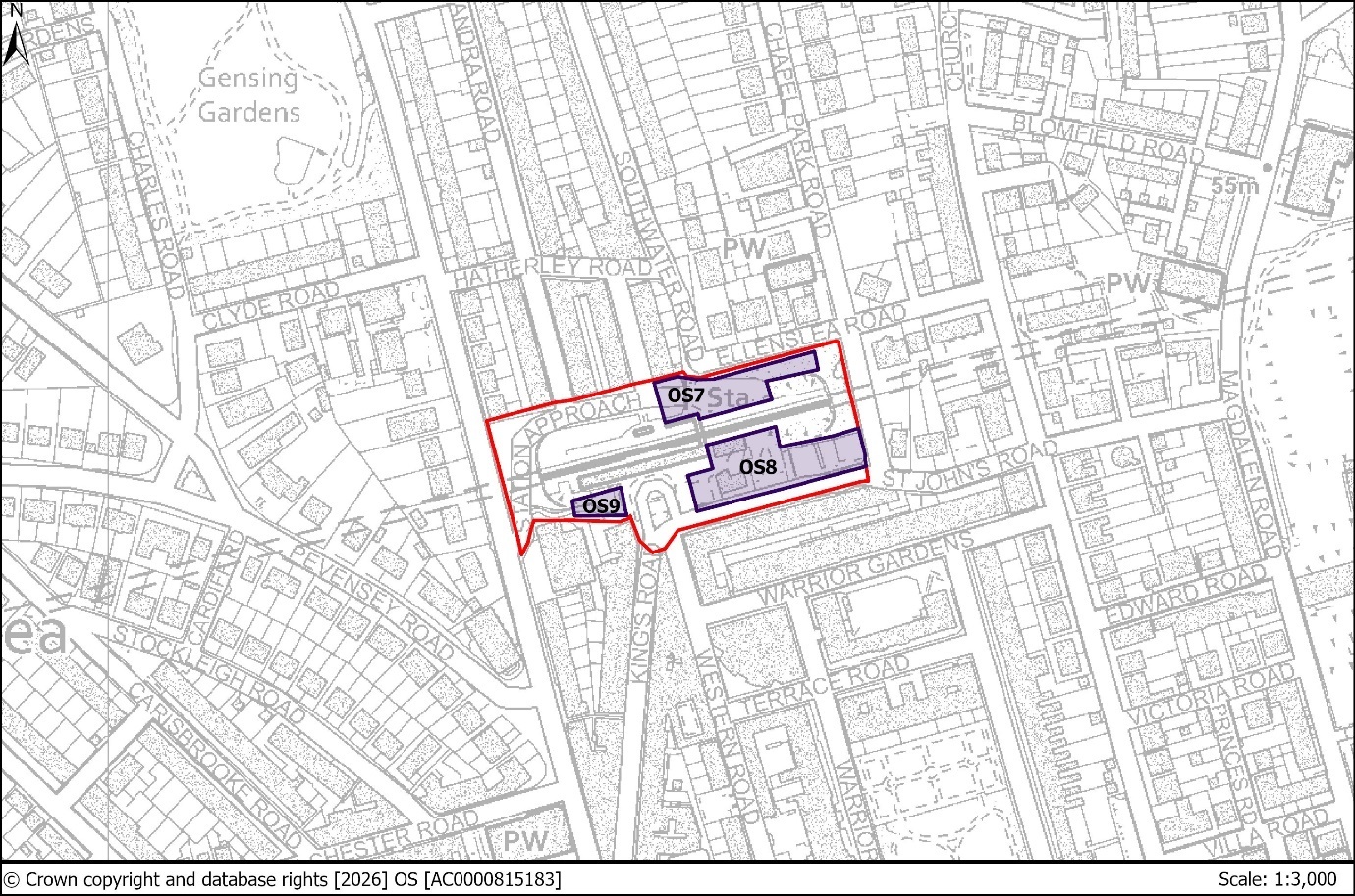
5.51The St John’s Road Regeneration Area totals 1.61ha and comprises land in and around Warrior Square Station, including a former Taxi office and café, the north and south station concourse, and equipped play area. The site fronts St John’s Road, London Road, Chapel Park Road and Ellensea Road and provides an opportunity for comprehensive regeneration in a highly sustainable location.
5.52Part of the location slopes steeply east to west and includes areas of terracing supported by retaining structures. There is a sharp difference in levels at the Chapel Park Road frontage where the site crosses the Hastings – St Leonards railway tunnel, and several other incidences of level changes within the boundary. It is within the Kings Road Conservation Area and partially within the St Leonards District Centre.
5.53As a key gateway into and out of St Leonards, a landmark development enhancing the views from Kings Road and the wider Conservation Area would be appropriate for this location. Similarly, there is potential to reprovide or improve the equipped play area to provide stronger links to the station and the District Centre.
5.54The station itself requires improvement to ensure high quality step free access to both platforms. In addition, any redevelopment proposal should seek to strengthen sustainable transport and multimodal links to and from the location.
5.55There is an opportunity to rationalise and improve the relationship of the station itself to the London Road including improvements or layout changes to vehicle and footpath access which has accessibility challenges and lacks natural surveillance. There is the potential for residential-led, mixed use development along St John’s Road and south of Ellensea Road subject to reaching agreement with landowners and other stakeholders within or adjacent to the area. Proposals will need to take into account loading capacities, easements and the need to avoid impacting the integrity and operation of the railway and its associated tunnels.
5.56Due to the prevalence of impervious surfaces, the location is vulnerable to surface water flooding. Redevelopment will provide an opportunity to improve flood risk attenuation measures, such as urban greening factor interventions and the introduction of new green and blue infrastructure.
Table 7: Opportunity Sites in Regeneration Area 3
| Site Ref |
Site Name |
Potential uses and indicative capacity |
| OS7 |
Land south of Ellenslea Road |
This site currently serves as carparking for the station. Proposals should seek to retain parking within the Regeneration Area as a whole and consider innovative solutions to incorporate additional mixed and residential uses at higher elevations. |
| OS8 |
Land north of St Johns Road |
This site is a sloping, terraced location comprised of most hardstanding and has the potential to incorporate mixed and residential uses. This area incorporates a play space of good quality but with poor relationship to the station and District Centre. Proposals for the Regeneration Area as a whole should consider how this relationship can be improved, either through relocation within the Regeneration Area or access improvements. |
| OS9 |
Land south west of St Leonards Warrior Square Station |
This site is located in a prominent gateway position, connecting the area with Kings Road and London Road. The site has the potential to incorporate some element of mixed or residential use, and has potential as a sustainable location for a Day Nursery. |
5.57Any redevelopment proposals should:
- be prepared in association with relevant stakeholders and be informed by comprehensive and inclusive consultation and engagement with the wider community;
- be informed by a design and conservation statement enabling a detailed understanding of the wider Conservation Area and townscape context;
- be based on thorough ground investigation taking into account the railway network infrastructure in consultation with the railway authority;
- improve the overall connectivity, legibility and platform access for the station platforms and consider the future of the station buildings as part of the overall context of the location;
- adapt to and mitigate the effects of surface water flooding.
Regeneration Area Policy 3 (R3): St Johns Road
- A comprehensive approach is required for the redevelopment of the station and the area immediately surrounding it, that incorporates improvements to the accessibility, capacity and design of Warrior Square Station.
- As the area has the potential to support the Borough’s requirements for new housing, appropriate residential development is acceptable as part of the overall mix including 25% affordable housing. A variety of commercial and community uses may be acceptable for street level elevations and trackside.
- Ensure that all new homes meet the Council’s Net-Zero Carbon Homes standards in Policy SC3 and that the scheme includes other measures to mitigate the effects of climate change in particular measures for shading and cooling.
- Proposals should be in accordance with a Masterplan and development brief that has been prepared in conjunction with the Railway Authority and adopted by the Council.
- Proposals for development should consider the setting of the Kings Road conservation area and the prominent position of the station as a key gateway site and landmark building location.
- Proposals should be informed by agreed land stability and geotechnical reports prepared in conjunction with the Railway Authority covering the temporary, intermediate and permanent condition of the site, taking into account all dead and imposed loads and railway infrastructure.
- Include a maintenance and management plan for any new, retained or improved land stability mitigation measures to ensure they will be safe for their intended lifetime.
- Car free or low-car development will be acceptable subject to Policy ID2.
- Proposals should take into account the topography of the area.
- Proposals should retain or reprovide the play space and improve the access and connectivity to the station and District centre.
- Opportunities to mitigate, manage and adapt to surface water flooding through to protect the railway line and surrounding pedestrian access should be explored.
- Proposals should ensure that green and blue infrastructure and high scoring urban greening features are incorporated.
